 Ferndale Roofing
 Siding Repair Built for the Nooksack River Valley Climate
Homes along the Nooksack River corridor near Ferndale deal with a specific mix of weather that's harder on exterior siding than most homeowners realize. You're close enough to the Strait of Georgia and Bellingham Bay to pick up salt-laden air on windy days, you're in the direct path of driving Pacific rain systems most of the fall and winter, and the valley's humidity and shade pockets stretch moss season out for months longer than drier parts of Washington. None of that is dramatic on any single day. It's the accumulation — year after year of moisture cycling in and out of seams, trim, and butt joints — that eventually shows up as soft spots, peeling paint, or panels that have started to separate from the wall.
Siding repair in this area isn't just about patching what's visible. It's about understanding why that spot failed in the first place, because in a climate like Whatcom County's, a repair that doesn't address the underlying moisture path just fails again in a year or two.
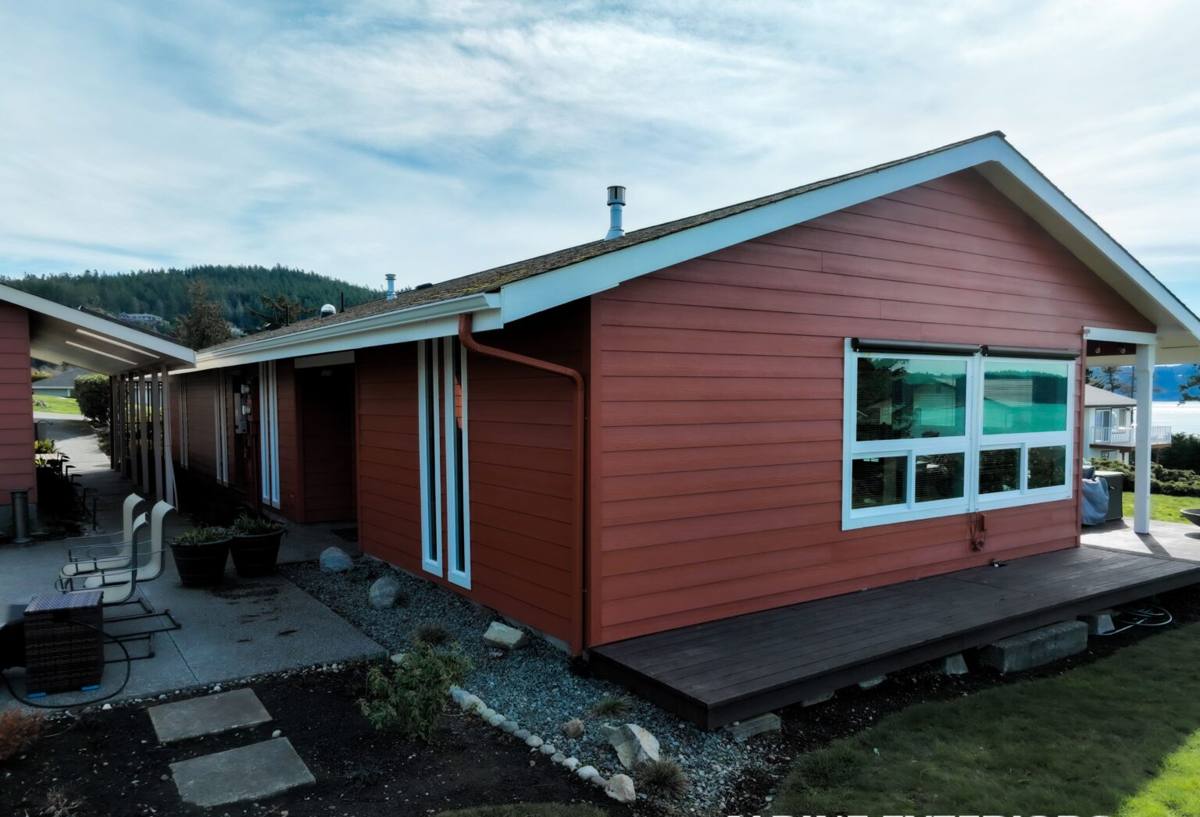
Signs a Nooksack-Area Home Needs Siding Repair
Most siding repair calls we get start with one of these:
- Soft, spongy, or visibly swollen siding, usually near the bottom courses or around window and door trim
- Paint that's peeling or bubbling in a specific area rather than uniformly across the wall — a strong sign of trapped moisture behind that spot
- Persistent moss or algae staining that keeps returning within weeks of cleaning
- Gaps opening up at seams, corner boards, or where siding meets trim, letting wind-driven rain track behind the surface
- Cracked or split boards from age, impact, or freeze-thaw cycling on saturated material
- Nail pops or fasteners backing out, often a sign the original installation didn't account for panel movement
Any one of these on its own might be a small fix. Several showing up in the same area, or the same issue reappearing after a prior patch, usually means there's a water intrusion problem behind the siding that needs to be traced back to its source before anything gets repaired.
Repair vs. Replace: How We Make the Call
Not every damaged section needs a full re-side, and we don't push a whole-house job when a targeted repair will hold up. The honest dividing line usually comes down to three questions: How much of the wall is affected? Is the damage isolated to siding, or has moisture reached the sheathing and framing underneath? And is the existing material still sound enough that a repair will actually blend in and perform, or is it past the point where patching is just delaying the inevitable? We walk homeowners through that assessment plainly — what we're seeing, what's driving it, and what your realistic options are.
What a Correct Siding Repair Actually Involves
A siding repair that's done right is never just "replace the bad board." Here's what we're checking and doing on every repair, regardless of size:
1. Find the Real Cause
Damaged siding is often a symptom, not the problem. We look at flashing above windows and doors, caulking at joints and penetrations, grade and drainage at the foundation line, and gutter performance, since overflowing or undersized gutters are one of the most common hidden causes of localized rot we see on homes in this part of Whatcom County.
2. Open Up and Inspect Behind the Siding
Once the damaged section is removed, we check the water-resistive barrier and sheathing underneath. If there's soft or delaminated sheathing, that gets addressed before any new siding goes back on — patching over compromised sheathing just hides a bigger problem.
3. Repair the Water Management Details
Flashing, house wrap, and weep paths get corrected or replaced as needed so water has a way out instead of a place to collect. This step is the difference between a repair that lasts and one that's back on our schedule next winter.
4. Install and Finish to Match
New material is fastened, sealed, and finished to blend with the surrounding siding as closely as the existing product allows. This is one of the areas where the type of siding on your home matters a lot — more on that below.
Common Siding Repair Issues We See Around Nooksack and Ferndale
| Issue | Typical Cause | Why It's Common Here |
|---|---|---|
| Bottom-course rot or softness | Splash-back moisture, poor grade slope, mulch piled against siding | Long wet season keeps ground-level moisture in contact with siding for months at a time |
| Paint failure in isolated spots | Trapped moisture behind the panel, often from a flashing gap | Driving rain off the Strait pushes water into small gaps that calmer climates wouldn't test |
| Recurring moss and algae | Shade, moisture retention, porous or textured surfaces | Tree cover and river valley humidity extend moss season well beyond a typical dry-summer region |
| Corner board and trim separation | Caulk failure, material movement, original install shortcuts | Repeated wet-dry and freeze-thaw cycles stress joints faster than in milder climates |
| Fastener pops | Wrong nailing pattern or fastener type for the material | Common on wood and engineered wood siding not detailed for coastal exposure |
Why We Repair With James Hardie Fiber Cement — Not Whatever's Already on the Wall
We install and repair with James Hardie fiber cement siding exclusively. We don't install vinyl, LP SmartSide, Cemplank, Allura, or primed wood siding, and that standard applies to repair work too. Here's the honest reasoning, not a sales pitch:
When a home already has vinyl, engineered wood, or cedar siding and a section fails, matching it is genuinely difficult. Vinyl fades unevenly over time, so a new panel next to a ten-year-old one is often visibly different in color even from the same manufacturer. Engineered wood products like LP SmartSide are sensitive to moisture at cut edges and seams — the exact failure point that usually causes the damage you're repairing in the first place — so a patch is fighting the same vulnerability that caused the problem. Cedar and primed spruce need ongoing refinishing to stay protected, and a fresh repair board next to weathered original boards rarely blends until both get repainted.
Where it makes sense, we'll often recommend transitioning the repaired section — or the whole elevation, depending on the extent of the damage — to James Hardie fiber cement. It's non-combustible, engineered specifically for the Pacific Northwest's wet climate (Hardie's HZ5 product line is built for exactly the freeze-thaw and moisture exposure Whatcom County sees), and finished with the factory-baked ColorPlus finish, which holds color far more evenly over time than field-applied paint. That means a repair done now still looks right next to a full re-side done later, and it comes with a genuinely strong transferable warranty backing the material.
We won't tell you fiber cement is the only way to patch a small section of a different siding type — sometimes a like-for-like repair is the practical, budget-right answer, and we'll say so. But when you're asking us what we'd put on the wall, this is why our answer is Hardie.
Our Siding Repair Process
- On-site assessment — We inspect the damaged area and the surrounding siding, checking for moisture behind the surface, not just what's visible.
- Diagnosis — We identify the actual cause (flashing, grade, gutters, seam failure, age) so the repair addresses the source, not just the symptom.
- Straightforward estimate — You get a clear explanation of what's needed, what it costs, and why — including whether repair or a broader fix makes more sense.
- Removal and inspection of sheathing — Damaged material comes off and we check what's underneath before closing anything back up.
- Correct the water path — Flashing, barrier, and drainage details get fixed as part of the repair, not treated as optional.
- Install and finish — New siding is fastened, sealed, and matched as closely as possible to the surrounding wall.
- Final walkthrough — We show you what was found and what was done, plainly.
What Affects the Cost of a Siding Repair
| Factor | Why It Matters |
|---|---|
| Extent of hidden damage | Rotted sheathing or framing behind the siding adds scope beyond the visible patch |
| Accessibility | Second-story sections, tight setbacks, or areas near landscaping take more time to access safely |
| Material match | Matching an existing product exactly (color, profile, age-related fading) can be more involved than a clean material transition |
| Root cause repairs | Flashing, gutter, or grading corrections needed to stop the problem from recurring |
| Number and location of affected areas | Scattered repair spots across multiple elevations cost more in mobilization than one concentrated area |
We give straightforward, itemized estimates so you know what you're paying for and why — no inflated scope, and no downplaying a problem that's bigger than it looks from the ground.
What to Check Before You Hire a Siding Repair Contractor
- Do they inspect behind the damaged siding, or just quote from what's visible?
- Do they explain the cause of the damage, or only offer to replace boards?
- Are they licensed and insured to work in Washington, and can they show it?
- Do they work regularly in Whatcom County, and understand how this climate affects siding differently than drier regions?
- Is the estimate itemized and clear about what's included — material, labor, and any flashing or barrier corrections?
Why Local Experience in Nooksack and Ferndale Matters
A siding repair crew that already works this area knows the patterns before they walk up to your house — where moss builds up fastest, which elevations take the worst of the driving rain, and how the river valley's humidity plays out differently than it does closer to the coast or further inland. That familiarity means a faster, more accurate diagnosis and fewer surprises once the siding comes off. It also means we're not learning the region on your project — we're applying what years of repair calls around Ferndale and the surrounding Whatcom County communities have already taught us.
If you've got a section of siding that's showing damage, staining, or softness, we're happy to take a look and give you a straightforward read on what's going on and what it'll take to fix it right. Reach out for a free, no-pressure estimate using the form below.