 Ferndale Roofing
 The Shingles Are Just the Top Layer
When people think about a roof, they picture shingles — the color, the texture, the brand. But shingles are only the outermost layer of a system that's supposed to work together. Underneath every well-built roof is an underlayment sheet doing the actual waterproofing, and tucked into every valley, wall intersection, chimney, and pipe penetration is flashing doing the job shingles physically can't do: sealing a corner or a joint where water wants to get in. If either of those two things is done poorly, or wears out early, you can have brand-new-looking shingles and still get a leak. In our experience working on roofs around Ferndale and the rest of Whatcom County, most leaks we get called out for aren't shingle failures at all — they're flashing or underlayment failures that just happen to show up as a stain on someone's ceiling months or years later.
This page is about those two unglamorous components, why they matter more here than in a lot of other parts of the country, and what a homeowner should actually look for.
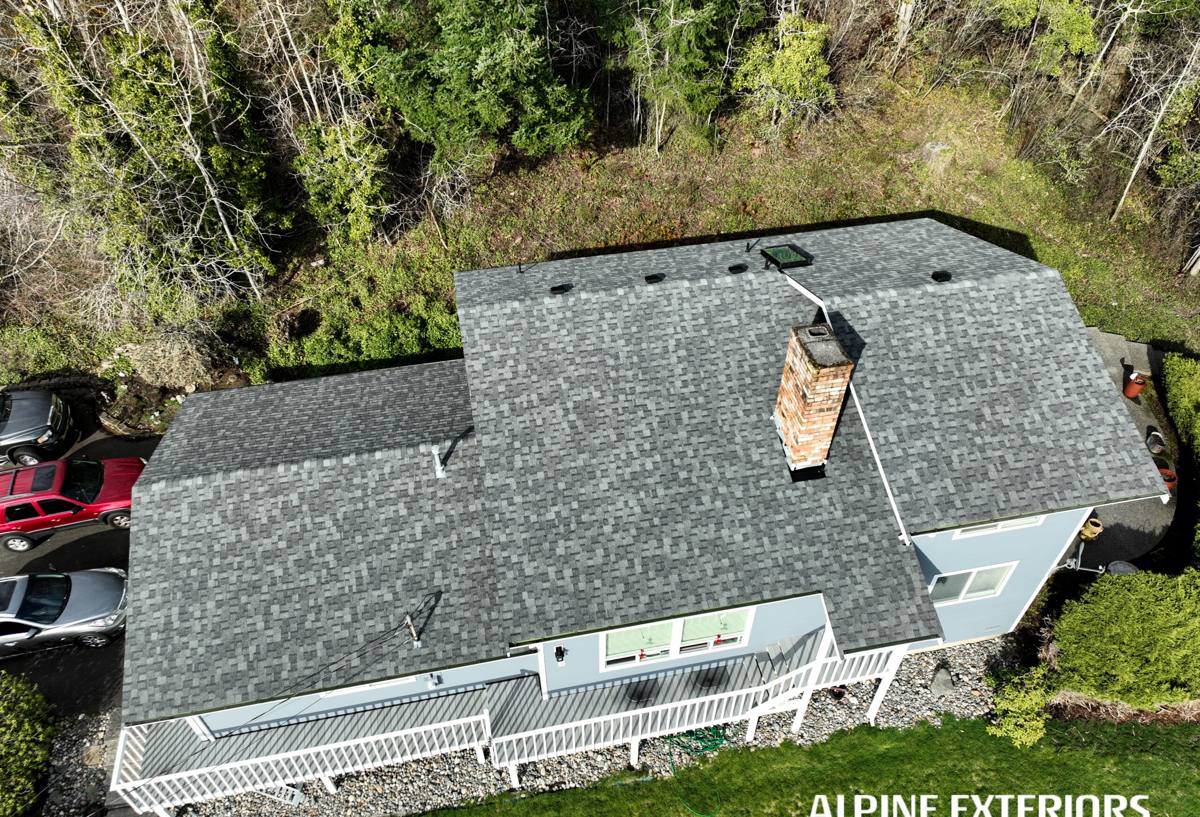
Underlayment: The Roof's Backup Plan
Underlayment is the water-resistant barrier installed directly on the roof deck, before shingles go down. Think of it as the roof's insurance policy — if wind-driven rain, an ice dam, or a future shingle crack lets water past the surface layer, the underlayment is what keeps it from reaching your plywood deck and the inside of your house.
Why It Matters More Here
Whatcom County doesn't get the hail or the extreme heat cycling that wears out roofs in other regions, but it gets something arguably harder on underlayment: long stretches of driving, wind-blown rain coming off the water. Rain that comes in sideways, rather than straight down, tests every seam and lap in the underlayment far more than a calm vertical rain does. A roof built with a minimal, bottom-tier underlayment might perform fine for years in a dry climate and still fail its first real Pacific storm season here.
Common Underlayment Types
| Type | What It Is | Best Use | Trade-Offs |
|---|---|---|---|
| Organic felt (15# or 30#) | Asphalt-saturated paper | Budget builds, dry climates | Absorbs moisture, degrades faster under our rain totals, tears more easily during install |
| Synthetic underlayment | Woven polymer sheet | Most re-roofs in this region | Higher upfront material cost, but resists tearing, doesn't wrinkle, holds up much longer if a roof sits exposed mid-project |
| Self-adhered (peel-and-stick) membrane | Rubberized asphalt with adhesive backing | Valleys, eaves, low-slope sections, around penetrations | Best water seal available, but costs more and is typically used selectively rather than across the whole roof |
Most solid re-roofs we recommend around here use synthetic underlayment across the main field, with self-adhered membrane reinforcing the eaves, valleys, and any low-slope transitions where water tends to pool or back up.
Flashing: Where Roofs Actually Fail
If underlayment is the backup plan for the flat parts of the roof, flashing is the primary defense at every place the roof isn't flat — valleys, chimneys, sidewalls, skylights, and any pipe or vent coming through the deck. Shingles can't bend around a corner or seal to a brick chimney by themselves; that's flashing's job, and it's metal or rubber doing precision work in the exact spots where water pressure is highest.
The Usual Failure Points
- Valleys — where two roof slopes meet and funnel a large volume of water; undersized or poorly lapped valley flashing is one of the most common leak sources we find
- Chimney flashing — step flashing along the sides and counter-flashing at the top; mortar joints and old caulking here fail quietly over years
- Sidewall flashing — where a roof meets a wall, like under a dormer or where a porch roof ties into the main house
- Pipe boots — the rubber collar around plumbing vents; the rubber itself is usually the first part of the whole roof to crack and fail, often well before the shingles are due for replacement
- Skylight flashing — a manufactured kit that still depends entirely on correct installation to perform
Salt Air, Driving Rain, and a Long Moss Season
Ferndale sits close enough to the water that homes catch real salt-laden air, and that air is hard on unprotected or lower-grade metal flashing over time — it accelerates corrosion, especially on cut edges and fastener heads where a protective coating is thinnest. Add in the driving rain that comes through Whatcom County for much of the year, and you've got two forces working on the same joints and seams, in the same direction, for months at a time.
Then there's moss. Our shaded lots, tree cover, and damp, mild winters make Whatcom County about as favorable to roof moss as it gets. Moss itself grows on the shingle surface, but the real damage it causes is often at the flashing lines — moss and the organic debris it traps hold moisture directly against metal edges and shingle-to-flashing transitions, which is exactly where you don't want standing dampness. A roof that looks fine from the ground can have moss quietly working at a valley or a chimney flashing joint for a couple of seasons before anyone notices a leak inside.
Common Flashing Materials
| Material | Typical Use | Durability Notes |
|---|---|---|
| Galvanized steel | Valleys, step flashing, drip edge | Solid and affordable; coating can wear thin at cut edges over long exposure to salt air |
| Aluminum | Step flashing, counter-flashing, drip edge | Doesn't rust, but can corrode (pitting) faster than steel in direct contact with certain masonry or in heavy salt exposure |
| Copper | Valleys, chimney flashing on higher-end roofs | Excellent longevity and ages to a natural patina; higher material cost |
| Rubber/silicone pipe boots | Vent and pipe penetrations | Shortest lifespan of any flashing component; UV and temperature cycling crack the rubber collar well before the roof itself is old |
There's no single "best" material for every situation — the right choice depends on the roof's slope, what it's flashing against (masonry, siding, another roof plane), and the budget. What matters more than the material itself is whether it was sized, lapped, and fastened correctly, since even premium metal will leak if it's installed as an afterthought.
Signs Your Flashing or Underlayment Has Already Failed
Because flashing and underlayment problems hide under the shingles or behind trim, they rarely announce themselves early. Here's what we tell homeowners to watch for:
- A ceiling stain that only shows up during or right after a heavy, wind-driven storm — a strong sign of a flashing leak rather than a general roof-surface issue
- Visible rust streaks running down from a valley or chimney
- Cracked, curled, or missing caulk/sealant around a pipe boot or chimney counter-flashing
- Moss buildup concentrated right along a valley or wall flashing line
- Daylight visible through the attic at a valley, chimney, or sidewall junction
- A musty smell or soft, discolored decking visible from inside the attic near a penetration
Any one of these is worth a look before it becomes an interior repair on top of a roof repair.
What Good Installation Actually Looks Like
The materials matter less than the sequence. Proper flashing work is layered so that water is always directed onto the next piece downhill — never into a seam. Step flashing along a chimney or wall should be woven in with each course of shingles, not just tucked in as one long strip after the fact. Valley flashing needs enough width and the correct underlayment beneath it to handle real volume, not just a token strip. Pipe boots should be set with proper fasteners and sealant, not just pressed down and hoped for. None of this is unusual or exotic work — it's just detail work that takes time, which is exactly the part that gets skipped on a rushed or underbid job.
Maintenance That Actually Protects These Components
Since flashing and underlayment are the parts of the roof doing the hardest work in our climate, a little routine attention goes a long way:
- Keep gutters and valleys clear of debris so water doesn't pool against flashing edges
- Address moss growth before it accumulates along flashing lines, especially on shaded, north-facing slopes
- Have pipe boots checked every few years — they're the shortest-lived component on the roof and cheap to replace before they crack
- After any major windstorm, a quick visual check (or a call to have it looked at) for lifted flashing or displaced shingles near valleys and walls is worthwhile
Getting a Straight Answer on Your Roof
If you're not sure what underlayment or flashing is currently on your roof, or you've had a stain appear after a storm and want to know whether it's a flashing issue or something else, we're happy to take a look and give you a straightforward assessment — no pressure, no upsell. Reach out for a free estimate and we'll walk you through exactly what we find and what your real options are.