 Ferndale Roofing
 Siding Replacement for Bellingham Homes
Bellingham sits close enough to the water that salt-laden air, wind-driven rain, and a moss season that can stretch from October through May all put real pressure on a home's exterior. Siding here isn't just a cosmetic layer — it's the thing standing between your framing and a climate that rarely gives a wall time to fully dry out. When siding starts to fail in this area, it usually isn't sudden. It's a slow accumulation of small failures: a caulk joint that opened up two winters ago, a corner board that's been wicking moisture, moss holding water against a north-facing wall that never sees direct sun. By the time paint is visibly peeling or boards are soft to the touch, the damage has often been building for years.
This page is specifically about replacing siding on homes in and around Bellingham — what the local climate demands, what a correct replacement job actually involves, and why we install James Hardie fiber cement exclusively rather than vinyl, LP SmartSide, or wood products.
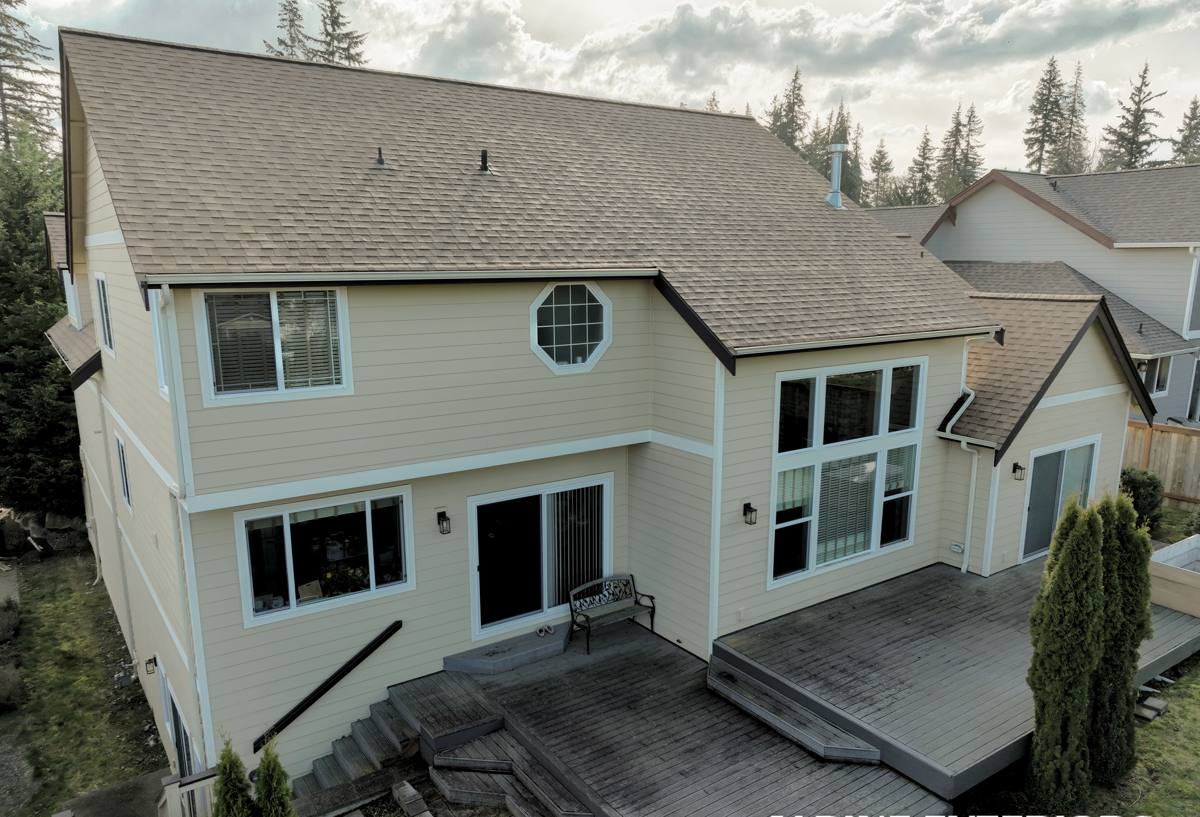
Why Bellingham's Climate Is Hard on Siding
Salt Air and Moisture
Proximity to Bellingham Bay means a steady low-level exposure to salt-laden moisture in the air, especially on homes closer to the water or exposed to prevailing westerly winds. Salt air accelerates the breakdown of fasteners, caulking, and paint films faster than an inland location would experience. Over enough years, that acceleration shows up as chalky, faded paint, corroded fastener heads bleeding rust streaks down the siding, and caulk joints that crack and open sooner than the manufacturer's stated service life would suggest.
Driving Rain
Whatcom County doesn't just get a lot of rain — a good share of it arrives sideways, driven by wind off the Strait of Georgia and Bellingham Bay. Driving rain finds every gap in a siding system: a lap joint that isn't sealed correctly, a butt joint without proper flashing, trim that wasn't back-primed. Products that can absorb and hold water, or that rely heavily on paint film integrity to stay water-resistant, are put to the test every wet season here, not just during the occasional storm.
Moss and Shaded Walls
Bellingham's tree cover and long overcast stretches mean north- and east-facing walls in particular can stay damp for days at a time. Moss and algae take hold readily in these conditions, and once established, they hold moisture directly against the siding surface. On wood-based products this creates a direct path to rot; on any product it accelerates surface degradation and makes a home look neglected well before there's structural concern.
Signs a Bellingham Home Needs Siding Replacement, Not Just Repair
- Soft or spongy spots when you press on the siding, especially near the bottom courses and around window and door trim
- Persistent moss or algae growth that returns within a season or two of cleaning
- Paint that's failing broadly rather than in one or two isolated spots
- Visible gaps, warping, or buckling in lap siding, particularly on the sides of the house that take the most wind-driven rain
- Rust streaking from fastener heads, which usually signals the fasteners themselves are compromised
- Interior signs — musty smells, staining on interior walls near exterior corners, or peeling interior paint on an exterior-facing wall
- Siding that's simply reached the end of its practical service life, even if it looks intact from the street
A repair makes sense when the problem is localized — one damaged board, one section behind a downspout that's been leaking. Once damage is spread across multiple walls or the underlying moisture barrier is compromised, patch repairs stop making financial sense and full replacement becomes the more honest recommendation.
What a Correct Siding Replacement Involves
Replacing siding is not simply pulling old boards off and nailing up new ones. On a Bellingham home, the water management details matter as much as the visible siding product, because that's what determines whether the new siding performs for its full expected life or starts showing the same problems as the old siding within a few wet seasons.
Tear-Off and Sheathing Inspection
Once old siding is removed, the sheathing underneath gets inspected for rot, delamination, or soft spots — problems that are invisible until the siding is off. Any compromised sheathing gets replaced before anything new goes up, because installing new siding over damaged sheathing just hides the problem for a few more years.
Weather-Resistive Barrier
A correctly installed weather-resistive barrier (housewrap or equivalent) goes on with proper overlaps and taped seams, shingle-fashion so water sheds downward and outward rather than working its way behind the barrier at a lap.
Flashing at Penetrations
Windows, doors, hose bibs, vents, and any other wall penetration need dedicated flashing details — not just caulk. Caulk is a maintenance item that will eventually fail; flashing is a permanent mechanical water diversion. This is one of the most common corner-cutting points in siding work generally, and it's the detail most responsible for early failures in driving-rain climates like ours.
Rainscreen Gap
On many Bellingham homes we recommend a furring strip rainscreen gap behind the siding. This creates a drainage and drying plane between the siding and the weather barrier, letting any moisture that does get past the siding drain out and letting the wall assembly dry rather than staying damp against the sheathing — a meaningful advantage in a climate where walls rarely get a long, dry stretch to recover.
Installation to Manufacturer Spec
Fastener spacing, nailing patterns, gap allowances at butt joints, and caulking only where the manufacturer specifies (not everywhere, which can trap moisture) all have to match the manufacturer's published installation instructions. This is also what keeps a manufacturer warranty valid — installing outside of spec can void coverage even on a premium product.
Why We Install Only James Hardie Fiber Cement
We don't install vinyl siding, LP SmartSide, primed spruce, or cedar. That's a deliberate standard, not a lack of options. Here's the honest reasoning:
| Product | Where it falls short in this climate |
|---|---|
| Vinyl | Can warp or deform with the temperature swings we do get, becomes brittle over decades, and offers little protection against moisture once a seam or fastener point fails |
| LP SmartSide (engineered wood) | Wood-based core is more vulnerable to moisture intrusion at cut edges and fastener penetrations if the factory seal is ever compromised during or after installation |
| Primed spruce / cedar | Natural wood requires the most consistent maintenance (repainting, caulk renewal) to keep moisture out, and a missed maintenance cycle in a wet climate shows up fast |
| James Hardie fiber cement | Non-combustible, dimensionally stable, factory-applied ColorPlus finish resists fading and doesn't rely on the homeowner repainting on a strict schedule, and the HZ5 product line is engineered for wet, moderate climates like ours |
Fiber cement is cement, sand, and cellulose fiber — it doesn't rot, it doesn't provide food for moss the way wood does, and it holds up to salt air and driving rain without the maintenance burden of natural wood. James Hardie's ColorPlus finish is baked on at the factory under controlled conditions, which gives a more durable, consistent finish than field-applied paint and comes with its own finish warranty separate from the product warranty. We chose to standardize on one product line because it lets us install to spec every time, know the material's behavior in this exact climate, and stand behind the result.
Our Siding Replacement Process
- On-site assessment — we look at all sides of the home, note which walls take the most weather exposure, check for moss and moisture patterns, and identify any areas of likely sheathing damage
- Written estimate — scope, product selection (Hardie plank profile, color, trim), and timeline laid out clearly before any work starts
- Tear-off — old siding removed, sheathing inspected and repaired as needed
- Weather barrier and flashing — housewrap, window and penetration flashing, and rainscreen furring installed to spec
- Hardie installation — siding installed per James Hardie's published instructions for fastener pattern, gapping, and finishing
- Final walkthrough — we review the completed work with you before calling the job done
Cost Factors for Bellingham Siding Replacement
Every home is different, so we don't quote broad numbers without seeing the house, but these are the factors that move a siding replacement estimate up or down:
| Factor | Why it matters |
|---|---|
| Extent of sheathing damage found at tear-off | Hidden rot behind old siding is common in older Bellingham homes and adds repair scope once discovered |
| Home size and wall complexity | More corners, dormers, and trim detail mean more labor and material cuts |
| Siding profile and color selection | Hardie offers multiple plank widths and finish options; some cost more than others |
| Rainscreen inclusion | Adds a step and modest material cost but pays off in wall assembly longevity in our climate |
| Story height and access | Two-story walls and steep or tight-access lots require more scaffolding and time |
Why Hire a Crew That Already Works Bellingham
A contractor who works Whatcom County regularly already knows which walls in this area take the worst weather, what moisture patterns to expect on a shaded north side near mature trees, and how the local building department handles siding replacement permitting and inspections. That local familiarity shows up in small but meaningful decisions — where to add extra flashing attention, when a rainscreen gap is worth recommending, which details matter most given how this specific climate behaves over a 20- or 30-year siding life. It also means a crew that's accountable locally: not a company that did one job in the area and moved on, but one that expects to still be reachable in this community years from now if a warranty question comes up.
If your Bellingham home's siding is showing wear from salt air, driving rain, or moss, we're happy to take a look and give you a straightforward, no-pressure assessment of whether repair or replacement makes sense — and what a correct James Hardie installation would involve for your home specifically. Use the form below to request a free estimate.