 Ferndale Roofing
 Siding in Sumas: What the Local Climate Actually Demands
Sumas sits at the edge of Whatcom County, in a low, damp corner of the county where moisture doesn't just fall from the sky — it sits in the air and in the ground for long stretches of the year. Whatcom County as a whole runs from saltwater shoreline near Bellingham Bay out to river valleys and foothills like the one around Sumas, and while the salt air itself is more of a coastal concern, the driving rain, the humidity, and the long moss season that come with living west of the Cascades hit every part of the county, Sumas included. Siding here isn't just a cosmetic choice. It's the single biggest barrier between a house's framing and a climate that stays wet for months at a time.
Damp Ground, Damp Air
Homes in and around Sumas tend to sit closer to river-valley moisture than homes up on higher, better-drained ground elsewhere in the county. That means siding has to manage two kinds of water exposure: the rain hitting it directly, and the ambient dampness working against it from a lower, cooler starting point. Materials and installation details that would get away with sloppy work in a drier climate simply don't hold up the same way here.
A Long Moss and Mildew Season
Moss and mildew aren't just a roof problem. Given enough shade, poor airflow, and a siding surface that holds water instead of shedding it, moss and algae will colonize wall surfaces too — especially on north-facing walls and anywhere landscaping keeps a wall shaded and slow to dry. In a climate where the wet season can run eight months or more, that's a long window for organic growth to take hold on a material that isn't built to resist it.
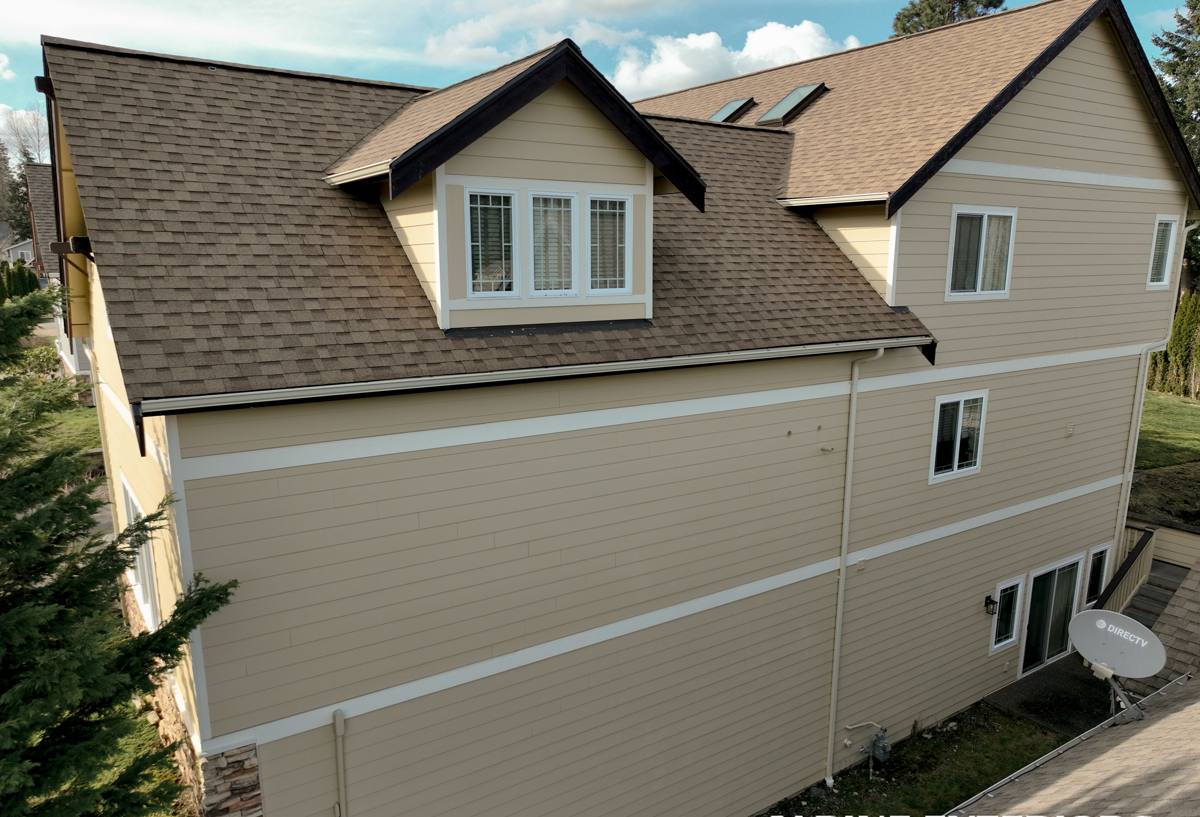
What a Correctly Installed Siding Job Actually Involves
Siding failures in this region are rarely about the siding material sitting out in the open and wearing down evenly. They're almost always about water finding a way behind the siding — through a bad seam, a missing flashing detail, or a fastener driven wrong — and then having nowhere to dry out. A correct installation is built around keeping water out and giving any moisture that does get in a way to escape.
Weather-Resistive Barrier and Flashing
Behind every piece of siding should be a continuous weather-resistive barrier, properly lapped so water sheds downward and outward rather than getting trapped. Flashing at windows, doors, roof-to-wall transitions, and any penetration through the wall has to be integrated with that barrier in the right order — not just caulked over afterward. Caulk is a backup, not a substitute for correct flashing sequence.
Fastening and Clearances
Fiber cement siding has specific fastening requirements — nail placement, spacing, and depth all affect how the panel performs over decades, not just in the first few years. Clearance from grade, from roof lines, and from decks and patios matters too: siding installed too close to the ground or to a hard surface stays wetter longer and is more likely to wick moisture at the bottom edge.
Joints, Seams, and Caulking
Every horizontal and vertical joint is a potential entry point for water. Correct installation minimizes joints where possible, backs them properly where they can't be avoided, and uses the right sealant in the right place — not sealant used to cover for a gap that should have been closed with better carpentry.
Why We Install Only James Hardie Fiber Cement Siding
Ferndale Roofing Co does not install vinyl siding, LP SmartSide, Cemplank, Allura, or primed spruce or cedar siding. That's not a marketing position — it's a standard we hold because of what we've seen happen to siding in this specific climate over time, and because supporting one product system well beats spreading our crews thin across several.
James Hardie fiber cement is a cement-based composite, not a wood product and not a vinyl product, which changes how it behaves against the two things that do the most damage to siding in Whatcom County: sustained moisture and temperature swings. It doesn't rot, it isn't a food source for insects, and it's non-combustible — a real advantage during wildfire smoke seasons that have become a regular part of Pacific Northwest summers. Hardie also engineers specific product lines (its HZ5 and HZ10 systems) for different climate zones, which means the board specified for a Sumas installation is matched to Pacific Northwest conditions rather than a one-size-fits-all product.
The factory-applied ColorPlus finish is another piece of why we standardized on Hardie. It's baked on under controlled conditions rather than field-applied, which means more consistent coverage and a finish that's backed by its own separate finish warranty, in addition to Hardie's product warranty. For a homeowner, that translates to fewer repaint cycles and a warranty structure that's actually transferable if the home sells.
How We Approach a Siding Project in Sumas
Every home is different, but the sequence we follow doesn't change:
- On-site assessment of the existing siding, sheathing, and any signs of moisture intrusion already present behind the wall.
- Removal of failing siding and inspection of the sheathing underneath — this is where hidden rot or past water damage gets caught before it's covered up again.
- Repair of any damaged sheathing or framing before new material goes up. Covering a problem instead of fixing it just guarantees a bigger repair later.
- Installation of a continuous weather-resistive barrier and correct flashing at every window, door, and penetration.
- Installation of James Hardie panels or lap siding to manufacturer fastening specifications, with attention to clearances at grade, roofline, and any attached structures.
- Final inspection of joints, trim, and caulking before the job is called done.
We don't treat siding as a cosmetic swap. On most homes we're also looking at the roof-to-wall transitions, trim, and any adjacent water-management issues, since siding doesn't perform in isolation from the rest of the exterior.
Comparing Siding Materials for a Sumas Home
We only install James Hardie fiber cement, but homeowners deserve to understand how the alternatives actually compare — not as a scare tactic, just as a fair account of the trade-offs each material carries in a wet, moss-prone climate.
| Material | Moisture Behavior | Maintenance | Fire Resistance | Warranty Structure |
|---|---|---|---|---|
| James Hardie Fiber Cement | Does not rot; engineered for wet climate zones | Low — factory finish resists fading and moss buildup better than raw wood | Non-combustible | Product and finish warranties, transferable |
| Vinyl Siding | Sheds water well but can trap moisture behind it if installed loosely; can warp in heat | Low upfront, but color fades and can't be repainted easily | Combustible, can melt/deform near heat sources | Typically product-only, often prorated |
| LP SmartSide (Engineered Wood) | Wood-based core; performance depends heavily on installation quality and caulking upkeep | Moderate to high — periodic repainting and caulk maintenance | Combustible | Product warranty, conditions apply |
| Cedar / Primed Spruce | Natural wood; absorbs moisture, prone to cupping and rot without diligent upkeep | High — regular refinishing and moisture monitoring required | Combustible | Typically none from a manufacturer; workmanship only |
None of these are "bad" products in every application. But in a climate that stays wet for most of the year and grows moss on anything that holds moisture, the maintenance burden and moisture sensitivity of wood-based and vinyl products is what led us to standardize on fiber cement.
Signs Your Current Siding Is Already Failing
Siding damage in this climate often starts quietly, behind the wall, before it becomes visible. A few warning signs are worth acting on before they turn into a bigger repair:
- Visible cracking, warping, or buckling in siding panels or boards
- Moss, algae, or dark streaking that keeps coming back no matter how often it's cleaned
- Soft or spongy spots when you press on the siding, especially near the bottom edges
- Peeling or bubbling paint, particularly on wood-based or previously painted siding
- Visible gaps opening up at seams, corners, or around windows and doors
- A noticeable rise in heating costs, which can point to moisture-compromised insulation behind failing siding
- Musty odors or visible staining on interior walls that share an exterior wall with damaged siding
Any one of these on its own isn't necessarily an emergency, but in combination — or left unaddressed through another wet season — they tend to compound.
Caring for Hardie Siding After It's Installed
Fiber cement is low-maintenance, not no-maintenance. A yearly rinse to keep moss and algae from establishing on shaded or north-facing walls goes a long way, especially given how long the wet season runs in this part of the county. Keeping gutters clear and downspouts directed away from the wall base protects the bottom courses of siding, which take the most splash-back and standing moisture. Trimming back landscaping that shades a wall or blocks airflow also helps siding dry out between rain events instead of staying damp for days.
Because the ColorPlus finish is factory-applied, it holds color far longer than field-applied paint — but it's still worth a periodic visual check for caulking that's shrunk or pulled away at joints and trim, since that's the kind of small gap that lets water in over time.
Why Hiring a Crew That Already Works in Sumas Matters
Siding installation isn't just about the material — it's about installation details being right for the specific conditions a home sits in. A crew that regularly works in Sumas and the surrounding Whatcom County area already knows how the local rain patterns, moss growth, and ground moisture affect flashing details, clearance decisions, and where extra attention is worth spending. That's not something a crew coming from a drier region necessarily accounts for by default.
It also means someone answering the phone and standing behind the work is close by, not a subcontractor network with the job outsourced to whoever's available. For a job that's meant to protect a home for decades, that continuity matters as much as the material choice itself.
If your Sumas home needs new siding, or you're not sure whether what's on the walls now is doing its job, we're happy to take a look and give you a straight answer. Reach out for a free, no-pressure estimate — there's no obligation, and no pressure to sign anything on the spot.