 Ferndale Roofing
 Building New in Nooksack? Your Windows Are a Structural Decision, Not Just a Style Choice
If you're framing a new home or an addition out toward Nooksack, the window package you choose and how it gets installed will shape how that building performs for the next 20-plus years. New-construction windows are different from replacement windows in one important way: they install with a nailing fin directly into the framed rough opening, before siding and house wrap go on. That means the window, the flashing, and the water-resistive barrier all have to work together as one system from day one. Get that sequence wrong and you won't see it for a few years — until you do, and by then it's a siding-off repair instead of a five-minute fix.
Out here in Whatcom County, that margin for error is thinner than in a lot of places. Nooksack sits inland from the coast but still gets plenty of the marine push that comes off Bellingham Bay and the Strait of Georgia, plus the valley's own rain patterns off the foothills. Homes in this area deal with salt-tinged air, long stretches of driving rain, and a moss season that can run most of the year on north-facing walls. New construction is the one chance to build a window opening that's ready for all three.
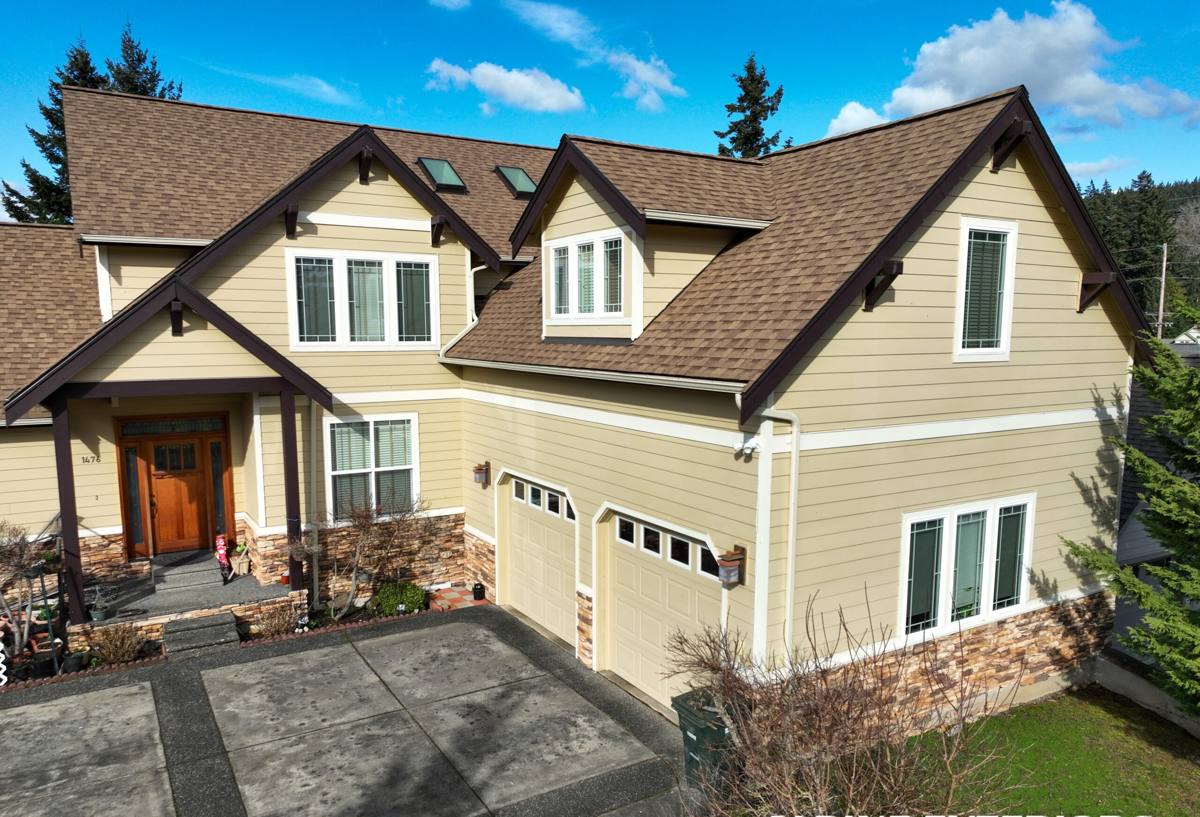
What Nooksack's Climate Actually Does to a Window Opening
Salt Air
You don't have to be waterfront to get salt exposure in this part of Whatcom County — wind carries it inland, and it settles on window frames, hardware, and fasteners over time. Salt air accelerates corrosion on lower-grade aluminum components, cheap screws, and unprotected steel flashing. It's not dramatic, it's slow — a hinge that sticks, a lock that binds, a fastener that streaks rust down the siding two years after move-in.
Driving Rain
Wind-driven rain doesn't just fall on a window, it pushes sideways into it. That's a flashing and sealant problem more than a glass problem. A window can be top-quality and still leak if the sill pan isn't sloped right, if the flashing tape laps in the wrong order, or if the head flashing doesn't extend far enough past the jambs. In new construction, this is 100% installer discipline — there's no old wall to blame.
Moss and Constant Damp
Shaded, north- and west-facing walls around Nooksack stay damp for long stretches, and that's exactly where moss and mildew take hold on sills, trim, and any wood component that isn't detailed to shed water fast. Framing that traps moisture behind the window — instead of directing it out — is what eventually leads to soft sheathing and stained interior drywall, usually discovered during a remodel years later.
What a Correct New-Construction Install Actually Involves
A lot of the "quality" in a window job has nothing to do with the window brand and everything to do with what happens in the rough opening before the window is ever set. Here's the sequence we hold to on every new-construction job:
- Rough opening checked for square, level, and correct dimension before the window ever shows up on site
- Sloped sill pan flashing installed so any water that gets past the window drains back outside, not into the wall
- Weather-resistive barrier (house wrap) integrated with the flashing in the correct shingle-lap order — top layer over the one below, always
- Window set, shimmed, and fastened per manufacturer spec — not just "nailed until it feels tight"
- Head flashing installed last, lapping over the side flashing and wrap
- Interior and exterior sealed with the right sealant for the substrate, not a generic caulk-and-go
- Final check for square and smooth operation before trim or siding closes the opening up
Every one of those steps is easy to skip and hard to inspect once siding is on. That's exactly why the crew doing this work matters as much as the window unit itself.
Choosing the Right Window for a Nooksack Build
There's no single "best" window brand — there's a right combination of frame material, glass package, and installation quality for this climate and this budget. A few honest trade-offs worth knowing before you spec a whole house:
| Frame Material | How It Handles This Climate | Trade-Off to Know |
|---|---|---|
| Vinyl | Good moisture and corrosion resistance, no repainting, solid value | Frame profile is thicker than fiberglass or wood; less design flexibility |
| Fiberglass | Very stable in temperature swings, holds paint well, strong against damp exposure | Higher upfront cost than vinyl |
| Wood/Wood-Clad | Best interior warmth and appearance | Exterior wood or clad joints need real diligence in a wet, salty climate — we're careful about where we recommend it |
| Aluminum | Strong and slim sightlines | Poor thermal performance and more prone to condensation unless thermally broken — we steer most residential Nooksack builds away from it for that reason |
Glass matters too. Low-E coatings and argon-filled dual or triple panes cut down on heat loss during our wet, gray winters and reduce condensation on cold mornings — a real issue in a valley that holds moisture the way this one does.
Why a Nooksack-Familiar Crew Changes the Outcome
New-construction window installation isn't exotic work, but it's unforgiving of shortcuts, and the right answer changes slightly depending on wall orientation, exposure, and how a given lot sits relative to wind and rain patterns. A crew that's done this work around Ferndale and out into the Nooksack area already knows which walls on a typical lot take the worst weather, how local framing crews tend to build a rough opening, and what inspectors in Whatcom County are looking for at frame check. That familiarity shows up as fewer surprises mid-build and fewer callbacks after the siding's closed up.
It also means we're not learning the region's weather behavior on your house. We've seen what happens when sill flashing is rushed on a north wall out here, and we build every opening assuming that wall will get tested.
Our Process on a New-Construction Job
- Plan review. We look at window schedules and rough opening sizes before the walls are even framed, so nothing gets built wrong the first time.
- Coordination with your builder. We work directly with your general contractor or framer on timing — windows need to go in at the right point in the sequence, not too early, not after wrap is already closed up wrong.
- Flashing and install. Sill pan, window set, and flashing sequence as outlined above, on every opening, every time — no shortcuts on the walls you can't see from the street.
- Quality check. Every window gets checked for square, smooth operation, and a sealed, weather-tight perimeter before we call the job done.
- Documentation. You get a record of what was installed and how, which matters for warranty claims and for whoever owns the house after you.
A Simple Checklist Before You Sign Off on a Window Package
- Does the quote specify sill pan flashing, not just "flashed per code"?
- Is the glass package rated for our climate zone, with Low-E and argon fill on at least the standard package?
- Does the installer carry manufacturer-specific install training or certification for the brand you're buying?
- Is there a written warranty that covers both the window unit and the installation labor separately?
- Has the installer worked in Whatcom County long enough to have seen a full wet season play out on their own work?
What This Costs to Get Right
Pricing on new-construction windows depends on frame material, glass package, size, and how many openings your plan has — a full custom build will price very differently than a simple ranch addition. In general, expect vinyl packages to sit at the lower end of the range, fiberglass and wood-clad options in the middle to upper end, and total project cost to move with window count and size more than almost anything else. We'll walk through actual numbers for your plan set rather than quote a blind average, since a same-size house with more glass or taller openings changes the math fast.
Building for the Long Haul in Whatcom County
A house going up in Nooksack today will sit through decades of the same driving rain, salt-tinged air, and shaded, mossy stretches that shape every other home in this part of the county. New construction is the one point in that house's life where getting the window install right costs the least and matters the most — before siding, trim, and interior finishes make every future fix ten times more expensive. It's worth doing carefully the first time.
If you're framing or planning a build near Nooksack or anywhere in the Ferndale area, we're happy to walk your plan set and give you a straight, no-pressure estimate on the window package and install. Use the form below to get started.