 Ferndale Roofing
 Why Lynden Homes Take a Beating from Whatcom County Weather
Lynden sits in the Nooksack Valley, close enough to the water that salt-laden air still reaches it on a west wind, and open enough that farmland exposure means driving rain hits siding straight-on for months at a time. Add in a long, gray moss season where shaded north walls and tree lines stay damp for weeks without a real drying window, and you have a climate that is genuinely tough on exterior building materials. Wood-based products swell, delaminate, or rot in these conditions. Vinyl warps and cracks in temperature swings and gets brittle in cold snaps. Even good products fail early when the underlying installation details are wrong.
Siding on a Lynden home isn't cosmetic — it's the primary barrier standing between wood framing and months of wet weather every year. When it's installed correctly with the right material, it should last decades with minimal upkeep. When it's not, homeowners find out the hard way, usually behind a wall they can't see.
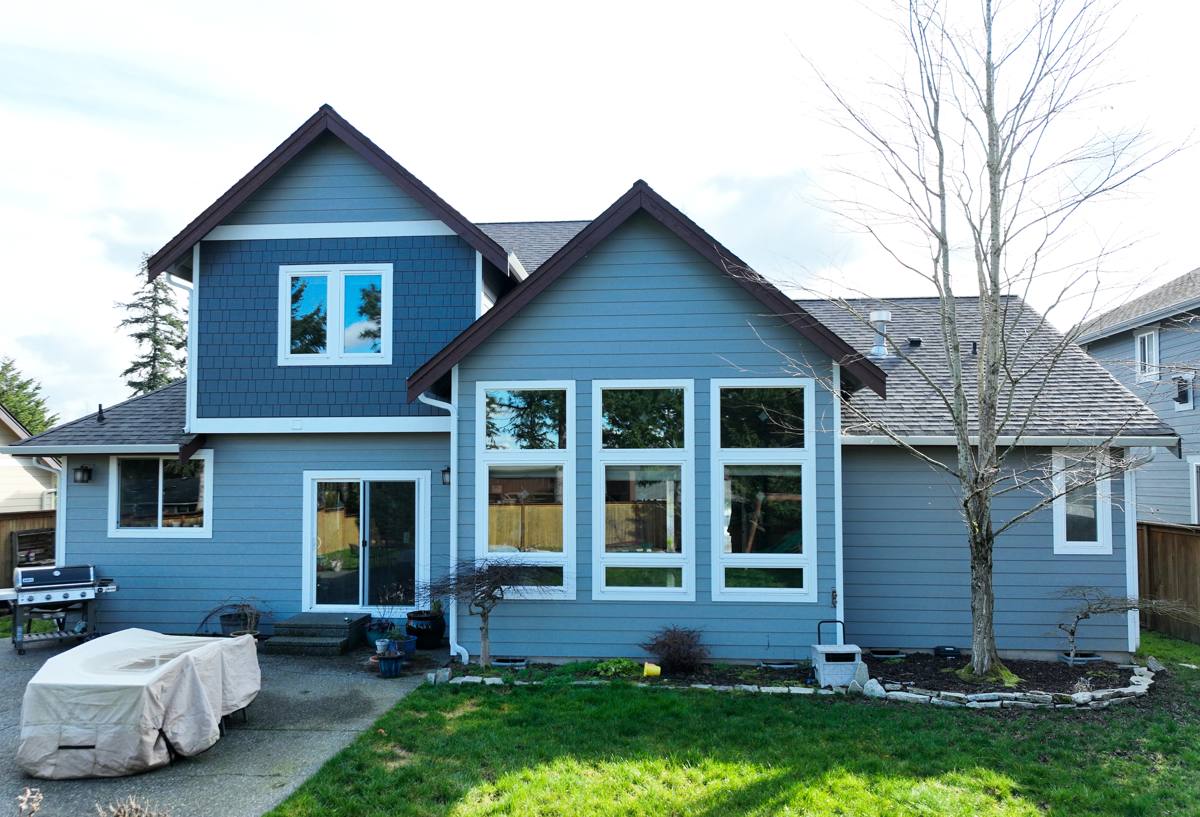
Why We Only Install James Hardie Fiber Cement
We install one siding system on every home we work on: James Hardie fiber cement. That's a deliberate standard, not a limitation of what we're capable of installing. Fiber cement is non-combustible, dimensionally stable in wet-to-dry cycles, and doesn't feed moss or mildew growth the way wood-based products can. James Hardie backs its siding with a factory-applied ColorPlus finish that's baked on and warranted separately from the substrate, so homeowners aren't relying on job-site paint to hold color and protect the board.
Just as important, Hardie makes climate-engineered product lines. Their HZ5 formulation is built specifically for the freeze-thaw, high-moisture Pacific Northwest, which is exactly the environment Lynden sits in. We've chosen not to install LP SmartSide, vinyl, Cemplank, Allura, primed spruce, or cedar because we don't want to stand behind a product on a Whatcom County home that wasn't engineered for this specific combination of rain volume, humidity, and temperature swing. That's a professional standard we hold ourselves to, not a claim that every alternative product is unusable everywhere.
What This Means in Practice
- One material system across the whole home — no mixing composite trim with a different-brand field panel
- A finish warranty that comes from the manufacturer, not just the installer
- A product line matched to this region's moisture exposure rather than a national average climate
- Consistent installation specs our crews already know cold, because it's the only system we install
What Correct Siding Installation Actually Involves
The siding material only performs as well as the assembly behind it. Most siding failures we see on older homes in this area trace back to installation shortcuts, not the board itself. A correct job includes:
Water Management Behind the Siding
A weather-resistive barrier goes over the sheathing first, lapped correctly so water sheds downward and never behind the layer beneath it. Every window, door, and penetration gets proper flashing integrated with that barrier — not caulked over the top of the siding as an afterthought. This is the layer that actually keeps a wall assembly dry; the siding itself is the second line of defense, not the only one.
Fastening and Clearances
James Hardie specifies fastener type, spacing, and placement for each product line, and those specs exist for a reason — get them wrong and you get cracking, popped nails, or panels that don't hold paint the way they should. Ground clearance, deck and patio clearance, and gaps at inside/outside corners all matter more in a wet climate than a dry one, because standing moisture at the bottom edge of a board is where rot and moss growth start.
Caulking and Sealant Joints
Sealant is used at specific joints, not as a substitute for correct flashing. Overusing caulk to compensate for a poor water-management layer is a common shortcut that looks fine on installation day and fails within a few wet seasons.
Our Process for a Lynden Siding Project
We walk the same steps on every home, adjusted for the specific exposure and condition of your walls:
- On-site assessment — we look at current siding condition, sheathing condition where accessible, moisture staining, and which elevations take the worst weather exposure
- Product and color selection — matching the right Hardie line and profile to the home's style and this climate's demands
- Tear-off and sheathing check — old siding comes off and we inspect what's underneath before anything new goes up, catching problems before they get sealed behind new material
- Water-resistive barrier and flashing installation — the step that determines how the wall performs for the next 30 years
- Siding installation to manufacturer spec — correct fastening, clearances, and joint treatment throughout
- Trim, caulking, and final detailing — the finish work that makes the job look as good as it performs
- Walkthrough and cleanup — we review the finished work with you before we consider the job done
Signs a Lynden Home May Need New Siding
Because moisture problems develop behind siding before they're visible on the surface, it pays to know the early warning signs:
- Soft or spongy spots when you press on the siding, especially near the bottom edges
- Paint that's peeling, bubbling, or needing repainting more often than it used to
- Persistent moss or dark streaking that comes back shortly after cleaning
- Visible warping, cracking, or gaps opening at seams and corners
- Rising energy bills that suggest the wall assembly isn't insulating or sealing the way it should
Any one of these on its own isn't necessarily an emergency, but a home showing several of them is worth a professional look before the underlying sheathing is compromised.
Matching the Right Hardie Line to Your Home
James Hardie's product range covers different looks and applications, and part of doing this job right is picking the profile that fits the home and its exposure — not just the one that's easiest to install.
| Product | Best Suited For | Look |
|---|---|---|
| HardiePlank Lap Siding | Most single-family homes; the standard replacement choice | Traditional horizontal lap, multiple textures |
| HardiePanel Vertical Siding | Accent walls, gables, farmhouse and modern styles common around Lynden | Clean vertical lines |
| HardieShingle Siding | Accent areas, dormers, gables wanting a shingle look without wood's maintenance | Staggered or straight-edge shingle profile |
| HardieTrim Boards | Corners, window and door trim, fascia | Crisp, paintable trim that matches the field siding system |
What Drives the Cost of a Siding Project
Every home is different, but the same handful of factors move the price on a Lynden siding job:
| Factor | Why It Matters |
|---|---|
| Home size and number of stories | More square footage and higher walls mean more material and labor, plus added scaffolding on taller homes |
| Current siding condition | Rotten sheathing or hidden moisture damage found during tear-off adds repair work before new siding can go on |
| Product line and profile selected | Plank, panel, and shingle products carry different material and labor costs |
| Trim and detail complexity | Homes with more corners, dormers, and window trim take more time to detail correctly |
| Site access | Fencing, landscaping, and setback from the road can affect how efficiently a crew can stage material |
We provide a specific, written estimate after seeing the home in person — general online price ranges rarely account for the condition underneath the existing siding, which is often the biggest variable.
A Homeowner's Checklist Before Hiring a Siding Contractor
- Ask whether the crew installing your siding works for the company directly or is subcontracted
- Confirm they carry current Washington contractor licensing and insurance
- Ask what water-resistive barrier and flashing details they use — not just what siding brand
- Get the manufacturer and product line specified in writing, not just "fiber cement" or "Hardie-style"
- Ask how they handle sheathing repairs if damage is found during tear-off
- Request a written estimate that breaks out material, labor, and any anticipated repair allowances
Why a Crew That Already Works in Lynden Matters
Siding installed to spec on paper can still underperform if the crew doesn't understand how a specific region's weather actually behaves against a wall. A crew that regularly works Whatcom County homes knows which elevations in the Nooksack Valley take the worst wind-driven rain, how long moss-prone shaded walls stay damp, and where clearance and flashing details matter most given the local exposure. That local pattern recognition doesn't show up in a spec sheet — it comes from having installed and later serviced siding on homes facing the same weather your home faces every year.
If your Lynden home's siding is showing its age, or you're planning ahead for a replacement, we'd be glad to take a look and talk through what your home actually needs. Reach out for a free, no-pressure estimate using the form below.