 Ferndale Roofing
 Marietta's Waterfront Location Asks More of Your Siding
Marietta sits low and close to the water between Ferndale and Bellingham, and that position puts homes here under a different kind of pressure than siding a few miles inland has to handle. Salt-laden air off Bellingham Bay accelerates corrosion on fasteners and trim, wind-driven rain finds its way into seams and laps that would stay dry elsewhere, and the shaded, damp stretches common to this part of Whatcom County keep moss and algae growing on north- and west-facing walls for most of the year. None of that is unusual for the area — it's just the baseline your siding has to survive, year after year, without you thinking about it.
The problem is that most siding products were never engineered with that baseline in mind. They're designed for a national average climate, not a maritime one. When a product's moisture tolerance, fastener hardware, and finish system are all matched to a drier, more temperate assumption, a Marietta home ends up asking more of the material than it was built to give — and the gap shows up as callbacks, repaint cycles, and early replacement.
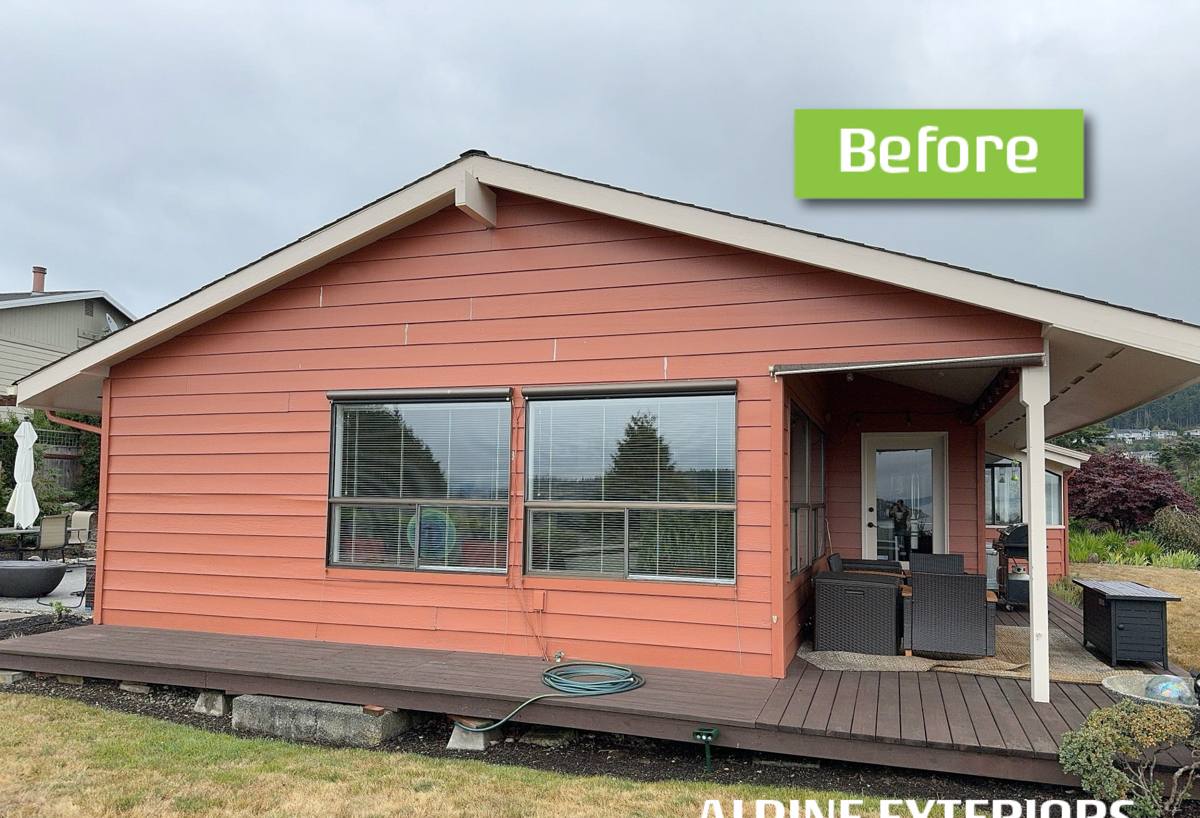
Signs Your Marietta Home's Siding Is Past Its Service Life
Siding failure in this climate is rarely dramatic. It's usually a slow accumulation of small signals that homeowners get used to seeing and stop noticing. Worth walking your exterior and checking for:
- Soft or spongy spots when you press on the siding, especially near the bottom courses and around window and door trim
- Paint that's peeling, bubbling, or needing a full repaint far sooner than the label promised
- Persistent moss, algae, or black streaking on shaded walls that comes back within weeks of cleaning
- Visible gaps, warping, or cupping at panel seams and butt joints
- Rust streaks bleeding from fastener heads or trim corners
- A musty smell or soft drywall on interior walls that back onto exterior siding
- Siding that's more than 20-25 years old, particularly if it's wood-based or vinyl
Any one of these on its own might just mean a maintenance task. Several at once, especially combined with age, usually means the material and the substrate behind it are both due for a real look — not another patch.
Why the Cladding Material You Choose Matters More Here
In a drier inland climate, the difference between siding materials mostly shows up as cosmetic wear. Near the Salish Sea, it shows up structurally. Wood-based and vinyl products react to sustained moisture and UV exposure differently than fiber cement does, and those differences compound over a Whatcom County winter after Whatcom County winter.
| Material | Moisture behavior | Maintenance in this climate | Typical lifespan here |
|---|---|---|---|
| Vinyl | Doesn't rot, but seams and laps can let water track behind the panels; warps and becomes brittle with UV and temperature swings | Low, but prone to cracking and fading; hard to color-match repairs | 15-25 years, shorter with wind-driven rain exposure |
| LP SmartSide / engineered wood | Wood-strand core; performs well when the finish and caulking are maintained but is vulnerable at cut edges and panel joints if moisture gets in | Ongoing caulk and paint upkeep, especially on rain-exposed elevations | 15-30 years, heavily dependent on maintenance discipline |
| Cedar | Naturally moisture-resistant but not moisture-proof; needs airflow and finish maintenance to avoid cupping and rot in constant damp shade | High — regular sealing, staining, and moss control | Highly variable, often 15-20 years before major repair in wet, shaded areas |
| James Hardie fiber cement | Non-combustible and dimensionally stable; doesn't absorb and swell the way wood-based products do; factory-cured finish sheds water at the surface | Occasional wash-down; no repainting on ColorPlus finishes | 30+ years when installed to spec |
This is why we standardized on one product line instead of offering the full menu. We'd rather install the material that's actually built for this exposure than sell whatever a homeowner assumes is standard and watch it underperform in five years.
What a Correct Siding Replacement Actually Involves
Tear-off and inspection
Replacement starts with full removal of the old siding, not an overlay. That's the only way to see what's actually happening behind it — sheathing condition, hidden rot around windows and penetrations, and whether previous work left gaps in the water-resistive barrier. In a wet coastal community like Marietta, skipping this step is how homeowners end up paying twice: once for new siding, again a few years later for the rot it was nailed over.
Water-resistive barrier and flashing
The house wrap and flashing details matter as much as the siding itself, arguably more. Every window, door, and penetration needs properly lapped flashing so water sheds outward instead of tracking behind the cladding. With the volume of driving rain this area sees, a flashing detail that's "close enough" inland is a leak point here.
Fastening and clearances
Fastener spacing, type, and depth need to match the manufacturer's installation manual — not a generic nailing pattern — because that's what the product warranty is actually written against. Ground clearance and gaps at trim and butt joints matter too: siding installed tight to grade or hardscape stays wet longer and invites the exact moss and algae growth that's already a problem on shaded coastal walls.
Why We Install Only James Hardie Fiber Cement
James Hardie is a non-combustible fiber cement product, which matters for fire risk during dry summer stretches, and its ColorPlus factory finish is baked on under controlled conditions rather than field-painted, so it holds color and resists the fading and peeling that a repaint-dependent product struggles with in constant damp-to-dry cycling. Hardie also builds climate-specific HZ product lines engineered for regional moisture and temperature exposure rather than a one-size-fits-all formulation, and backs correctly installed work with a strong, transferable warranty.
We're not going to pretend every other product on the market is worthless — vinyl, engineered wood, and cedar all have legitimate uses and loyal customers. But we install exteriors for a living in a marine climate, and after years of tear-offs and callbacks, fiber cement is what we're willing to put our name behind. That's a professional standard we hold, not a knock on every homeowner who chose something else.
Our Process for a Marietta Siding Replacement
- On-site assessment — we walk the exterior, check for moisture intrusion, and evaluate sheathing condition before quoting anything
- Written scope and product selection — plank style, exposure, and color chosen for your home and the specific elevations most exposed to wind-driven rain
- Full tear-off — old siding removed down to the sheathing, not covered over
- Substrate repair — any rot or damaged sheathing found is repaired before anything new goes on
- Water-resistive barrier and flashing installation — done to manufacturer and code detail at every window, door, and penetration
- Hardie installation to spec — correct fastener pattern, clearances, and joint treatment
- Final walkthrough — trim, caulking, and touch-up reviewed with you before we consider the job done
What Siding Replacement Costs — and What Drives the Range
Every home is different, and we'll always give you a firm number after an on-site look rather than a phone quote. What actually moves the price:
| Factor | Why it affects cost |
|---|---|
| Home size and wall complexity | More corners, gables, and trim detail mean more labor and material cuts |
| Sheathing condition underneath | Hidden rot found during tear-off adds repair scope before new siding can go on |
| Plank style and exposure | Lap width, texture, and factory finish options are priced differently |
| Trim and accessory scope | Corner boards, window trim, and soffit work bundled into the project add cost but improve the water-shedding detail overall |
| Access and site conditions | Grade, landscaping, and staging space around the home affect labor time |
As a rule, avoid comparing bids purely on the bottom-line number without checking whether they include full tear-off, sheathing repair if needed, and correct flashing detail — those are the line items that determine whether the job lasts 10 years or 30.
Why Hiring a Crew That Already Works Marietta Matters
A crew that's used to working this specific stretch of Whatcom County knows what to expect before the tear-off even starts: where moisture tends to hide behind older siding on shaded, water-facing walls, how much clearance to build in given the rainfall this area gets, and which elevations need the most attention to flashing and drainage. That's the kind of judgment that comes from doing the work here repeatedly, not from a general knowledge of siding installation. It shows up in fewer surprises mid-project and in a finished job that's actually built for the exposure your specific home sits in — not a generic install dropped into a marine climate and hoped for the best.
If your siding is showing wear, or you just want an honest read on what shape it's in, we're glad to come take a look. The estimate is free, there's no pressure, and you'll get a straight answer about what your home actually needs — use the form below to get started.