 Ferndale Roofing
 Why Everson-Area Decks Wear Out Faster Than People Expect
Everson sits inland along the Nooksack River valley, but it doesn't escape the weather pattern that shapes every deck in Whatcom County. Moist marine air pushes in off the Salish Sea and Bellingham Bay for months at a stretch, and by the time it reaches the valley it's usually still carrying enough humidity to keep exposed wood damp long after a storm has passed. Add driving rain that comes in sideways during fall and winter, shaded yards and tree cover common on rural and semi-rural lots in this area, and a moss season that can run from October well into spring, and you have a climate that's genuinely tough on outdoor structures.
Decks take the worst of it because they're horizontal. Roofs shed water fast; decks hold it, especially on boards that are flat, tightly spaced, or shaded most of the day. Over a few seasons, that constant damp-dry cycle is what breaks down fasteners, softens wood fiber, and lets moss and algae get a foothold on ledger boards, stair stringers, and the framing underneath the decking itself.
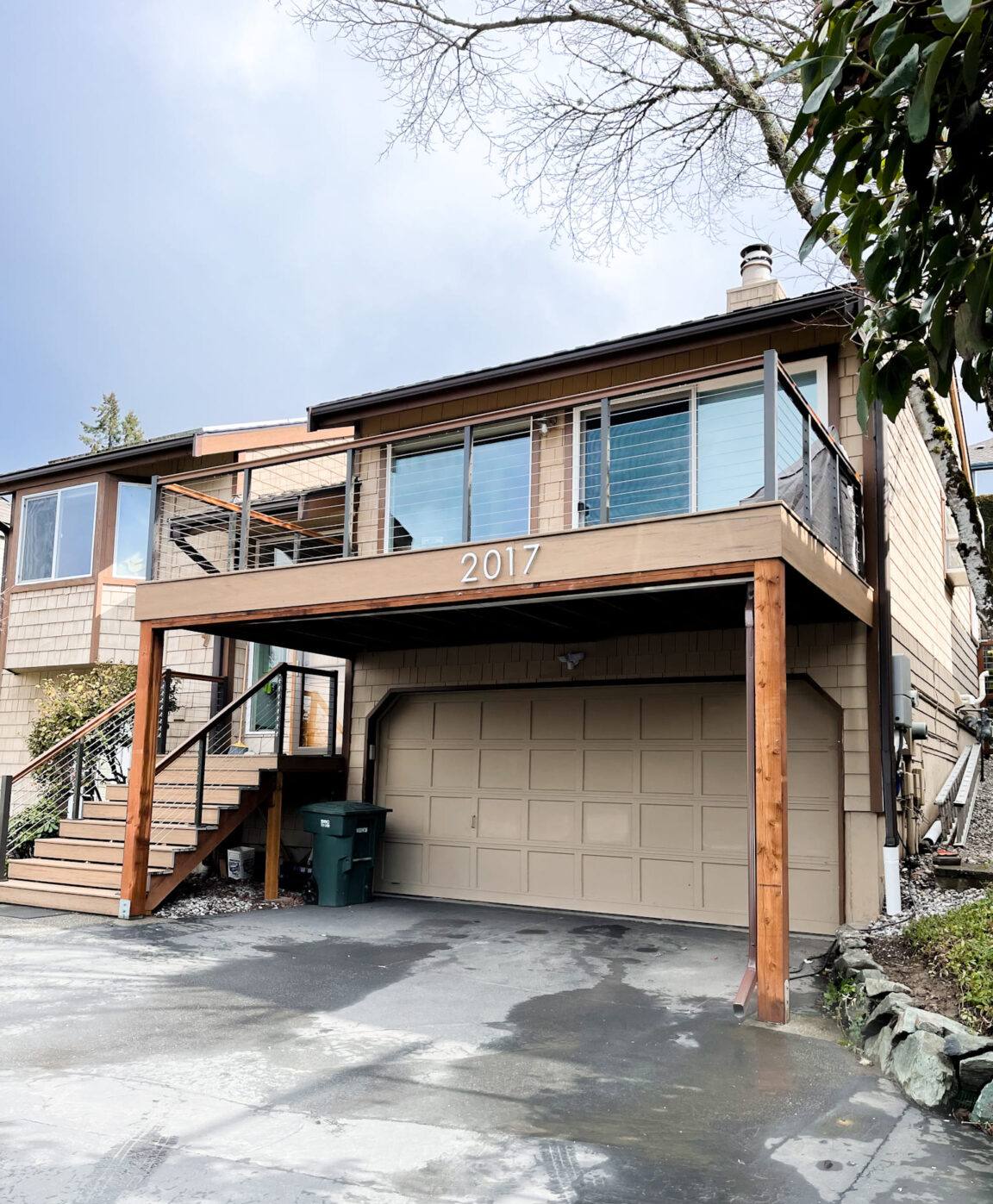
What Deck Repair Actually Means Once Wood Has Been Wet All Winter
Homeowners often call about a soft board or a wobbly railing, but "repair" on a deck that's been through several wet Whatcom County winters is rarely just one board. A proper repair means finding where moisture actually got in and fixing that, not just replacing whatever looks bad on the surface.
Common Failure Points We See on Everson-Area Decks
- Ledger board connection — where the deck attaches to the house is the single most common spot for hidden rot, because water tracks behind poorly flashed ledger boards for years before it shows on the surface.
- Joist ends and post bases — end grain soaks up water faster than the face of a board, so joist tails and the bottoms of support posts rot from the inside out.
- Fasteners and hardware — older or mismatched screws and nails corrode, weaken, and can even react with certain treated lumber, leaving connections that look fine but have lost most of their holding strength.
- Railings and stairs — these get the most direct rain exposure and the most physical stress, so loose posts and split balusters are usually the first visible sign that something bigger is going on underneath.
- Moss and algae buildup — beyond being slippery, moss holds moisture against the wood surface and accelerates decay in exactly the boards it's growing on.
Our Deck Repair Process
We approach every repair the same way, whether it's a single railing section or a full structural rebuild of the deck frame.
How a Repair Visit Works
- We inspect the whole deck, not just the spot you called about — probing ledger boards, joists, and post bases for soft wood, since rot rarely stays confined to where it's visible.
- We check the ledger flashing and the connection to the house, since that's where a repair can either solve the problem for good or just delay it.
- We give you a straight answer on what's structural versus cosmetic, and what can wait versus what shouldn't.
- We remove and replace only what's actually compromised, matching lumber dimensions and fastener types so the repair holds up the same way the rest of the deck does.
- We reseal or refinish repaired sections so they weather consistently with the surrounding wood instead of aging at a different rate.
We don't pad a repair with unnecessary work, and we don't patch over a rotted ledger board just to save a trip. If a repair isn't going to hold up through another Whatcom County winter, we'll tell you that before we start, not after.
Repair or Replace? How We Help You Decide
Not every deck problem needs a full rebuild, but some do — and the honest answer depends on how much of the structure is affected, not just its age.
| Factor | Usually Points to Repair | Usually Points to Replace |
|---|---|---|
| Ledger board condition | Solid wood, flashing intact or easily corrected | Soft or rotted along most of its length |
| Framing (joists/beams) | Isolated soft spots at a few joist ends | Widespread softness across the frame |
| Decking boards | Scattered boards cupped, splintered, or soft | Most of the surface is failing at once |
| Railings and stairs | Loose posts, split balusters, worn treads | Structure no longer meets a safe, stable standard |
| Age and past maintenance | Regularly sealed, moderate age | Never sealed, well past typical service life |
In a lot of cases the honest recommendation is a hybrid: rebuild the parts that are actually failing — often the ledger connection, a section of framing, or the stairs — while keeping the parts of the structure that are still sound. That keeps the cost proportional to the actual problem instead of the whole deck.
Materials We Use — and Why
What we repair with matters as much as the repair itself, especially in a climate that doesn't give lumber much time to dry out between rain events.
Framing and Structural Repairs
For anything structural — joists, beams, ledger boards, post bases — we use pressure-treated lumber rated for ground contact where it applies, along with corrosion-resistant, code-rated fasteners and connectors. Mixing old, corroded hardware with new lumber is a common shortcut that fails quietly, so we replace hardware as part of the repair rather than reusing what's already there.
Decking Surface
We'll work with whatever decking material your home already has, and we'll give you a straight opinion on whether wood or composite decking makes more sense if you're replacing a larger section. Wood decking costs less up front and can be spot-repaired board by board, but it needs regular sealing to hold up through repeated wet seasons. Composite decking costs more initially and doesn't need sealing, but individual boards can be harder to source and color-match years later, and it still depends entirely on a sound, dry frame underneath — composite decking on a rotted frame is just a nicer-looking version of the same problem. We'll walk through both honestly rather than pushing one option.
Flashing and Fasteners
Ledger flashing gets self-adhering waterproof flashing tape and properly lapped metal flashing, installed so water sheds away from the house rather than behind the board. It's a small material cost relative to the rest of a repair, but it's the difference between a repair that lasts and one that's back on our schedule in two years.
Signs Your Deck Needs Attention
Most deck problems give some warning before they become a safety issue. Worth checking for, especially heading into another wet season:
- Boards that feel spongy, bounce, or flex more than they used to underfoot
- A screwdriver or awl sinks easily into wood at the ledger board, post bases, or joist ends
- Railings or posts that wiggle, or balusters that are cracked or missing
- Visible gaps, rust streaks, or daylight where the deck meets the house
- Persistent moss or dark staining that comes back soon after cleaning
- Stair stringers that feel uneven or treads that have started to sag
- Fasteners that are rusted, popped up, or missing altogether
None of these mean the whole deck is a loss — but they're worth a look before another winter of Whatcom County rain gets into the structure.
Why a Crew That Already Works in Everson and Around Ferndale Matters
A deck repair holds up or fails based on details that are specific to this climate — how the ledger is flashed, what fastener spec actually resists this area's damp-dry cycle, how much shade and moss exposure a given lot gets. A crew that works Ferndale and the surrounding Whatcom County communities regularly, including Everson, has already seen how local decks fail and what actually fixes them for good, rather than learning that on your project.
There's also a practical side to it: being local means we can get out for an inspection without a long drive tacked onto the cost, and we're not disappearing to the next county once the work is done. If something needs a follow-up look after the first hard rain tests the repair, we're close enough to make that easy.
Keeping a Repaired Deck in Good Shape
A repair is only as good as the maintenance that follows it. Once the structural work is done, the main thing that protects it going forward is staying ahead of moisture and moss rather than reacting to them.
- Sweep debris and standing leaves off the deck surface regularly through fall, since trapped organic matter holds moisture against the wood
- Clean moss and algae off decking and stairs before it builds up, rather than after it's already staining the wood
- Reseal or refinish wood decking on a regular schedule rather than waiting until it's visibly gray and dry
- Check the ledger board and post bases once a year for early soft spots, since catching rot early is far cheaper than catching it late
- Make sure gutters and downspouts near the deck are directing water away from it, not onto it
If your deck in Everson or anywhere around Ferndale is showing soft boards, a wobbly railing, or just hasn't been looked at in a while, we're happy to come take a look. The estimate is free, there's no pressure to do more work than the deck actually needs, and you'll get a straight answer about what's worth repairing now versus what can wait.