 Ferndale Roofing
 Decking Built for Birch Bay's Coastal Conditions
Birch Bay sits right on the water, and that proximity to Puget Sound and the Strait of Georgia shapes everything about how a deck ages here. Salt-laden air, near-constant winter rain, and a moss season that can stretch from October through May put more stress on a deck than most inland Whatcom County properties ever see. A deck that's specified and built for a dry-climate showroom does not automatically hold up here. Composite decking, installed correctly, is one of the few surfaces that genuinely stands up to what Birch Bay throws at it year after year.
We work on decks across Ferndale and the surrounding coastal communities, and Birch Bay projects come with their own checklist. This page walks through what that checklist looks like, what a correct composite deck installation actually involves, and why local experience matters more here than almost anywhere else in the county.
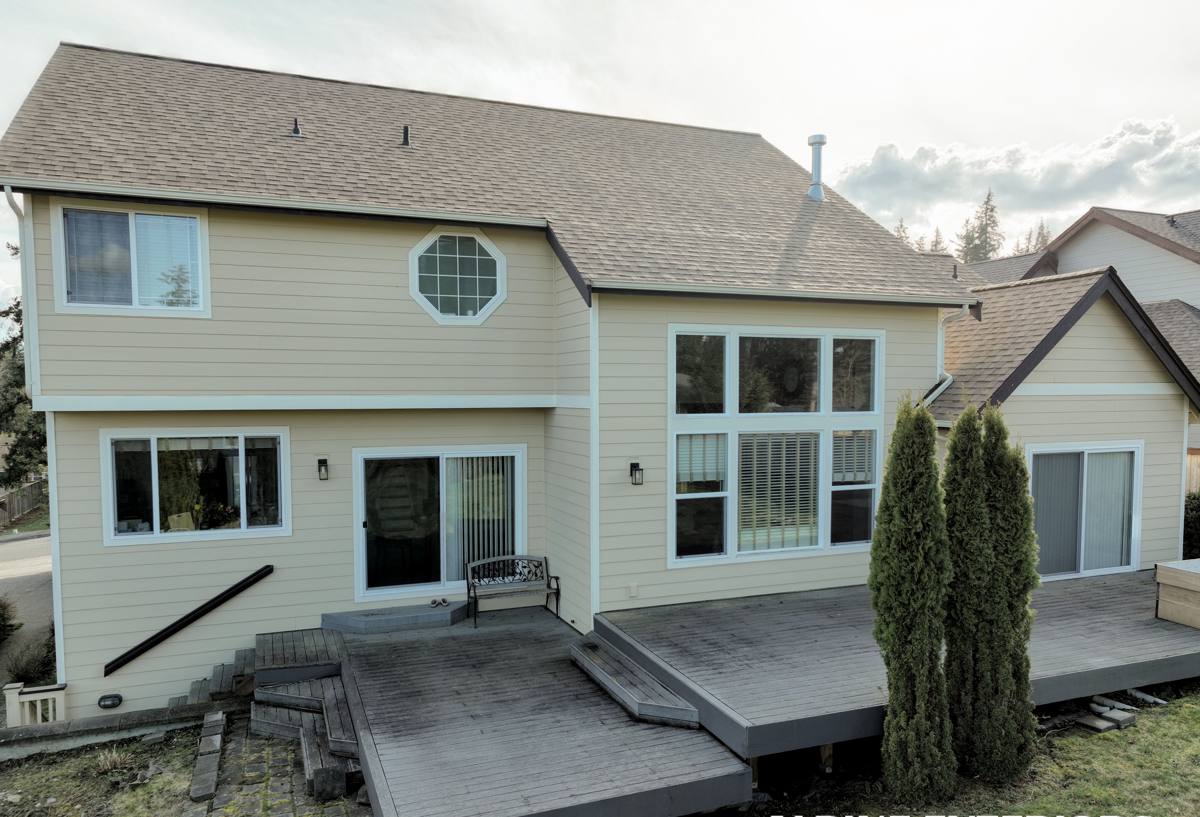
What Salt Air and Rain Actually Do to a Deck
It helps to understand the specific mechanisms at work, because they drive every decision we make on a Birch Bay deck build.
Salt Air
Airborne salt from the bay settles on every exposed surface, including deck boards, fasteners, and railing hardware. On wood decking, salt accelerates surface checking and graying. On metal fasteners and structural hardware, it speeds up corrosion, even on coated products, if the coating isn't rated for a marine-adjacent environment. Over time, corroding fasteners are one of the more common hidden failure points we find on older Birch Bay decks.
Driving Rain
Rain here doesn't just fall straight down — wind off the water pushes it sideways into railings, fascia boards, and any gap where water can find its way behind a board or into a ledger connection. Standing water and repeated wetting-and-drying cycles are what eventually cause wood to rot, fasteners to loosen, and lesser composite products to stain or swell at the cut ends.
Moss and Organic Growth
Whatcom County's long wet season gives moss, algae, and lichen a wide window to establish themselves on any surface that stays damp and shaded. On a deck, moss doesn't just look bad — it holds moisture against the board surface, and on a poorly ventilated deck it can contribute to slippery conditions and, on wood, accelerated decay underneath.
Why Composite Makes Sense for This Location
We recommend composite decking for most Birch Bay homeowners for straightforward, practical reasons, not because it's trendy.
- No annual sealing or staining. Wood decks in a salt-and-rain environment need re-sealing on a tight schedule to keep water out of the grain. Composite boards don't require that maintenance cycle.
- Consistent moisture resistance. Quality composite boards are engineered to resist water absorption at the core, which matters when a deck faces sideways-driving rain for months at a time.
- Better resistance to surface mold and moss staining. Modern capped composite boards have a shell that resists organic staining far better than bare wood, and they clean up with routine washing rather than sanding and refinishing.
- Dimensional stability. Composite boards handle the wet-dry cycling of a coastal climate with less warping, cupping, and splitting than most dimensional lumber over the long run.
Composite isn't maintenance-free — no outdoor decking product is — but the maintenance it does need is lighter and less time-sensitive, which matters for a property where the weather window for outdoor work is shorter than people expect.
What a Correct Installation Involves in Birch Bay
The board itself is only part of the equation. Most of the deck failures we get called out to inspect in coastal Whatcom County trace back to installation shortcuts, not the decking material. A correct job here includes:
Substructure and Framing
The joists, beams, and posts underneath the decking take the same coastal weathering as the surface, often with less airflow to dry out. We use fasteners and structural connectors rated for corrosion resistance appropriate to a marine-influenced environment, not standard interior-grade hardware, and we make sure the framing is pressure-treated lumber rated for ground contact where it's called for.
Ventilation and Drainage
A deck built low to the ground or against a wall without adequate airflow underneath will hold moisture longer after every rain event. We plan joist spacing, board gapping, and any skirting with drainage and airflow in mind, so water has somewhere to go instead of sitting against the framing.
Ledger Board Attachment
Where a deck attaches to the house, the ledger connection is the single most important waterproofing detail on the entire structure. Flashing has to be installed correctly, in the right sequence, with proper fasteners, to keep water from working its way behind the ledger and into the house's rim joist. This is the detail that causes the most expensive hidden damage when it's done wrong.
Fastening the Decking
Composite boards expand and contract with temperature more than most homeowners expect, and clip or fastener spacing has to account for that movement, especially with wide temperature swings between a cold, damp winter morning and a warmer afternoon. Manufacturer spacing specs exist for a reason, and skipping them shows up later as buckling or gaps.
Railings and Hardware
Railing posts see direct wind load off the water, so post attachment has to be solid, not just to code minimums but with corrosion-resistant hardware that will still be tight in five or ten years of salt exposure.
Comparing Decking Options for a Coastal Property
| Factor | Pressure-Treated Wood | Cedar | Composite |
|---|---|---|---|
| Salt air resistance | Moderate; fasteners corrode faster | Moderate; grays and checks quickly near the coast | High with marine-rated hardware |
| Moss/algae staining | Prone to staining, needs regular cleaning | Prone to staining, needs regular cleaning | Resists staining on capped boards, easy to wash |
| Maintenance cycle | Seal/stain every 1-2 years in this climate | Seal/stain every 1-2 years in this climate | Periodic washing, no sealing required |
| Upfront cost | Lowest | Mid-range | Higher upfront, lower lifetime cost |
| Typical lifespan here | Shorter without diligent upkeep | Shorter without diligent upkeep | Longer with correct installation |
Wood options can absolutely work if a homeowner is committed to the maintenance schedule. Most Birch Bay clients we talk to are looking for a deck that holds up without that ongoing commitment, which is where composite earns its higher upfront cost.
Our Process for Birch Bay Deck Projects
- On-site assessment. We look at sun and wind exposure, proximity to the water, existing framing condition if it's a rebuild, and drainage around the deck footprint.
- Product selection. We walk through composite board options and hardware grades suited to a salt-air environment, and give an honest read on trade-offs at different price points.
- Framing and structural work. Any repair or replacement of joists, beams, and footings happens before a single deck board goes down, with corrosion-resistant fasteners throughout.
- Flashing and ledger detailing. Where the deck ties into the house, we handle flashing and waterproofing as its own dedicated step, not an afterthought.
- Decking installation. Boards are laid with manufacturer-specified spacing and fastening for the expansion and contraction this climate produces.
- Railings and finish details. Railing systems are installed and torqued to hold up under wind load off the bay.
- Final walkthrough. We go over basic care — cleaning schedule, what to watch for — so the deck is easy to maintain from day one.
Signs an Existing Deck Needs Attention
- Soft or spongy spots underfoot, especially near the house connection
- Visible rust streaking from fasteners or hardware
- Persistent green or black staining that returns quickly after cleaning
- Gaps opening up between boards or boards that have started to cup or bow
- Railings that feel loose or flex under light pressure
- Standing water that doesn't drain within a few hours of rain stopping
Any of these are worth a professional look before they turn into a structural repair instead of a surface one. In a climate this wet, small issues don't stay small for long.
Why Local Experience Matters for This Job
Decking looks like a straightforward trade from the outside, but a crew that mostly works drier, inland jobs will make different assumptions than a crew that works Birch Bay and the Whatcom County coastline regularly. That shows up in the hardware grade they default to, how seriously they treat ledger flashing, how they space and vent the substructure, and whether they've actually seen what a few winters of salt air and driving rain do to a shortcut. We've built and repaired decks across Ferndale and the surrounding coastal areas, and Birch Bay's conditions are part of our regular planning, not a special case we have to research on the fly.
Hiring locally also means someone who can respond quickly if a warranty issue or unexpected weather event affects your deck, rather than a crew that has to travel in from outside the area.
Get a Free Estimate
If you're planning a new composite deck or replacing an aging one in Birch Bay, we're happy to take a look and give you a straightforward, no-pressure estimate. Use the form below to get started.