 Ferndale Roofing
 Why Siding Takes a Beating in Blaine
Blaine sits right on the water at the northern edge of Whatcom County, and that location comes with a specific set of exterior problems. Homes here deal with salt-laden air blowing in off Semiahmoo Bay and the Strait of Georgia, near-constant winter rain driven sideways by wind, and a moss season that can stretch from October well into May. Any one of these would be manageable on its own. Together, they create conditions that punish cheap siding, poor installation, and deferred maintenance faster than almost anywhere else in the county.
Salt air is corrosive to exposed metal fasteners and trim, and it accelerates the breakdown of finishes that aren't rated for coastal exposure. Driving rain doesn't just wet the surface of your siding — wind pressure pushes water sideways and upward, finding any gap in flashing, caulking, or lap joints. And moss doesn't just grow on roofs. Given damp, shaded wall sections (north-facing walls, areas under eaves, spots shielded from direct sun) moss and algae take hold on siding too, holding moisture against the wall surface for months at a time.
What Blaine Homes Actually Need From Their Siding
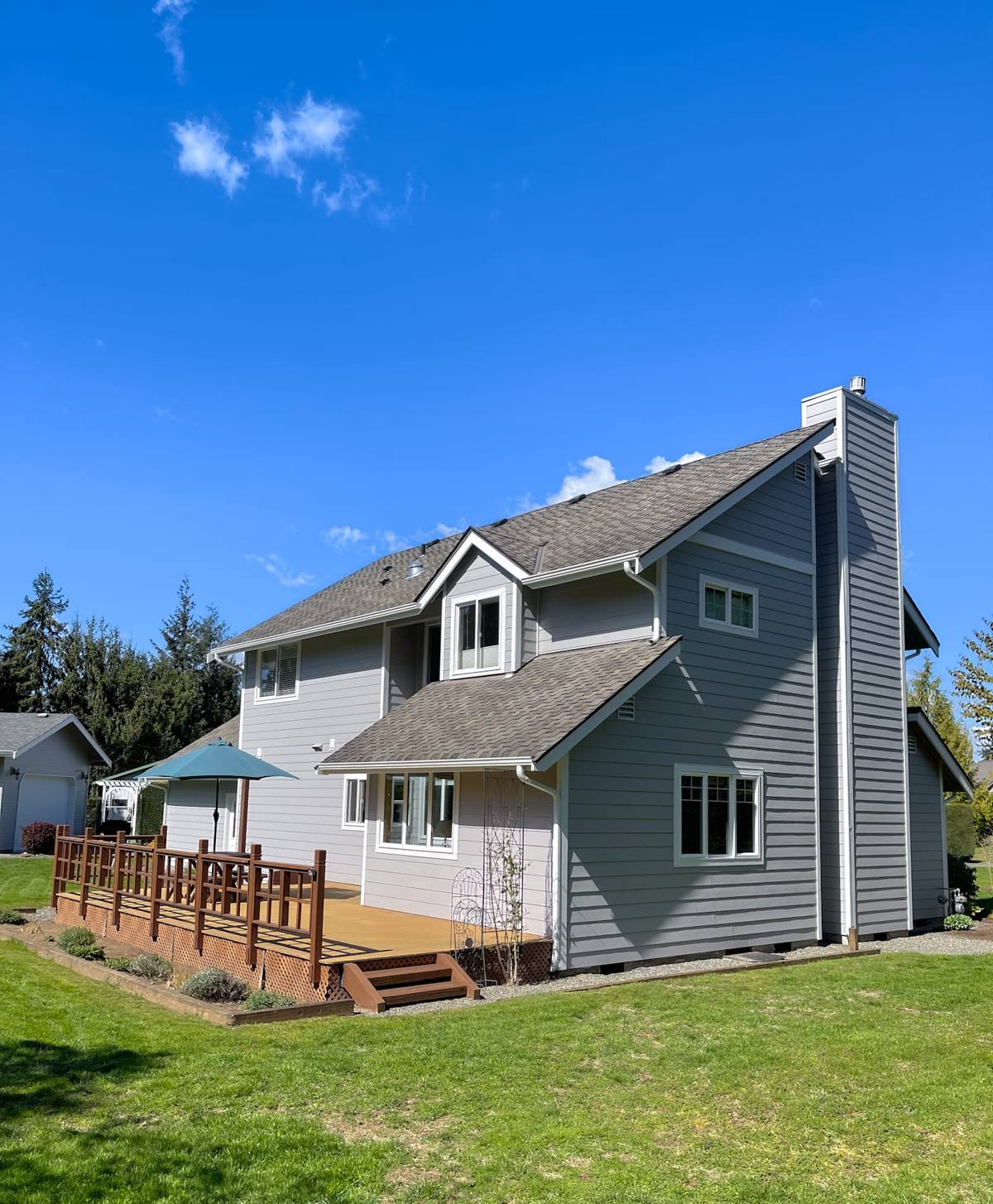
Given that combination of exposure, siding in Blaine needs to do three things well: shed water aggressively, resist moisture absorption at the material level, and hold its finish without needing constant upkeep. A product that looks fine in a showroom but swells, delaminates, or fades within a few coastal winters isn't a good fit for this address, no matter how it performs in a drier inland town.
This is also a wind-exposed area. Waterfront and near-waterfront properties in Blaine see stronger sustained gusts than homes further inland in Ferndale or Lynden, which puts more stress on fastening patterns, panel overlaps, and trim attachment. Siding that's installed to a minimum-code standard rather than a coastal-appropriate standard tends to show it first at the seams — cracked caulk lines, lifted trim, and water staining at butt joints within the first few years.
Common Failure Points We See on Blaine Homes
- Caulk-dependent seams that were never properly flashed, failing once the caulk shrinks and cracks
- Fastener corrosion staining showing through paint on older installations
- Moss and algae buildup on shaded, north-facing wall sections
- Swollen or delaminating panel edges where water has been wicking in for years
- Trim and butt joints that were never back-primed or sealed on the cut ends
Why We Install Only James Hardie Fiber Cement
We made a deliberate decision to install James Hardie fiber cement siding exclusively, and not offer vinyl, LP SmartSide, or other fiber cement brands. That's not a marketing position — it's a practical one, built around what actually holds up in Whatcom County's coastal microclimates like Blaine.
Fiber cement is non-combustible, which matters for insurance and building code considerations, and it does not absorb and swell the way engineered wood products can when repeatedly saturated. James Hardie's HZ5 product line in particular is engineered for climates with prolonged moisture exposure — freeze-thaw cycling, high humidity, and sustained rain — which describes Blaine's winters accurately. The ColorPlus factory finish is baked on under controlled conditions rather than field-applied, which gives it far better adhesion and UV/salt resistance than a job-site paint job, and it comes with its own finish warranty separate from the product warranty.
Vinyl siding can work loose or warp under strong, sustained coastal wind and doesn't offer the same fire rating. Engineered wood products like LP SmartSide perform well in many parts of the country, but they rely on their outer resin-treated skin to keep moisture out — and any cut edge, fastener puncture, or installation gap that isn't properly sealed becomes a point where moisture can get into the wood substrate underneath. In a climate like Blaine's, where the wall assembly rarely gets a long stretch of time to fully dry out, we don't think that's a good trade-off for our customers. Fiber cement's water resistance is a property of the material itself, not just its surface treatment, which is why it's what we put on Blaine homes.
What Correct Installation Actually Involves
Material choice only gets you halfway there. Most siding failures we see on older Blaine homes trace back to installation shortcuts, not the product itself. A correct James Hardie installation involves several steps that are easy to skip and hard to notice until years later:
- Drainage plane and weather-resistive barrier installed correctly behind the siding, with proper overlap and integration at penetrations
- Rainscreen gap or furring where conditions call for it, to let incidental moisture drain and the wall assembly breathe
- Flashing at every horizontal transition — windows, doors, deck ledgers, roof-to-wall intersections — not caulk used as a substitute for flashing
- Correct fastener type, spacing, and penetration depth per Hardie's installation specifications, with corrosion-resistant fasteners appropriate for coastal exposure
- Proper clearances from grade, roofing, and decks so siding isn't sitting in a moisture trap
- Back-primed or factory-sealed cut ends at every field cut, especially around trim and joints
Skipping any one of these doesn't necessarily show up on install day. It shows up two, five, or ten winters later, as a stain, a soft spot, or a seam that's opened up — usually after the damage has already reached the sheathing behind it.
Our Process for Blaine Siding Projects
1. On-Site Assessment
We walk the exterior with you, looking at current siding condition, moisture staining, moss and algae patterns, trim condition, and any problem areas specific to your home's orientation and wind exposure.
2. Scope and Product Plan
We identify the right James Hardie panel or lap profile and HZ line for your home, plan trim details, and flag any sheathing or moisture damage we expect to find once the old siding comes off.
3. Tear-Off and Sheathing Check
Old siding comes off and we inspect the sheathing and framing underneath before anything new goes up. Any rot or moisture damage gets addressed before we move forward — not covered over.
4. Weather Barrier and Drainage Installation
This is the step that determines whether the siding lasts. We install the weather-resistive barrier, flashing, and drainage detailing to spec, with particular attention to wind-driven rain given Blaine's exposure.
5. Siding and Trim Installation
Panels or lap siding go up per James Hardie's fastening specifications, with all cut ends sealed and joints properly detailed rather than caulk-dependent.
6. Final Walkthrough
We review the finished work with you, including care and maintenance notes specific to a coastal property.
Cost Factors for Blaine Siding Projects
| Factor | Why It Matters in Blaine |
|---|---|
| Home size and wall complexity | More corners, dormers, and trim details mean more flashing and cut work |
| Current siding condition | Hidden sheathing or moisture damage found at tear-off can add repair scope |
| Wind and coastal exposure | Waterfront and open-exposure lots may call for upgraded fastening and drainage detailing |
| Panel vs. lap profile | Different James Hardie profiles have different material and labor costs |
| Trim and accessory scope | Window, door, and corner trim work adds labor beyond flat wall coverage |
| Access and site conditions | Waterfront lots, slopes, and limited access can affect staging and labor time |
Why Local Experience in Blaine Matters
A crew that already works in Blaine understands the difference between a standard installation and one that needs to be adjusted for a wind-exposed or waterfront lot. We know what moisture patterns to expect on north-facing and shaded walls in this area, what wind exposure does to fastener and trim choices near the water, and how the region's long wet season affects sequencing and drying time during a project. That's the kind of judgment that doesn't come from a spec sheet — it comes from having done this work up and down this stretch of coast.
Working with a crew based in Whatcom County also means straightforward scheduling and follow-up. If a question comes up after the job is done, you're not waiting on a company with no presence in the area.
Questions Worth Asking Any Siding Contractor in Blaine
- Do you install a proper drainage plane and rainscreen detail, or just siding over house wrap?
- What fastener type and spacing do you use, and is it rated for coastal exposure?
- How do you flash windows, doors, and horizontal transitions — not just caulk them?
- What happens if you find sheathing damage once the old siding comes off?
- What warranty applies to the product, and what applies to your installation labor?
If your Blaine home's siding is showing staining, moss buildup, soft spots, or open seams, it's worth having it looked at before another wet season passes. We offer free, no-pressure estimates — use the form below to get a straightforward assessment of your home's siding and what it would take to do the job right.