 Ferndale Roofing
 Birch Bay Decks Face a Different Set of Problems
Birch Bay sits right on the water, and that changes what a deck goes through year to year compared to a deck a few miles inland. The salt air here works on fasteners, flashing, and connectors in ways that plain rain doesn't. Add Whatcom County's long wet season, near-constant humidity for months at a time, and heavy shade from surrounding trees on many lots, and you get decks that grow moss faster, hold moisture longer, and corrode from the inside out before the surface boards even look bad.
We're a Ferndale-based crew, and Birch Bay is part of our regular service area — not a once-in-a-while trip. That matters for deck repair specifically, because so much of getting it right depends on recognizing patterns you only see by working the same coastline over and over: which ledger connections fail first, which fastener types hold up and which don't, and which parts of a deck the salt air reaches even when the wood looks fine.
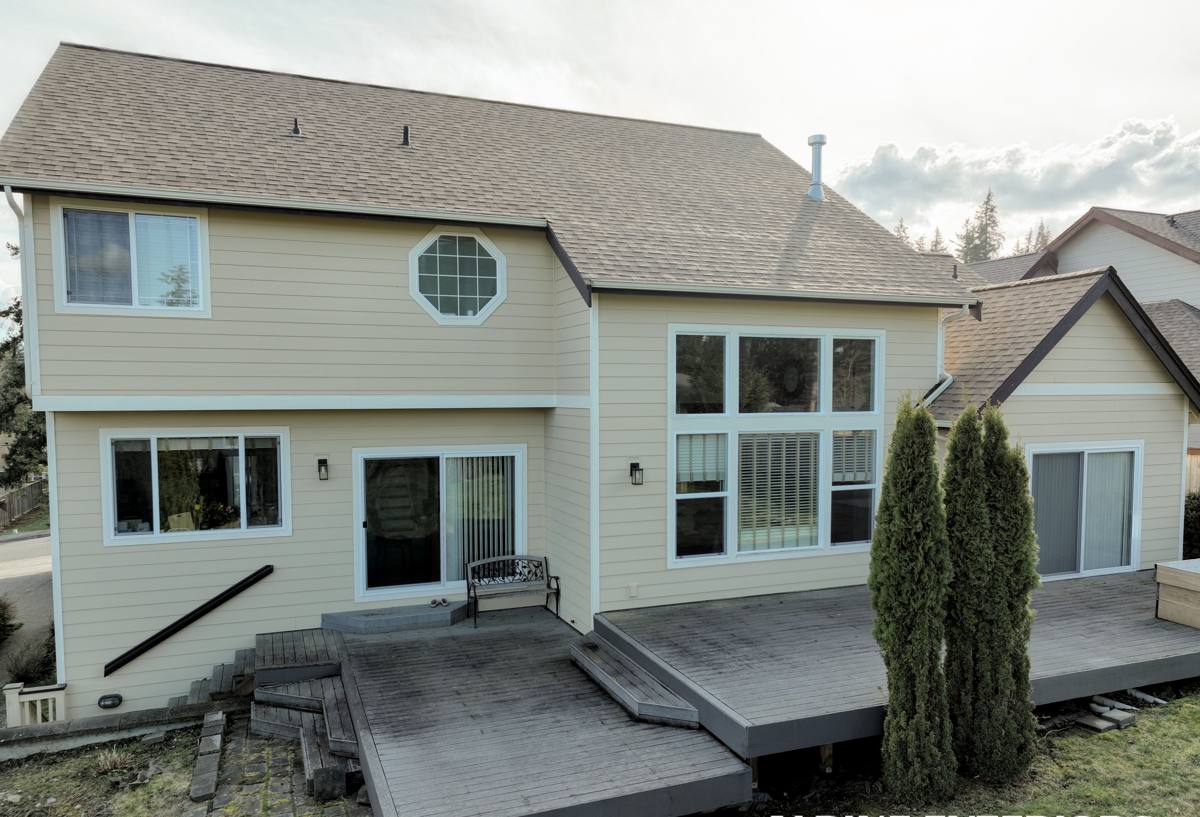
How Salt Air and Moisture Actually Damage a Deck
Two separate processes are usually at work on a Birch Bay deck, and they don't always show up at the same time or in the same place.
Moisture and Moss
Standing water and shade let moss and algae take hold on decking, especially on the north side of a house or under overhangs. Moss holds moisture against the wood surface long after the rain stops, which softens fibers, accelerates rot, and makes boards slick and unsafe underfoot. Once moss gets a foothold, it tends to come back season after season unless the underlying moisture problem — drainage, airflow, or shade — gets addressed along with the surface cleaning.
Salt Air Corrosion
Salt in the air settles on metal hardware — nails, screws, joist hangers, post bases, and flashing — and speeds up corrosion well beyond what you'd see a few miles from the water. Corroded fasteners lose holding strength gradually and quietly. A deck can look structurally sound while the connectors doing the real work underneath are already compromised. This is the single biggest reason we don't treat Birch Bay deck repair the same way we'd treat a repair job in a drier, inland part of Whatcom County.
Signs a Birch Bay Deck Needs Repair
Some of these are obvious from a walk around the yard. Others take a closer look, which is part of why we recommend a hands-on inspection rather than guessing from the driveway.
- Soft, spongy, or bouncy spots in the decking or framing underneath
- Persistent moss or green staining that comes back within weeks of cleaning
- Rust streaking below screw heads, joist hangers, or post brackets
- Gaps opening up where the deck ledger meets the house
- Railings or stair stringers that flex or feel loose when you lean on them
- Boards that stay damp long after the rest of the yard has dried out
- Visible daylight or gapping between decking boards that's grown wider over time
Any one of these can be a minor fix. Several at once, especially involving the framing or ledger, usually means the deck needs a broader repair plan rather than a patch.
Repair or Replace? How We Make the Call
Not every deck problem calls for a full rebuild, and not every deck problem is safely solved with a surface fix. The honest answer depends on where the damage is and how far it's spread.
| Condition | Usually Repairable | Usually Needs Replacement |
|---|---|---|
| Decking boards | Isolated soft or cracked boards, surface moss/algae | Widespread rot across most of the deck surface |
| Ledger board | Minor flashing gaps caught early | Rot at the house connection or sustained water intrusion behind siding |
| Framing/joists | A few compromised joists, isolated corrosion | Rot or corrosion spread through most of the substructure |
| Posts & footings | Surface checking, minor movement | Undersized footings, heaving, or rotted post bases |
| Railings/stairs | Loose balusters, worn treads | Structurally failing stringers or non-compliant railing height/spacing |
We walk this through with the homeowner directly rather than defaulting to "replace it all" — a targeted repair is often the right call, and we'll say so plainly when it is.
What a Correct Deck Repair Involves
A repair that only replaces the boards you can see, without checking what's underneath, tends to fail again within a season or two on a Birch Bay lot. We work from the structure outward.
1. Structural Check First
Before touching decking boards, we check the ledger connection, joists, beams, posts, and footings. This is where salt-air corrosion does its quiet damage, and it's the part of the deck that actually keeps people safe.
2. Fastener and Hardware Assessment
Corroded nails, screws, and connectors get replaced with hardware rated for coastal or wet-service exposure — not just whatever matches what's already there. Reusing corroded fasteners in a repair is a shortcut that shows up as a callback later.
3. Flashing and Water Management
Where the deck meets the house is the most common source of hidden rot. We check and correct ledger flashing so water sheds away from the house rather than tracking behind the siding or pooling against the ledger board.
4. Decking and Railing Repair
Once the structure and connections are sound, we address the visible surface — replacing damaged boards, resetting loose railings, and correcting any gaps or movement in stairs.
5. Moisture and Moss Follow-Up
Where drainage or shade is driving repeat moss growth, we'll flag it and talk through practical options — this might mean adjusting gaps between boards, addressing standing water nearby, or simply setting expectations on a cleaning schedule that fits the site.
Materials That Hold Up in a Coastal Environment
Not every fastener or connector performs the same way a few hundred feet from saltwater. Our standard for Birch Bay repair work reflects that.
| Component | What We Use and Why |
|---|---|
| Fasteners | Coated or stainless-rated screws and nails suited for wet, salt-exposed conditions rather than standard interior-grade hardware |
| Joist hangers & connectors | Corrosion-resistant coated connectors matched to the wood treatment used, since mismatched metals accelerate corrosion |
| Flashing | Durable flashing at the ledger connection, installed to shed water away from the house rather than trap it |
| Decking | Matched to the existing deck where possible, or discussed as an upgrade opportunity if the homeowner wants lower maintenance going forward |
We're upfront when a material trade-off exists. Some lower-maintenance decking options cost more up front and have their own installation sensitivities; some traditional wood options cost less but need more regular upkeep in a salt-air environment. Neither is a bad choice — it's about matching the material to how the homeowner actually wants to maintain the deck long-term.
Our Deck Repair Process
- On-site inspection — we walk the deck top to bottom, checking framing, connections, and hardware, not just the surface boards
- Straight assessment — we tell you what's actually failing, what's still sound, and whether repair or replacement makes sense
- Written estimate — clear scope and pricing before any work starts, no surprise add-ons mid-job
- Repair work — structure and connections addressed first, then decking, railings, and stairs
- Cleanup and walkthrough — we review the finished repair with you and point out anything worth watching going forward
Maintenance That Actually Helps in Birch Bay
A repair holds up longer with a bit of regular upkeep suited to a salt-air, moss-prone climate. This isn't about aggressive maintenance — just the basics done consistently.
- Sweep off debris and standing leaves regularly, especially in shaded areas
- Rinse salt residue off decking and hardware periodically, particularly after storms with wind off the water
- Address moss or algae early rather than letting it establish for another season
- Check railings and stair connections for looseness once or twice a year
- Keep gutters and downspouts near the deck clear so runoff isn't draining onto or under it
- Have the ledger flashing and connection checked periodically, since it's hidden and easy to overlook
Why It Matters That We Already Work Birch Bay
Deck repair advice that works for a dry, inland property doesn't always hold up on the water. A crew that mostly works elsewhere in Whatcom County may not think to check for salt-air corrosion on hardware that looks fine, or may default to fastener and connector choices that aren't suited to this exposure. Working Birch Bay regularly means we're not guessing at what the local conditions do to a deck over five or ten years — we've seen it directly, repair after repair, and we build that into how we assess and fix the deck in front of us.
It also means faster, more accurate estimates. We're not learning the area's quirks on your project; we already account for them.
Get an Honest Look at Your Deck
If your Birch Bay deck has soft spots, recurring moss, rusted hardware, or just feels less solid than it used to, it's worth a direct look before small problems turn into a full rebuild. We offer free, no-pressure estimates — we'll tell you plainly what needs attention, what can wait, and what your realistic options are. Use the form below to get started.