 Ferndale Roofing
 Deck Replacement Built for How Sudden Valley Actually Weathers
A deck in Sudden Valley doesn't fail the same way a deck in a dry climate fails. Out here, the problem almost never starts with the boards themselves — it starts underneath, where moisture sits against framing, fasteners, and footings for months at a stretch. Whatcom County's long wet season, the marine-influenced air moving in off the Salish Sea, and the shade thrown by mature trees around this part of the county all combine to keep a deck damp far more often than it's dry. That's the environment we build and replace decks for, and it changes almost every decision in the job — from footing depth to fastener grade to which decking material we'll actually stand behind.
This page is specifically about deck replacement — not new deck construction from scratch, and not a repair. If your existing deck is old enough, damaged enough, or built to a standard that doesn't hold up anymore, replacement is usually the more honest recommendation than patching it again.
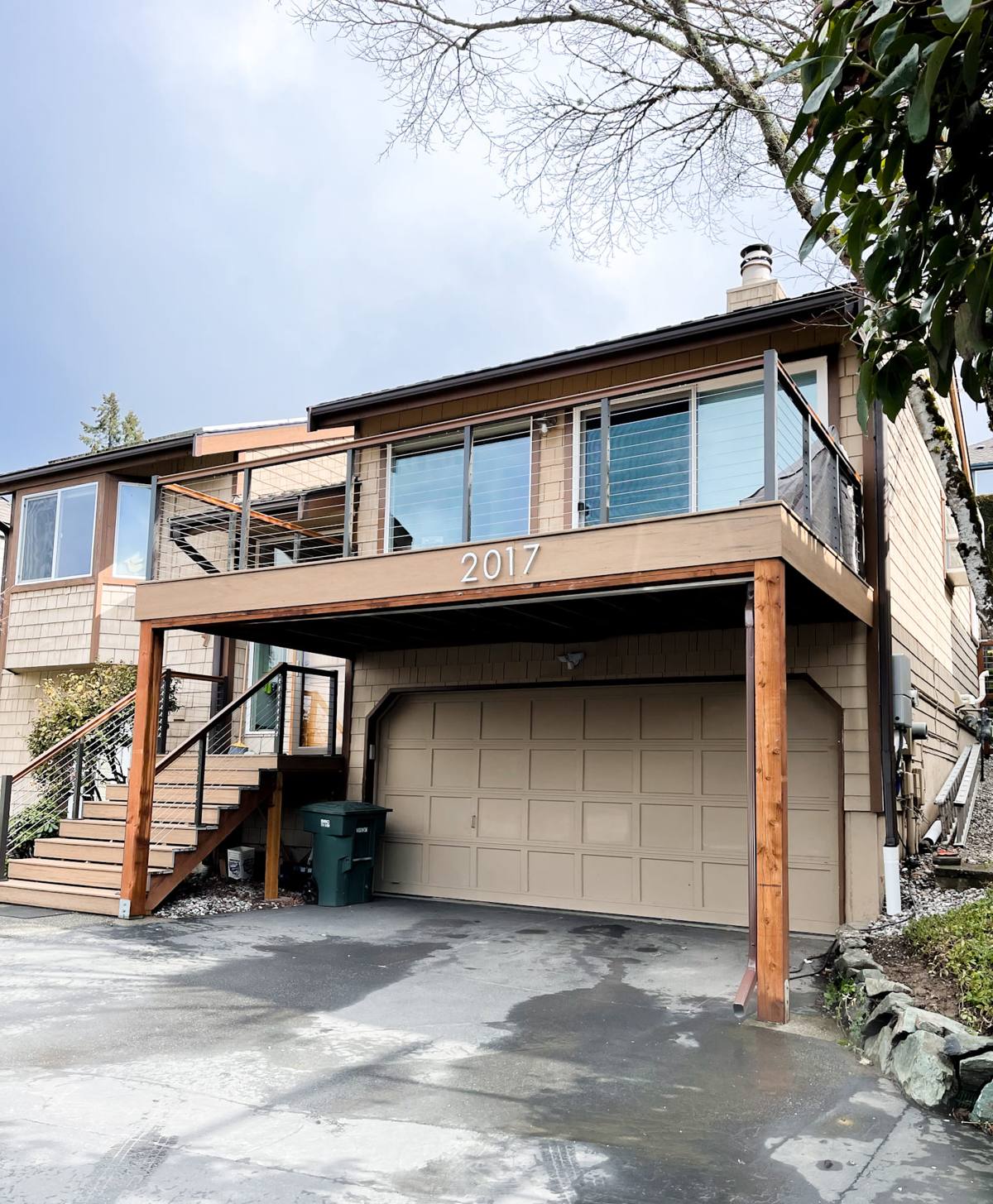
What Local Climate Does to a Deck Over Time
Ferndale Roofing Co works decks and exteriors across Whatcom County, and the pattern in older decks is consistent no matter the neighborhood: moisture gets in somewhere, and everything downstream of that entry point degrades faster than homeowners expect.
Moss and Constant Dampness
A long moss season isn't just a cosmetic issue. Moss and algae hold water against the deck surface and in the gaps between boards, which slows drying time after every rain event. On shaded decks — common where mature trees sit close to the house — that surface can stay damp for days after the rain stops, which is exactly the condition that rots untreated wood and corrodes low-grade fasteners.
Driving Rain and Water Intrusion
Wind-driven rain doesn't just fall straight down — it gets pushed sideways into ledger board connections, under flashing, and into any gap where the original builder didn't seal things correctly. A ledger board that isn't properly flashed against the house is one of the most common hidden failure points we find on older decks in this area, and it's usually invisible until the wood underneath is already soft.
Marine Air and Metal Fatigue
The salt-tinged air common across this part of Washington accelerates corrosion in fasteners, joist hangers, and structural hardware that aren't rated for it. A deck built with standard interior-grade screws or under-spec'd hangers will show rust and metal fatigue years before a comparable deck built with the right corrosion-resistant hardware.
Signs a Sudden Valley Deck Needs Replacement, Not Repair
Not every aging deck needs a full teardown. But there are signs that tell us repair would just be delaying the inevitable — and often at a cost that doesn't make sense compared to doing it right once.
- Soft, spongy, or spreading boards near the ledger board or stair stringers
- Visible rust streaking from fasteners or hardware onto the decking surface
- Railings that flex or wiggle more than a firm push should allow
- Persistent moss or algae growth that returns within weeks of cleaning
- Gaps or separation where the deck meets the house (ledger pulling away)
- Footings that show cracking, heaving, or visible movement
- A deck older than 15–20 years that was never rebuilt or re-flashed
- Multiple past repairs to the same section of decking or framing
If you're seeing two or more of these at once, the framing underneath is usually further along than the surface suggests. That's the point where a proper replacement — done once, done right — costs less over the life of the deck than another round of patchwork repair.
What a Correct Deck Replacement Actually Involves
A deck replacement isn't just pulling up old boards and screwing down new ones. Done correctly, it touches every layer of the structure:
Demolition and Structural Inspection
We remove the old decking, railings, and — where needed — the framing, and inspect what's underneath before quoting the rebuild. This is where hidden rot, undersized footings, or a poorly attached ledger board usually surface. It's also the point where an honest contractor tells you what's actually wrong, rather than just covering it back up.
Footings and Framing
Footings need to be sized and set to current code depth for this region's frost line and soil conditions, not just matched to whatever was there before. Framing gets rebuilt with lumber rated for ground contact or exterior exposure where required, spaced to support the decking material you're choosing — composite and wood have different span requirements.
Ledger Board and Flashing
This is the single most important connection on the whole deck, and the one most often done wrong on older builds. A correctly flashed ledger keeps water from ever reaching the rim joist or the house's wall framing. We treat this step as non-negotiable regardless of decking material chosen.
Fasteners and Hardware
Given the marine air and long wet season here, we use corrosion-resistant, code-rated hardware — hot-dip galvanized or stainless-rated hangers and fasteners, not standard interior-grade hardware that will show rust within a few seasons.
Decking, Railings, and Final Grade
The visible layer goes on last — decking boards, railing systems, stair treads — installed with proper gapping for drainage and expansion, and graded/sloped correctly so water sheds away from the house instead of pooling against it.
Decking Material Options for This Climate
There's no single "best" decking material for every home — it depends on budget, maintenance tolerance, and how much shade and moisture the deck sits in. Here's how the common options actually perform in a Whatcom County setting like Sudden Valley:
| Material | Moisture Performance | Maintenance | Our Take |
|---|---|---|---|
| Pressure-treated wood | Good if sealed regularly; prone to moss in shade | Annual cleaning and re-sealing recommended | Lowest upfront cost, but needs real upkeep to last in this climate |
| Cedar | Naturally rot-resistant but softer surface | Periodic staining/sealing to hold color and protection | Good look for the region; still needs a maintenance routine |
| Composite decking | Excellent — doesn't absorb water or rot | Occasional washing; no sealing/staining | Higher upfront cost, lowest long-term maintenance in wet, shaded yards |
| PVC decking | Excellent — fully synthetic, no organic material to rot | Low; simple cleaning | Strong option where moss and moisture are constant issues |
We won't push a single product line as the only right answer. We'll walk you through what each option actually costs to own over 10–15 years in this climate, not just what it costs to install.
Cost Factors Homeowners Should Actually Weigh
Every deck replacement quote depends on size, framing condition, and material, but these are the variables that move the number most in Sudden Valley homes specifically:
| Factor | Why It Matters Here |
|---|---|
| Deck height and footing access | Sloped or tree-covered lots common in the area can add labor for footing excavation and material staging |
| Extent of hidden rot found at demo | Wet climate means framing damage is often worse than surface boards suggest |
| Decking material chosen | Wood vs. composite/PVC changes both material cost and long-term maintenance cost |
| Railing system and code compliance | Older railings often don't meet current height/spacing code and need full replacement |
| Ledger and flashing condition | A poorly flashed original ledger may require rim joist repair, not just re-flashing |
Our Process, Start to Finish
- Free on-site assessment — we inspect the existing deck, framing, and ledger connection in person, not from a photo.
- Honest scope and quote — you get a clear breakdown of what needs replacing structurally versus cosmetically, and material options with real trade-offs.
- Permitting — where required by the local jurisdiction, we handle the permit and inspection process so the work is documented and code-compliant.
- Demolition — old decking, railings, and compromised framing come out, with the site protected and cleared as we go.
- Rebuild — footings, framing, ledger flashing, decking, and railings installed to code, in that order, with no shortcuts on the parts you won't see once it's finished.
- Final walkthrough — we go over the finished deck with you before we consider the job done.
Permits and Local Code Considerations
Deck replacements that involve structural changes — new footings, a rebuilt ledger connection, or a change in size or height — typically require a permit and inspection through the local building department. This isn't paperwork for its own sake: it's the mechanism that confirms footing depth, railing height, and structural connections meet current code, which matters more in a wet climate where under-built decks fail faster. We handle this process as part of the job rather than leaving it for the homeowner to sort out separately.
Why a Crew That Already Works Sudden Valley Matters
Deck replacement isn't a one-size-fits-all trade — the right approach in a dry inland climate is often the wrong approach here. A crew that already works this part of Whatcom County knows to flash ledgers more conservatively, spec corrosion-resistant hardware as standard rather than upsell, and account for shaded, moss-prone conditions when recommending materials. That local pattern recognition is the difference between a deck that needs attention again in five years and one that holds up through fifteen or twenty wet seasons.
We're a Ferndale-based crew, and Sudden Valley is part of the territory we know — not a one-off job we're driving in for. That matters when questions come up later, whether that's a warranty question, a follow-up maintenance question, or just wanting someone local to call.
If your deck is showing its age or you're just not sure whether it needs repair or full replacement, we'll come take a look and give you an honest answer — no pressure, no upsell, just a straight assessment and a free estimate.