 Ferndale Roofing
 Why Sandy Point Siding Wears Differently Than Siding Inland
Sandy Point sits close to the water, and that changes what siding has to survive. Homes just a few miles inland in Ferndale deal with plenty of Whatcom County rain, but Sandy Point adds salt-laden air off the water, near-constant wind exposure, and a moss season that runs longer than it does on more sheltered lots. Siding here isn't just shedding water — it's fighting corrosion, trapped moisture, and organic growth at the same time, often on homes that see wind-driven rain hit the walls at an angle instead of falling straight down.
That combination is harder on exterior materials than most homeowners expect. Salt air accelerates the breakdown of fasteners, caulk, and paint film. Driving rain finds its way into laps, seams, and trim joints that would stay dry on a calmer site. And moss doesn't just sit on the surface — given enough time, it holds moisture against the wall and works into any gap it can find. None of this means Sandy Point homes need exotic materials. It means the material and the installation both need to be matched to the conditions, not just picked because they're common or inexpensive.
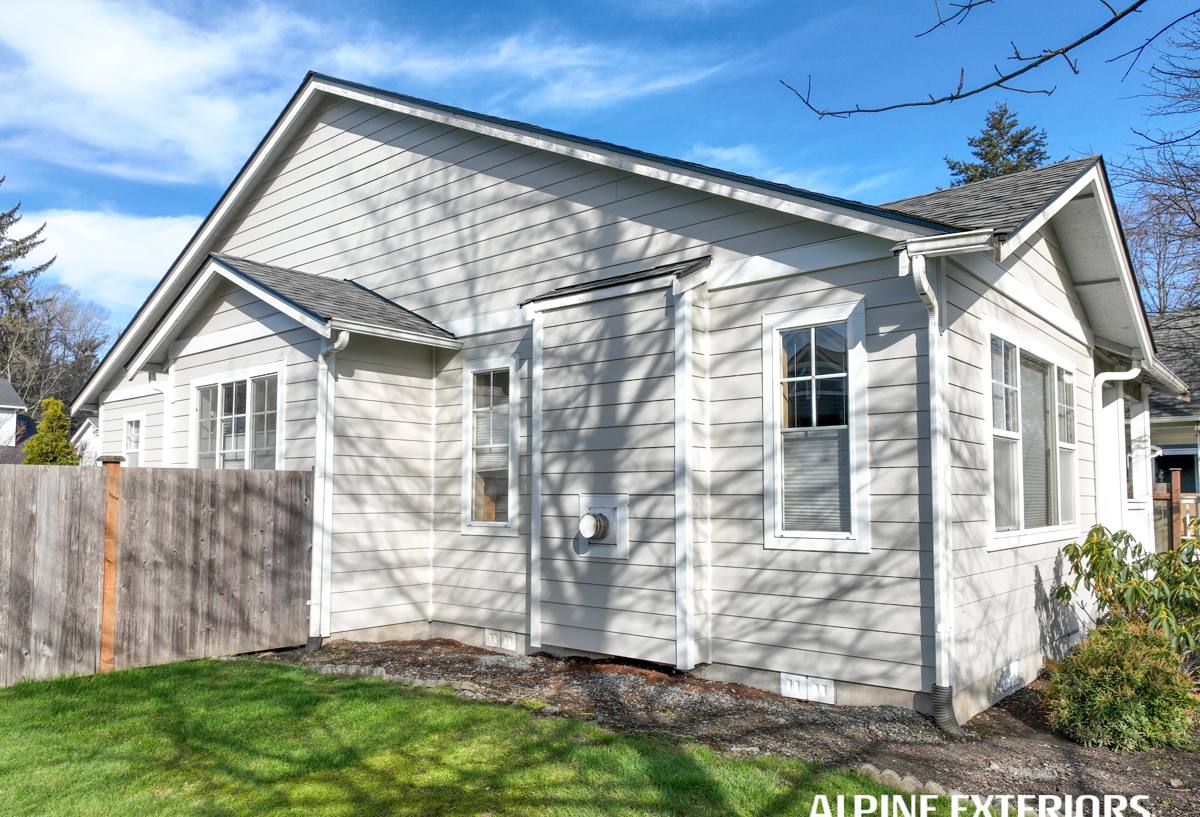
How Salt Air and Moisture Affect Different Siding Materials
Not every siding material responds to a marine-influenced climate the same way. This matters more in Sandy Point than it would a few miles inland.
| Material | How it holds up near salt air and moisture |
|---|---|
| Vinyl | Can warp or become brittle with temperature swings and UV exposure; seams and J-channels are a common path for wind-driven rain to get behind the panel |
| Untreated or primed wood | Absorbs moisture readily, is a food source for the moss and mildew common in this climate, and needs frequent repainting to stay protected |
| Engineered wood (e.g. LP SmartSide) | More moisture-resistant than raw wood but still wood-based, meaning edges and cut ends need diligent sealing to prevent swelling over time |
| James Hardie fiber cement | Not wood-based, so it doesn't swell, rot, or feed moss the way organic materials can; factory-applied finish is engineered to resist fading and moisture intrusion |
This isn't a knock on every product on that list — each has legitimate uses. It's why, on a site like Sandy Point where salt air and driving rain are a daily reality rather than an occasional event, we've standardized on James Hardie fiber cement and don't install the alternatives.
Why We Don't Install Vinyl or Wood-Based Siding Here
Vinyl siding is inexpensive and easy to install, and it does an adequate job in a lot of climates. Near the water, its weak points are the seams and channels where panels overlap — exactly where wind-driven rain wants to go. Wood and wood-based products bring warmth and a traditional look, but they ask for ongoing maintenance (repainting, caulking, and moss treatment) that most homeowners underestimate when they're comparing upfront costs. We'd rather put a material on your home that's built for this exposure from the start than sell you something that needs constant upkeep to keep pace with it.
What a Correct Siding Replacement Actually Involves
Replacing siding is not simply pulling off old panels and nailing up new ones. On a Sandy Point home, what's underneath the old siding matters as much as what goes back on top.
Inspecting What's Underneath
Once the old siding comes off, we check the sheathing for soft spots, staining, or rot — signs that moisture has been getting behind the old material. Any damaged sheathing gets repaired or replaced before anything new goes up, because installing new siding over a compromised wall just hides the problem for a few more years. We also look at the house wrap or weather-resistive barrier and replace it where it's failed, since that layer is your home's real backup line of defense against wind-driven rain.
Flashing and Water Management Details
Most siding failures near the water don't start in the field of the wall — they start at windows, doors, corners, and roof-to-wall transitions. Proper flashing at these details, installed so water sheds outward and downward at every layer, is what keeps driving rain from working its way behind the siding over time. This is also where rushed installations tend to cut corners, because flashing work is slower and less visible than hanging panels.
Installing to Manufacturer Spec
James Hardie siding has specific requirements around fastener spacing, clearances from grade and roof lines, caulking at joints, and gaps for expansion. Installing to that spec isn't optional if you want the product warranty to mean anything — and it's also what determines whether the siding performs the way it's designed to in a demanding climate like this one.
Why James Hardie Is What We Put on Sandy Point Homes
We install exclusively James Hardie fiber cement siding, and on a site like Sandy Point the reasons are practical, not just brand preference.
- Fiber cement is not an organic material, so it doesn't provide the same food source for moss and mildew that wood and wood-based sidings do
- It doesn't swell, rot, or delaminate from repeated wetting and drying the way raw or engineered wood can
- James Hardie's ColorPlus factory finish is baked on and engineered to hold color and resist moisture better than field-applied paint
- Hardie's HZ5 product line is engineered for climates like the Pacific Northwest's, accounting for moisture exposure specific to this region
- It's non-combustible, which matters for insurance and peace of mind regardless of proximity to the water
- The warranty is transferable and backed by a manufacturer with decades of fiber cement manufacturing behind it
None of that means Hardie siding is maintenance-free. It still needs to be caulked, painted if you choose an unfinished product, and kept clear of built-up debris and moss at the base. But it starts from a materially stronger position against the specific conditions Sandy Point deals with — salt air, wind-driven rain, and a long moss season — than the alternatives.
Our Siding Replacement Process
- On-site assessment of your current siding, trim, and any visible moisture damage
- Removal of old siding and inspection of sheathing and the weather barrier underneath
- Repair of any damaged sheathing and installation of a new weather-resistive barrier where needed
- Flashing correction at windows, doors, corners, and roof-to-wall intersections
- Installation of James Hardie fiber cement siding to manufacturer specification
- Final walkthrough covering caulking, trim details, and any touch-up painting needed
We don't skip the tear-off inspection step to save time, even when the old siding looks fine from the outside. On a site exposed to as much wind-driven rain as Sandy Point, problems at the sheathing and flashing level are common even when the surface siding still looks presentable.
What Affects the Cost of a Sandy Point Siding Project
| Factor | Why it matters here |
|---|---|
| Condition of existing sheathing | Water-damaged sheathing found during tear-off adds repair work but prevents new siding from failing early |
| Home size and wall complexity | More corners, dormers, and trim details mean more flashing and cutting labor |
| Siding profile and finish | Lap width, texture, and factory-finished versus paint-ready Hardie products carry different material costs |
| Site access | Waterfront and shoreline properties can have tighter access for staging materials and equipment |
| Trim and accessory work | Fascia, soffit, and window trim replacement alongside siding affects total scope |
We give a firm, itemized estimate after walking your property in person — not a rough figure based on square footage alone. Exposure and existing damage vary too much from one Sandy Point property to the next for a generic number to mean much.
Why Hiring a Crew That Already Works in Sandy Point Matters
Contractors who mostly work inland don't always account for how much harder a shoreline site is on exterior materials and installation details. A crew that's worked in Sandy Point before knows to expect wind-driven rain from a specific direction, plans flashing accordingly, and doesn't treat salt air exposure as an afterthought. If your property falls within Sandy Point's homeowners association, it's also worth checking their exterior material guidelines before work begins — an experienced local crew can usually tell you what to expect there and help you plan around it.
Local experience also means fewer surprises during the job itself — knowing what sheathing condition to expect after years of coastal exposure, understanding realistic scheduling around Whatcom County's wetter months, and having already worked through the access and staging challenges that waterfront lots can present.
Signs Your Sandy Point Home May Need Siding Replacement Soon
- Visible moss or algae growth that returns quickly after cleaning
- Soft or spongy spots when you press on the siding, especially near the base of walls
- Peeling, bubbling, or chalky paint that keeps recurring despite repainting
- Warping, buckling, or gaps opening up at panel seams
- Persistent musty smells or visible staining on interior walls near exterior corners
- Siding that's original to a home more than 20-25 years old, especially wood or vinyl
Any one of these on its own isn't necessarily an emergency, but a few together are usually a sign that moisture has been getting behind the siding for a while.
If you're seeing any of these signs on a Sandy Point home, or you'd just like an honest read on where your siding stands, we're happy to take a look. Fill out the form below for a free, no-pressure estimate — we'll tell you what we actually see, not just what sells a job.