 Ferndale Roofing
 Storm Damage Roof Repair for Semiahmoo-Area Homes
Homes along the Semiahmoo shoreline and the surrounding waterfront communities near Ferndale take a different kind of beating than roofs a few miles inland. The combination of salt-laden air off the water, wind-driven rain rolling in off the Salish Sea, and a moss season that barely takes a break puts real, ongoing stress on roofing materials. When a storm rolls through and knocks loose a ridge cap, lifts a row of shingles, or drives water under flashing that was already weakened by corrosion, the damage rarely stays cosmetic for long. This page covers what storm damage repair actually looks like for a roof in this specific stretch of Whatcom County, and what we do differently because of it.
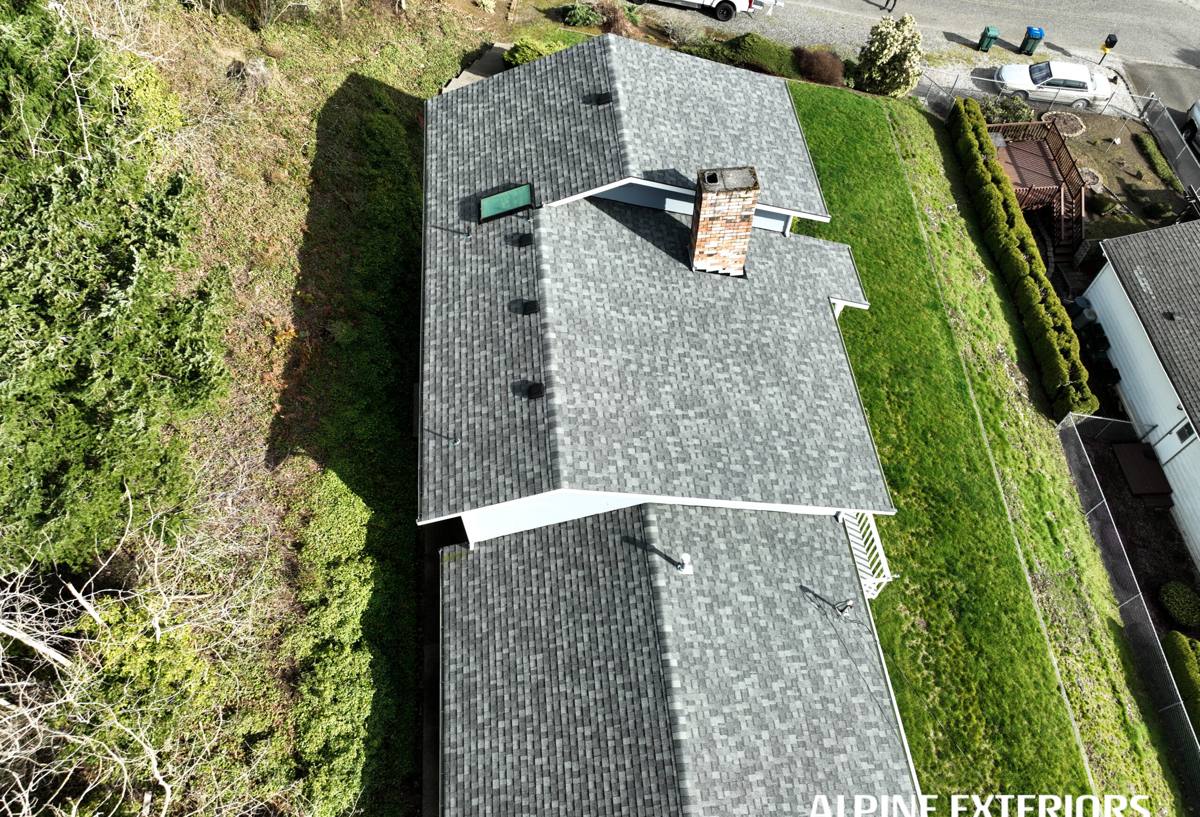
What Coastal Storms and Salt Air Actually Do to a Roof
It helps to understand the mechanics before you're staring at a leak, because the damage from a coastal storm is rarely just "a hole." It's usually several smaller problems stacking on top of each other.
Wind and Wind-Driven Rain
Storms off the water don't just bring rain straight down — they push it sideways. That matters because most roofing systems are designed to shed water moving downhill, not water being forced uphill under a shingle tab or sideways into a vent. Wind-driven rain finds every marginal seal: a nail that's backed out slightly, a shingle tab whose adhesive strip never fully bonded, a pipe boot that's starting to crack. None of those are visible from the ground, but a hard blow off the water will expose them fast.
Salt Air and Metal Fatigue
Salt air is corrosive to exposed metal — flashing, fasteners, vent caps, gutter hardware. On a roof a few miles inland, a standard galvanized nail or flashing seam might hold up fine for decades. Closer to the water, that same hardware can start rusting and losing its grip years earlier. Once a fastener corrodes, it loses holding power, and that's exactly the kind of weak point a storm will exploit.
The Long Moss Season
Whatcom County's damp, shaded, mild climate means moss has a long growing window, and waterfront properties with mature trees nearby often see it worse than most. Moss holds moisture against the roof surface long after a storm has passed, which softens shingle mat, accelerates granule loss, and can lift shingle edges enough for wind to get underneath them. A roof with heavy moss going into storm season is a roof with more failure points than one that's been kept clean.
Signs Your Semiahmoo Roof May Have Storm Damage
Some storm damage is obvious. A lot of it isn't — it shows up weeks later as a stain on a ceiling or a slow rise in a heating bill. After any significant wind or rain event, it's worth checking for the following:
- Missing, cracked, or curled shingles, especially on the side of the roof facing the water
- Granules collecting in gutters or at downspout outlets
- Lifted or visibly bent flashing around chimneys, skylights, or roof-to-wall transitions
- Soft spots or discoloration on interior ceilings, especially near exterior walls
- Gutters pulling away from the fascia or sagging under debris
- New or worsening moss growth in valleys and shaded slopes
- Daylight visible through the roof deck from inside an attic
- A musty smell in an attic or upper closet that wasn't there before
Any one of these on its own might be minor. Two or three together, especially after a storm, is usually a sign the roof needs a real inspection, not just a glance from the driveway.
What a Correct Storm Damage Repair Actually Involves
The biggest mistake we see after a storm is a repair that addresses the symptom — the visible leak or missing shingle — without addressing why it happened. On a coastal roof, that usually means the underlying cause was already weakened hardware, saturated underlayment, or moss that had been softening the surface for months. A repair that skips those causes tends to fail again in the next storm.
A correct repair starts with tracing the water, not just patching where it appeared inside the house. Water can travel several feet along a rafter or under underlayment before it shows up as a stain, so the entry point and the stain are often not in the same place. From there, we check the surrounding shingles, flashing, and decking for hidden damage — soft or delaminated decking, corroded fasteners nearby, or underlayment that's absorbed water and lost its ability to shed it.
Repair vs. Replace: What Actually Drives the Decision
Not every storm-damaged roof needs a full replacement, and not every roof can be reasonably patched. The honest answer depends on a handful of factors, not the size of the visible hole.
| Factor | Leans toward repair | Leans toward replacement |
|---|---|---|
| Roof age | Roof is under roughly 12–15 years old | Roof is near or past its expected service life |
| Extent of damage | Isolated to one section or slope | Multiple slopes affected, or widespread granule loss |
| Decking condition | Deck is solid, dry, and sound | Deck is soft, delaminated, or water-stained in multiple spots |
| Fastener/flashing condition | Hardware still holding, minor surface corrosion | Widespread corrosion or repeated fastener pull-out |
| Moss/algae history | Light, manageable growth | Heavy, recurring moss that's degraded the mat underneath |
| Typical cost range* | Roughly $400–$2,500 depending on scope | Full replacement priced per square foot of roof area |
*Broad ranges only — actual cost depends on the roof's size, pitch, material, and what we find once we're up there. We'll give you a real number after inspecting, not a phone-quote guess.
Our Storm Damage Repair Process
- Inspection. We walk the roof and the attic, not just look up from the ground, and check flashing, fasteners, decking, and ventilation along with the obvious damage.
- Documentation. We note and photograph what we find, which is also what you'll want on hand if you're filing an insurance claim.
- Honest scope. We tell you plainly whether this is a repair, a partial re-roof of one slope, or a full replacement — and why.
- Temporary protection if needed. If there's active water intrusion, we get the roof weathertight first, before scheduling the permanent fix, so the damage doesn't spread while you're deciding on next steps.
- The repair itself. Damaged materials come out, decking is checked and replaced where needed, and new flashing, underlayment, and shingles go in matched to what's already on the roof wherever possible.
- Final check. We confirm the repair area sheds water correctly and that surrounding materials weren't disturbed or left vulnerable.
Materials and Methods That Make Sense Near the Water
For roofs exposed to salt air, we lean toward hardware and materials with better corrosion resistance than the bare minimum — stainless steel or heavier-gauge, properly coated fasteners and flashing rather than standard-grade galvanized, especially in areas most exposed to wind off the water. This isn't about chasing the most expensive option available; it's about matching the material to the environment it has to survive in. A fastener that's fine on an inland roof isn't necessarily the right call fifty yards from saltwater. We'll walk you through what's appropriate for your specific roof rather than defaulting to whatever's cheapest or whatever's trendiest — both extremes tend to cost homeowners more down the line.
Underlayment Matters More Here
Given how much wind-driven rain this stretch of coastline sees, we don't cut corners on underlayment. A quality synthetic or self-adhered underlayment in vulnerable areas — valleys, eaves, around penetrations — gives the roof a real second line of defense if wind ever pushes water past the shingles themselves.
Working With Insurance After Storm Damage
If a storm caused the damage, your homeowner's insurance may cover some or all of the repair. We're not your insurance adjuster and won't promise a claim outcome we don't control, but we can give you clear documentation — photos, a written scope, and an honest assessment of cause — that helps support your claim. We'd rather tell you plainly if something looks like ordinary wear rather than storm damage, because that's the kind of straight answer that protects you if the claim gets reviewed.
Why It Matters That We Already Work in Semiahmoo
A roofing crew that regularly works this part of Whatcom County knows things a crew driving in from farther away doesn't — which slopes catch the worst of the wind off the water, how fast moss comes back on a shaded north-facing roof near mature trees, and what hardware actually holds up out here versus what fails early. That local pattern recognition matters when you're trying to figure out whether a leak is a one-time storm event or the first sign of a bigger problem building up. It also means faster response after a storm, when a lot of homeowners in the same area are calling around at once.
If your roof took a hit in a recent storm, or you just want a straight assessment of how it's holding up against what this coastline throws at it, we're glad to take a look. Reach out for a free, no-pressure estimate using the form below — we'll tell you exactly what we see and what, if anything, needs to happen next.