 Ferndale Roofing
 Siding in Kendall Has to Work Harder Than Siding Almost Anywhere Else
Kendall sits in the part of Whatcom County where the weather doesn't do anything halfway. Winters bring long stretches of driving rain that comes in sideways more often than straight down. Summers are short and mild, which sounds pleasant until you realize it means walls rarely get a hard, sustained dry-out between wet spells. Add in the marine-influenced air that moves through this whole region off the Sound and up the valleys, and you've got a climate that's constantly testing whatever material is nailed to the outside of a house.
Most exterior products are engineered for an "average" American climate — hot dry summers, cold dry winters, moderate rain. That's not Whatcom County. Here, the test is sustained moisture exposure, wind-driven rain intrusion at joints and penetrations, and enough shade and humidity to grow moss on anything that holds still long enough. Siding that isn't built and installed with that specific combination in mind tends to fail in ways that show up slowly — swelling at the bottom edges, soft spots behind trim, streaking and dark growth in shaded elevations — long before the homeowner realizes there's a problem underneath.
Moisture That Doesn't Let Up
The issue in Kendall isn't usually one big storm. It's the accumulation — weeks of damp air and light-to-moderate rain that keep exterior surfaces wet far longer than manufacturers' test labs assume. Wood-based and wood-adjacent products (cedar, primed spruce, engineered wood panels) are the most vulnerable to this pattern because their core material absorbs water. Once moisture gets past the surface coating — through a nail hole, a butt joint, a cut edge that wasn't sealed — it doesn't dry out fast in this climate. It sits, and the material starts to break down from the inside.
Moss, Shade, and Slow-Drying Walls
Trees, hills, and cloud cover mean a lot of Kendall properties have at least one wall that rarely sees direct sun. Those north- and east-facing elevations, and anything tucked under eaves or tree canopy, are where moss and algae take hold first. On porous or textured surfaces, moss doesn't just sit on top — it roots into surface irregularities and holds moisture against the substrate, extending every wet cycle. Over years, that constant damp-and-shade combination is one of the biggest drivers of premature siding failure in this part of the county.
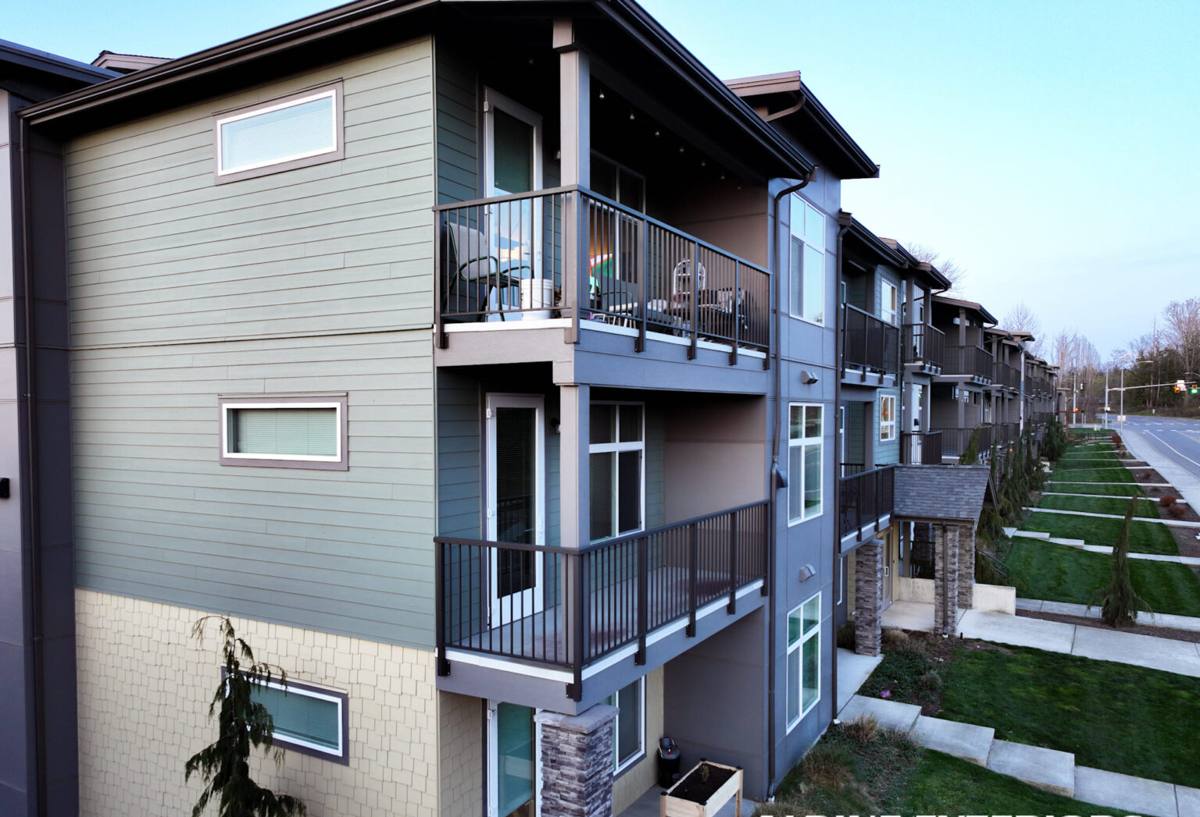
What "Correct" Fiber Cement Installation Actually Means
Fiber cement siding is only as good as the assembly it's installed into. The board itself resists moisture and rot far better than wood-based products, but a fiber cement job done wrong — tight to the wall with no drainage path, gaps sealed with caulk instead of proper flashing, fasteners driven wrong — will still let water in and trap it there. In a climate like Kendall's, the installation details matter more than they would somewhere drier.
A Drainage Gap Behind the Siding
Correct installation includes a rain screen or drainage gap — a small air space between the back of the siding and the weather-resistive barrier — so any moisture that does get past the outer surface has somewhere to go and can dry out instead of sitting against the wall sheathing. Skipping this step is one of the most common corner-cuts on lower-bid siding jobs, and it's invisible once the siding is up, which is exactly why it gets skipped.
Flashing, Fastening, and Joint Details
Every window, door, and penetration needs proper flashing integrated with the weather-resistive barrier — not just caulk bridging the gap. Fasteners need to be the right type, spaced and set to manufacturer specification (not overdriven, which crushes the board's edge and creates a wick point). Butt joints need to be backed and sealed correctly, not just tight-fitted. None of this shows up in a driveway photo. It shows up five or ten years later, in whether the wall behind the siding stayed dry.
Why We Install Only James Hardie
We standardized on James Hardie fiber cement siding and don't install vinyl, LP SmartSide, Cemplank, Allura, or bare cedar and primed wood siding. That's a professional standard, not a knock on every homeowner who has one of those products on their house today — plenty of them perform fine for a while. It's about what we're willing to warranty our labor against and put our name on, in a climate that punishes weak points.
Vinyl expands and contracts significantly with temperature swings, can crack in impact or extreme cold, and its lighter-gauge profiles often look and perform like it on a close-up, textured home. Wood-based engineered siding and cedar both depend on an intact factory or field coating to keep moisture out of an absorbent core — in a climate this wet, any breach in that coating (a nail pop, a cut end, a scratch) becomes a slow, hidden entry point for rot. Fiber cement alternatives to Hardie exist, but Hardie's manufacturing process, engineered-for-climate HZ product lines, factory-applied ColorPlus finish, and transferable warranty are the combination we've found holds up best to sustained scrutiny over time.
| Material | Moisture Behavior | Typical Maintenance Burden |
|---|---|---|
| James Hardie fiber cement | Non-combustible, engineered to resist moisture and swelling when properly installed | Occasional wash; repaint only if not ColorPlus factory finish |
| Vinyl siding | Doesn't absorb water, but seams and panels can allow moisture behind the wall; expands/contracts with temperature | Low, but cracks and fades over time; hard to patch invisibly |
| Cedar / primed wood siding | Absorbs moisture readily once coating is breached; slow to dry in shaded, humid conditions | Regular repainting/resealing; higher risk of rot in shaded elevations |
| LP SmartSide / engineered wood | Wood-strand core relies on coating integrity; edge and cut exposure is a known vulnerability | Moderate; touch-up sealing at cuts and joints is critical |
The HZ5 Product Line, and Why It's the Right Fit for This Climate
James Hardie engineers its siding in regional formulations matched to local climate demands. For homes in this part of Washington, that means their HZ5 line, built specifically for climates with significant moisture exposure and freeze-thaw cycling. It's a different formulation than what Hardie sells in a dry desert climate — the difference isn't marketing, it's how the board is engineered to perform against the specific stress this region puts on it.
Paired with the factory-applied ColorPlus finish — baked on in a controlled environment rather than field-painted on site — you get color and moisture protection that isn't dependent on job-site weather conditions during installation, and a finish that resists the fading and chalking that field-applied paint shows first in constant damp, low-light conditions.
Our Process for a Kendall Siding Project
- On-site assessment. We look at existing siding, sheathing condition, moisture history, and which elevations get the least sun — those get extra attention in the plan.
- Tear-off and sheathing check. Old siding comes off and we inspect what's underneath before anything new goes up. Hidden rot or compromised sheathing gets addressed before it's covered again.
- Weather-resistive barrier and drainage plane. Correctly lapped house wrap and a rain screen gap go in first — this is the layer that does the real long-term moisture management work.
- Flashing at every penetration. Windows, doors, vents, and any wall penetration get integrated flashing, not just sealant.
- Hardie installation to manufacturer spec. Correct fastener type and spacing, proper joint treatment, and factory-finish handling so the ColorPlus coating isn't damaged during install.
- Final walk-through. We go over the finished work with the homeowner and flag anything worth watching going forward.
Color and Style Choices for Kendall Homes
ColorPlus finishes come in a range that works with both the wooded, rural character common around Kendall and more traditional home styles. Because the finish is factory-baked, the color holds consistently across the whole house — no batch variation between the boards installed on a sunny week versus a rainy one. Board profiles (lap siding, shingle-style panels, vertical board-and-batten accents) let a home take on a different look without changing the underlying performance, which matters when a shaded, moss-prone elevation needs the same protection as a sun-facing one but the homeowner wants visual variety between them.
What Ongoing Maintenance Actually Looks Like
Fiber cement isn't maintenance-free, but the maintenance is straightforward and infrequent compared to wood-based sidings — and in this climate, that gap matters:
- Rinse siding annually, focusing on shaded and north-facing walls where moss and algae take hold first
- Keep gutters clear so overflow doesn't run down and pool against a wall section repeatedly
- Trim back vegetation that's shading a wall or holding moisture against it
- Check caulking at trim and penetrations every few years and re-seal if it's cracked or pulling away
- Inspect after major wind events for any impact damage or loosened boards
- With ColorPlus finish, repainting generally isn't needed — touch-up is only for accidental damage
Why Hiring a Crew That Already Works in Kendall Matters
Siding installation isn't a one-size-fits-all trade, and the difference between a generic install and a correctly climate-adapted one shows up years later, not on installation day. A crew that already works Kendall and the surrounding Whatcom County communities knows which elevations on a typical property here need the most attention, how the local moisture pattern behaves across the seasons, and what a rushed or corner-cut installation looks like once it starts to fail. That's knowledge you don't get from a crew that mostly works drier inland climates and treats every job the same way.
Local experience also means faster response if something needs a look after the job is done — a re-caulk, a question about a section that's holding moisture, a follow-up on a warranty item. That's harder to get from a company that's not regularly in the area.
Getting Started
If your Kendall home's siding is showing moss, soft spots, peeling paint, or you're just planning ahead for a replacement, we're glad to come take a look and walk you through what we'd recommend and why. There's no pressure and no cost to get an estimate — just a straight assessment of what your home needs from its siding in this climate.