 Ferndale Roofing
 Kendall's Climate Is Harder on Siding Than It Looks
Kendall sits inland from the coast, tucked into the tree-covered foothills of Whatcom County on the way toward Mt. Baker. That setting is beautiful, but it creates its own set of problems for exterior siding. Homes here get less direct sun than open lots closer to town, more shade from mature evergreens, and long stretches where roofs, walls, and trim simply don't dry out between rain events. Add in the broader Whatcom County pattern of salt-influenced air moving inland off the Sound, driving rain that hits siding at an angle during winter storms, and a moss season that can run from October through May, and you've got a climate that punishes any siding product with weak spots in its moisture management.
We've worked on homes throughout the Ferndale and Kendall area long enough to see the same failure patterns repeat: paint that blisters and peels within a handful of years, wood and wood-composite panels that swell and delaminate at the bottom edge, and moss and algae staining that never fully washes off certain surfaces. None of that is inevitable. It's a direct result of what the siding is made of and how it was installed.
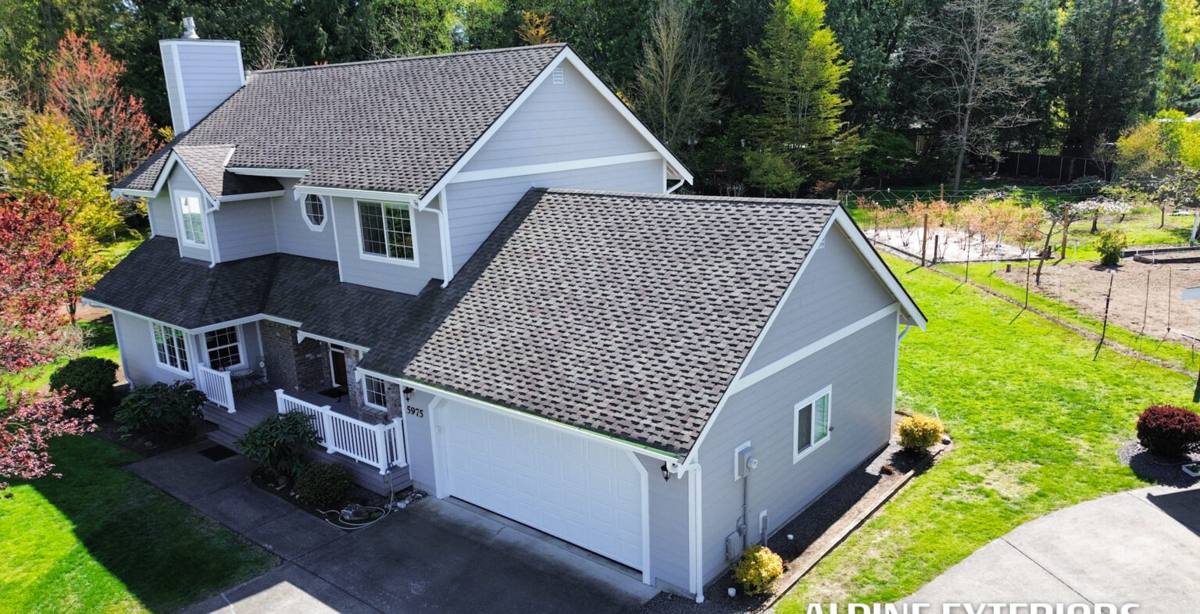
Why We Only Install James Hardie in This Area
Ferndale Roofing Co. installs James Hardie fiber cement siding exclusively. We don't install vinyl, LP SmartSide, Cemplank, Allura, or primed wood products, and that's a deliberate call, not a sales pitch. In a climate like Kendall's, the material matters as much as the workmanship. Fiber cement is non-combustible, dimensionally stable, and doesn't rely on a factory coating alone to keep moisture out the way wood-composite products do. James Hardie backs its siding with a strong transferable warranty and a finish system, ColorPlus, that's baked on at the factory rather than field-applied, which matters a lot when a house is going to sit under tree cover and damp air for decades.
We're not going to tell you every other product on the market is worthless. Vinyl is inexpensive and low-maintenance in dry climates. Wood composite has a warmer look some homeowners prefer. But we've made a professional decision that in Northwest Washington's wet, shaded, moss-prone conditions, those trade-offs aren't ones we're willing to put our name behind. Hardie is what goes on the houses we build.
What Kendall Homes Specifically Need From Their Siding
Every region asks something different of its siding. In Kendall, three things matter more than in drier or sunnier parts of the county:
- Moisture tolerance under shade. Siding that stays damp longer needs a material that won't swell, rot, or delaminate from prolonged exposure.
- Moss and algae resistance. A factory finish that resists organic growth reduces the pressure-washing and repainting cycle that wood and some composites require.
- Resistance to driving rain at the joints. Wind-driven rain finds every gap in flashing, caulking, and butt joints. The product and the install both need to account for it.
James Hardie's HZ5 product line is engineered specifically for regions like ours — cold, wet, freeze-thaw climates — as opposed to the HZ10 line built for hot, humid southern states. Installing the correct climate-engineered version isn't a minor spec detail; it's the difference between siding that performs for 30+ years and siding that's fighting the wrong battle from day one.
What a Correct James Hardie Installation Actually Involves
James Hardie's own installation manual is long for a reason — most siding failures we get called out to inspect trace back to install shortcuts, not the product itself. A correct job on a Kendall home includes:
| Step | Why It Matters Here |
|---|---|
| Weather-resistant barrier installed and lapped correctly | Backstops the siding against the moisture that's already in the air most of the year |
| Proper flashing at windows, doors, and roof lines | Driving rain finds these transitions first; bad flashing here causes hidden rot behind good-looking siding |
| Correct fastener type, spacing, and penetration | Under-driven or over-driven nails loosen panels and open gaps that trap moisture |
| 6-inch minimum clearance from grade, 2-inch from roofing | Keeps splashback and roof runoff from constantly wetting the bottom courses |
| Caulked and painted cut edges | Job-site cuts expose raw fiber cement; sealing them protects against the moss and algae growth common under tree cover |
| Proper joint treatment at butt seams | Poorly sealed seams are the most common entry point for wind-driven rain |
None of this is exotic. It's just detail work that takes time and experience with the product, which is exactly where a lot of installs go wrong — not because the crew was careless, but because they don't do Hardie often enough to know where the climate-specific risks are.
Common Installation Mistakes We See on Older Kendall Homes
- Panels installed with no gap at butt joints, causing buckling as the material expands and contracts
- Missing or undersized flashing above windows and doors
- Siding installed too close to grade or roof surfaces, feeding constant moisture into the bottom edge
- Cut panel edges left unsealed, leading to early moss and algae staining right at the cuts
- Fasteners driven into a nailing pattern that doesn't match the local wind-exposure requirements
ColorPlus Finish: One Less Maintenance Cycle in a Damp Climate
Standard field-painted siding needs repainting on a cycle, and in a shaded, damp environment like Kendall that cycle comes faster than it would in a drier climate. James Hardie's ColorPlus finish is baked on in a controlled factory setting through multiple coats, which gives it better color retention and adhesion than paint applied on-site after installation. It won't eliminate maintenance entirely, nothing does in this climate, but it removes one of the biggest recurring costs homeowners in wooded, shaded settings deal with. Color and texture options range from smooth lap siding to shingle-style panels and vertical board-and-batten, so the look can match anything from a traditional farmhouse-style home to a more modern build.
What Failing Siding Looks Like Before It Becomes a Bigger Problem
Homeowners in Kendall don't always catch siding problems early because the damage often starts on the sides of the house that get the least sun and the most shade. Watch for:
- Soft or spongy spots when you press on the siding, especially near the bottom courses
- Paint that's bubbling, peeling, or chalking faster than it should
- Dark streaking or thick moss growth that keeps coming back after cleaning
- Visible gaps opening at butt joints or around trim
- Warping, cupping, or panels that have pulled slightly away from the wall
Any of these are worth a look before they turn into sheathing or framing repairs, which cost far more than the siding itself.
Our Process, Start to Finish
We keep the process straightforward:
- On-site inspection. We look at the current siding, the sheathing underneath where accessible, moisture exposure on each elevation, and any rot or flashing issues already present.
- Written estimate. We walk through product selection, HZ5 specification, color and profile options, and a clear cost breakdown, no vague allowances.
- Prep and tear-off. Old siding comes off, sheathing is inspected and repaired as needed, and the weather-resistant barrier is installed or replaced.
- Installation to manufacturer spec. Flashing, fastening, clearances, and joint treatment are done to James Hardie's published requirements, not shortcuts.
- Final walkthrough. We go over the finished job with you before we consider it done.
What Drives the Cost of a Siding Job in Kendall
| Factor | How It Affects the Job |
|---|---|
| Home size and elevation count | More square footage and more complex rooflines mean more cutting, flashing, and labor |
| Condition of existing sheathing | Rot or moisture damage found during tear-off adds repair scope before new siding can go on |
| Siding profile | Lap, shingle, and board-and-batten styles differ in material and labor time |
| Access and site conditions | Tree cover, slope, and driveway access affect setup and staging time on wooded Kendall lots |
| Trim and detail work | Window and door trim, corner boards, and fascia detail add time beyond flat wall area |
We don't quote a number without seeing the house. Broad ranges without an inspection aren't honest, and every Kendall property is different once you factor in shade, drainage, and the condition of what's already on the walls.
Why It Matters That We Already Work in This Area
A crew that's already worked on homes throughout Ferndale and the surrounding Whatcom County communities knows what this climate does to a house before the first panel goes up. That means recognizing where moss buildup signals a bigger moisture problem, knowing which elevations on a shaded lot need extra attention at the flashing, and not treating a Kendall install the same way you'd approach a job on a dry, open lot elsewhere in the state. It also means a crew that's still local when a warranty question comes up five or ten years down the road.
Questions Worth Asking Any Siding Contractor Before You Hire
- Are you installing the climate-specific HZ5 product line, or a generic version?
- Who handles flashing at windows, doors, and rooflines — is it part of your standard scope?
- What's your minimum clearance from grade and from roof surfaces?
- How do you treat cut edges and butt joints?
- Is the manufacturer's warranty transferable, and what voids it?
If your siding is showing its age or you're planning ahead for a replacement, we're glad to come take a look and give you a straight answer on what your home actually needs. Reach out for a free, no-pressure estimate using the form below.