 Ferndale Roofing
 Built for Salt Air, Driving Rain, and a Long Moss Season
Decks in the Lummi Nation area take a different kind of beating than decks twenty miles inland. Sitting close to Bellingham Bay and the surrounding waterways, homes here deal with salt-laden air moving off the water, wind-driven rain that gets pushed sideways under railings and against ledger boards, and a wet season that runs long enough for moss and algae to take hold on any surface that doesn't drain or dry quickly. None of that is a reason to avoid a wood or composite deck — it just means the deck has to be built and detailed correctly for the environment it's actually in, not for a dry-climate spec sheet.
We've replaced decks throughout Ferndale and the surrounding Whatcom County waterfront and low-lying areas long enough to know which failures show up first out here: rusted fasteners, soft spots where the ledger meets the house, slick moss buildup on north-facing boards, and railing posts that loosen because the framing underneath was never properly flashed. A deck replacement done right in this area addresses all of that up front, not as a repair five years later.
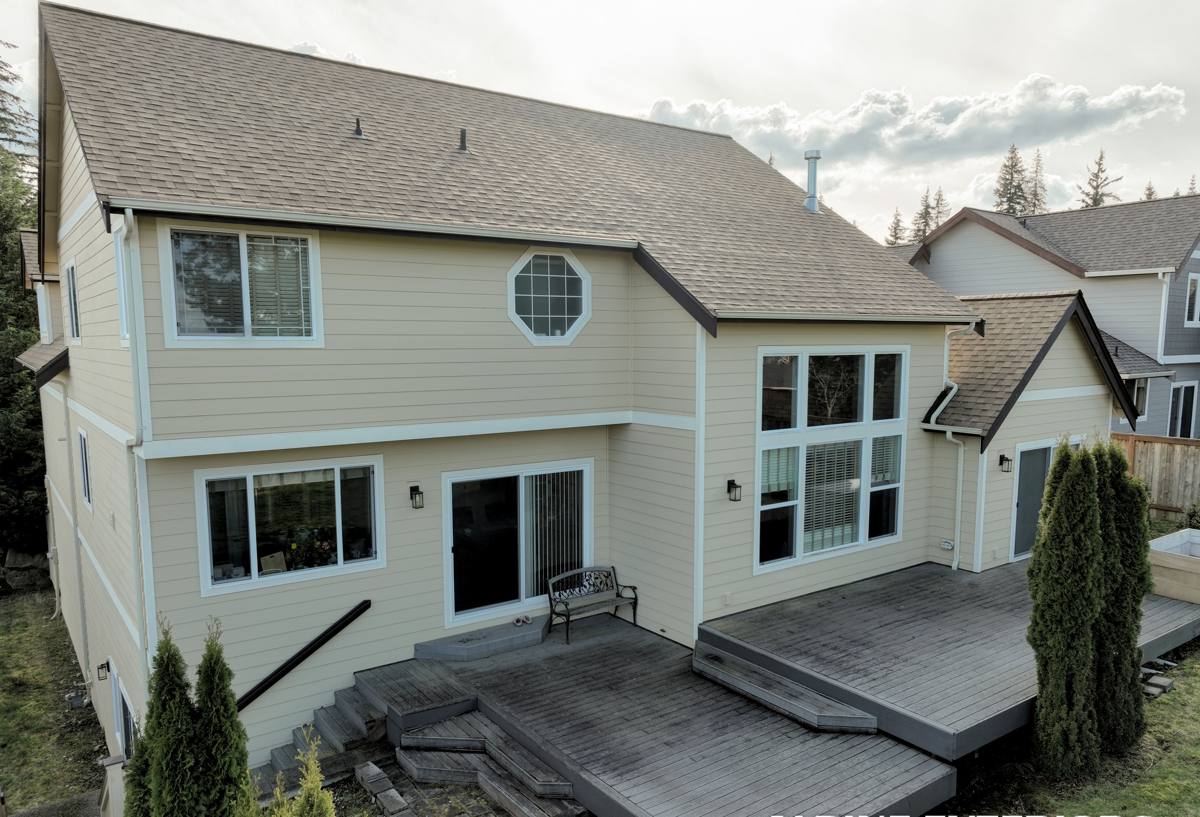
When Repair Isn't Enough
Not every tired deck needs full replacement. But there are a handful of signs that tell us the structure itself has been compromised, not just the surface:
- Soft, spongy, or spring-loaded decking when you walk across it, especially near the house
- Visible rot or dark staining at the ledger board where the deck attaches to the structure
- Rusted, corroded, or backed-out fasteners and joist hangers
- Posts or railings that wobble even when tightened
- Persistent moss or algae that regrows within weeks of cleaning
- Gaps opening up between deck boards and the house siding or trim
That last one is worth paying attention to. A gap opening at the house connection is often a sign that the ledger flashing has already failed and water has been getting behind it for a while. In a climate that stays wet as long as ours does, that kind of intrusion doesn't dry out on its own between rains — it just keeps working.
What a Correct Deck Replacement Actually Involves
Substructure and Framing
Everything about how a deck holds up long-term comes down to what's underneath the boards. We size and space joists for the actual load and span, not the minimum code allows, and we use framing lumber and hardware rated for exterior, moisture-heavy exposure. Post footings are set below frost depth and sized for the soil conditions on the lot, since drainage and soil saturation vary block to block this close to the water.
Ledger Attachment and Flashing
This is the single most important detail on any deck near Bellingham Bay, and it's the part most often done poorly on older builds. The ledger board — where the deck bolts into the house — needs proper flashing that sheds water away from the house structure, not just a bead of caulk. We flash it correctly, lap it under the existing siding or house wrap, and use structural lag bolts or through-bolts rated for the load, not deck screws. Get this wrong and it's not a matter of if water gets behind the siding, it's when.
Fasteners and Hardware
Standard galvanized fasteners corrode faster in salt-influenced air than most homeowners expect. We use stainless steel or coated fasteners rated for coastal and treated-lumber exposure throughout the structure, including joist hangers, post bases, and railing hardware — not just on the visible top surface.
Choosing the Right Decking Material for This Climate
There's no single "best" decking material — there's the right material for how the deck will be used, how much upkeep the owner wants to do, and how much direct weather exposure the deck actually gets. Here's how the common options hold up in this specific climate:
| Material | How It Handles Salt Air & Rain | Moss/Algae Resistance | Upkeep |
|---|---|---|---|
| Pressure-treated wood | Good if sealed and maintained; needs re-staining more often near the water | Low — needs regular cleaning | Highest — annual inspection and refinishing |
| Cedar | Naturally rot-resistant but still needs sealing in this exposure | Moderate | Moderate to high |
| Composite (capped) | Very good — won't rot or absorb moisture like wood | Better, but still needs periodic washing on shaded boards | Low |
| PVC decking | Excellent — fully moisture-resistant, no organic material to feed rot | Best of the group, especially with textured/grooved surfaces | Lowest |
We're honest about the trade-offs rather than pushing one product line. Wood costs less up front but asks for real annual maintenance in a climate that doesn't dry out fast. Composite and PVC cost more initially but make sense for owners who want to spend weekends doing something other than re-staining a deck every year. Where a home has a lot of shade or sits close to the water, we'll usually steer that conversation toward capped composite or PVC simply because the maintenance math works out better over time — not because wood is a bad product.
Our Deck Replacement Process
- On-site assessment — we inspect the existing deck, ledger connection, and framing to confirm what's actually failing versus what's cosmetic.
- Honest scope and estimate — you get a clear breakdown of what needs to be replaced, material options with real trade-offs, and a straightforward price — no pressure, no upsell script.
- Demo and disposal — full removal of the old structure, checking the ledger area and any framing behind it for hidden moisture damage before we build.
- Framing and flashing — new substructure built to span and load, ledger properly flashed and fastened.
- Decking, railing, and finish work — installed per manufacturer spec (critical for warranty coverage on composite and PVC products), with fastening patterns suited to expansion and contraction in our temperature swings.
- Final walkthrough — we go over the finished deck with you, including what maintenance (if any) the material you chose actually needs.
Permits and Building on Lummi Nation Land
Deck replacement work in the Lummi Nation area can involve different permitting and review steps than a comparable project elsewhere in Whatcom County, depending on the property and its status. We don't guess on this — before any work starts, we confirm with the property owner what approvals apply to that specific site and make sure the project meets them. If you're not sure what's required for your property, that's a normal question to bring to us at the estimate, and we'll help you sort out what applies before anything gets scheduled.
Maintenance Checklist to Protect Your New Deck
A well-built deck in this climate still needs some basic seasonal attention to get its full lifespan. A short list we give every customer:
- Sweep or hose off standing debris regularly — wet leaves and needles trap moisture against the surface
- Clean moss and algae off shaded or north-facing boards before it builds a foothold, especially heading into the wet months
- Check railing posts and stair connections once a year for any looseness
- Inspect the ledger board area at the house connection annually for any staining, gaps, or soft spots
- If you chose wood, plan on re-staining or sealing on the schedule the product calls for — skipping a cycle in this climate shows up fast
- Keep gutters and downspouts near the deck clear so runoff isn't dumping directly onto or under the structure
Why a Crew That Already Works in Lummi Nation Matters
A deck built to a generic national spec sheet is built for average conditions — and this area isn't average. Salt-influenced air, sustained wind-driven rain, and a moss season that runs longer than most of the country's is a specific combination, and it punishes shortcuts on flashing, fastener selection, and material choice faster than it would somewhere drier. Working this area regularly means we've already seen which details fail first here and we build past those failure points as standard practice, not as an upsell.
It also means fewer surprises during the project itself — we're familiar with the property considerations specific to Lummi Nation, we're not learning site logistics for the first time, and we're a short drive away if something needs a follow-up look after the build.
If your deck is showing its age or you're planning a replacement and want a straight answer about what it actually needs, we're happy to take a look and give you a free, no-pressure estimate — no obligation, just an honest read on the project.