 Ferndale Roofing
 Decks in Custer Take a Different Kind of Beating
Custer sits close enough to the water and far enough into open country that its decks deal with a combination most homeowners don't expect until they're kneeling down and finding soft wood. You've got salt-tinged marine air rolling in off the Strait, long stretches of driving rain through the fall and winter, and a moss season that can run eight months or more depending on how much tree cover and shade a property has. None of those things alone would wreck a deck fast. Together, applied year after year, they will.
We work on decks throughout Ferndale and the surrounding Whatcom County area, and Custer properties tend to show a specific pattern: wooded or semi-rural lots with more shade than a typical in-town yard, older fastener hardware that was never rated for coastal exposure, and decks that get walked on in wet boots eight or nine months a year without much of a dry season to let anything fully cure out. That combination is why a deck repair here isn't the same job as a deck repair on a sun-baked lot fifty miles inland.
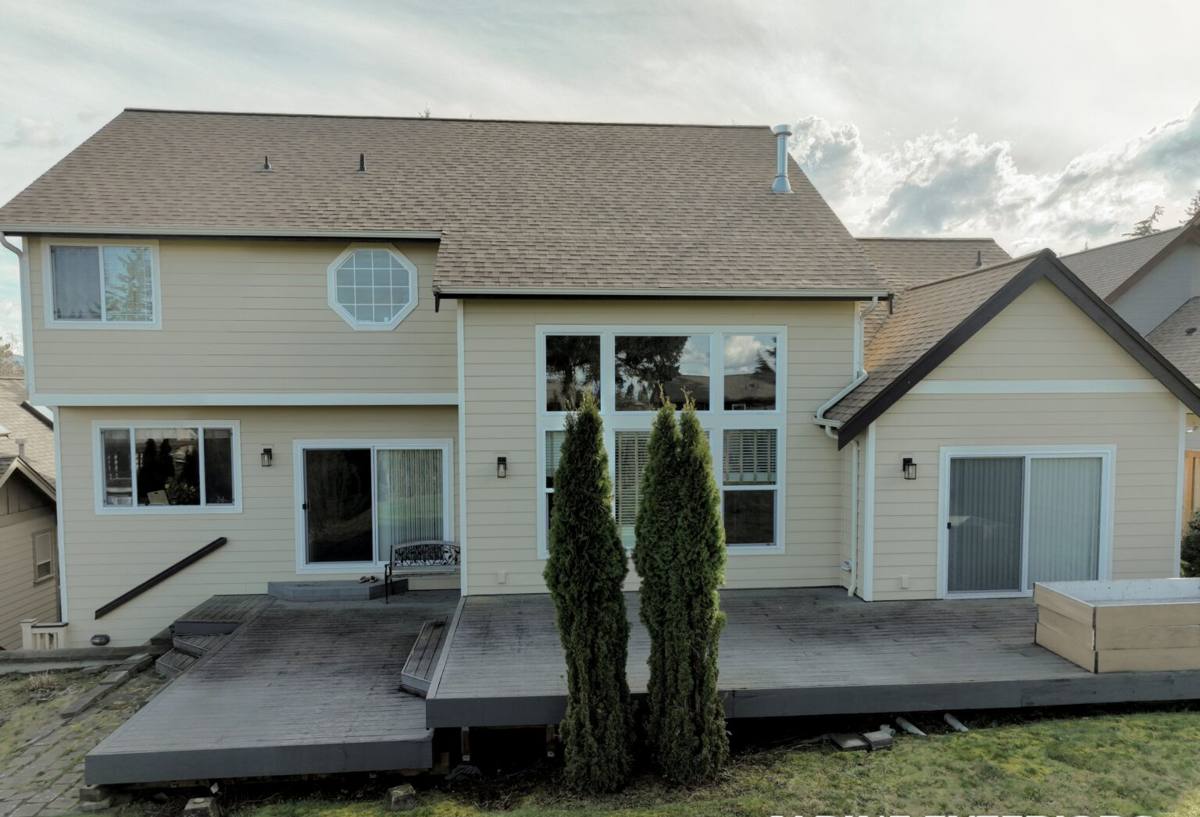
Common Deck Damage We Find in Custer Homes
Most of the repair calls we get in this area fall into a handful of categories. Rarely is it just one thing — usually a few of these are happening at once, which is part of why a proper inspection matters before anyone starts pulling boards.
- Ledger board rot — where the deck attaches to the house is the single most common failure point we see, especially on older decks that were never properly flashed.
- Corroded fasteners and hangers — standard galvanized hardware breaks down faster in salt-laden air than most people expect, and once a joist hanger starts rusting through, it's not a cosmetic problem anymore.
- Moss and algae buildup on decking — beyond making boards slippery, sustained moss cover holds moisture against the wood and accelerates rot underneath it.
- Post base and footing deterioration — wood posts set in or near grade without proper standoff hardware take on moisture from the ground up.
- Soft or spongy decking boards — usually a sign moisture has been sitting in the wood grain far longer than a season.
- Stair stringer rot — stairs shed water differently than a flat deck surface and often rot from the inside of the stringer out.
Repair or Replace? How We Make That Call
Not every damaged deck needs to come out. A lot of what we do is targeted repair — replacing a ledger board, swapping corroded hangers, sistering a rotted joist, or pulling and replacing a run of decking. But there's a point where patching stops making financial sense. Here's roughly how we think about it:
| Condition | Usually Repairable | Usually Needs Replacement |
|---|---|---|
| Ledger board | Localized rot caught early, structure otherwise sound | Widespread rot, no flashing ever installed, structural movement |
| Framing (joists/beams) | One or two joists affected, main beam solid | Multiple joists soft, beam sagging or checked through |
| Decking boards | Isolated soft boards, fasteners still sound | Cupping/splitting across most of the surface |
| Posts/footings | Surface weathering, post base intact | Post rotted at grade line, footing heaved or cracked |
| Railings | Loose balusters, minor surface rot | Posts pulling from rim joist, code non-compliance |
A deck that's 12–15 years old and was built without proper ledger flashing is a common Custer scenario where a repair can address the immediate rot, but we'll tell you honestly if the underlying structure is fighting an uphill battle against the site conditions.
What a Correct Deck Repair Actually Involves
Structural work first
Any repair starts with the framing, not the surface. If a joist or ledger is compromised, replacing decking on top of it just hides the problem for another season. We check moisture content in suspect framing members, not just visual appearance, because wood can look fine on the surface while the core is punky.
Flashing done right
A huge share of ledger rot in this region traces back to missing or poorly installed flashing where the deck meets the house wall. Proper flashing directs water away from that joint instead of letting it wick into the ledger board and the rim joist behind the siding. If your deck was built without it — common on older homes — we install it as part of the repair, not as an upsell.
Fasteners rated for the exposure
Standard galvanized fasteners and hangers are not our default choice for repair work out here. Given the salt content in the air this close to the water, we generally use hot-dip galvanized or stainless hardware rated for coastal/ACQ-treated lumber contact, because mismatched or under-rated metal corrodes faster and can actually accelerate wood decay around the fastener.
Drainage and airflow underneath
Low-clearance decks that don't get airflow underneath hold moisture longer after every rain. Where we can, we address grading or venting under the deck as part of the repair so the framing actually gets a chance to dry between storms instead of staying damp through the whole wet season.
Our Process, Start to Finish
- On-site inspection — we walk the whole structure, probe suspect areas, and check moisture levels in framing and decking, not just what's visible from the top.
- Honest scope and estimate — you get a written breakdown of what's structural, what's cosmetic, and what we'd recommend versus what's optional.
- Permitting where required — structural repairs and railing work can trigger Whatcom County permit requirements depending on scope; we handle that conversation upfront so there are no surprises.
- Demo of the compromised sections only — we don't tear out more than needs to come out.
- Framing and flashing repair — corrected fastener specs, proper flashing details, sistered or replaced framing as needed.
- Decking, stairs, and railing reinstalled or repaired to current code for guard height and baluster spacing where work is exposed.
- Final walkthrough — we show you what was done and what to keep an eye on going forward.
Decking Material Options When Boards Need Replacing
If your repair includes replacing a section — or all — of the decking surface, it's worth weighing your options rather than automatically matching what's already there, especially if what's already there is part of why you're calling us.
| Material | Moss/Moisture Behavior | Maintenance | Typical Trade-off |
|---|---|---|---|
| Pressure-treated lumber | Resists rot but surface still holds moss/algae if shaded | Needs periodic cleaning and re-sealing | Lowest upfront cost, more upkeep |
| Cedar | Naturally rot-resistant, still needs care in shaded/wet spots | Regular sealing to hold color and resist checking | Good look, moderate maintenance |
| Composite decking | Doesn't absorb moisture like wood; surface can still grow algae/moss film if shaded and unwashed | Occasional washing, no sealing/staining | Higher upfront cost, less ongoing labor |
None of these are moss-proof — moss and algae are a surface condition tied to shade and moisture exposure, not just material choice. What changes between materials is how much the surface itself degrades underneath that buildup, and how much maintenance it takes to stay ahead of it.
Moss, Algae, and Salt Air: Keeping a Repaired Deck From Regressing
Fixing the structural problem and then letting the same conditions rebuild it isn't a real fix. Once we've repaired a deck, the biggest factor in how long that repair lasts is what happens between now and next winter's rain. A few things make a real difference on Custer properties specifically:
- Trimming back overhanging branches where possible to cut down shade and let boards dry faster after rain
- Cleaning moss and algae off decking before it packs into board gaps and holds moisture against the wood
- Checking that gaps between boards haven't closed up with debris, which blocks drainage and airflow
- Inspecting hardware annually for early corrosion, especially anything not upgraded during the repair
- Keeping gutters and downspouts near the deck clear so runoff isn't dumping directly onto or under the structure
Permits and Code Considerations in This Area
Depending on the scope of the repair — particularly anything involving structural framing, footings, or railing height and spacing — Whatcom County may require a permit. This isn't a formality we skip to save time; unpermitted structural work can complicate a home sale down the road and, more importantly, means nobody outside our own crew has checked the work against code. We'll tell you plainly whether your project needs a permit before work starts, not after.
Why It Matters to Hire a Crew That Already Works Custer
A deck repaired by someone unfamiliar with this stretch of Whatcom County often gets fixed to a generic standard — right fasteners for a dry climate, adequate flashing for occasional rain, decking sealed on a schedule that assumes a real summer dry-out period. None of those assumptions hold up out here. We work this area regularly enough to know which fastener grade actually holds up near the water, which shaded lots need extra attention to drainage, and which older Custer-area decks were built before flashing at the ledger was standard practice. That local pattern recognition is what keeps a repair from turning into a repeat visit two winters later.
Deck Repair Checklist Before You Call
- Press on decking boards near the house and near the stairs — do they feel soft or spongy?
- Look at the ledger board where the deck meets the siding — any staining, gaps, or visible rot?
- Check railing posts by pushing on them — any movement at the base?
- Look underneath the deck at joists and the main beam for discoloration or soft spots
- Note any areas with heavy moss or algae buildup, especially shaded corners
- Check visible fasteners and hardware for rust streaking or corrosion
If any of those raise a flag, it's worth having someone look before another wet season goes by. If you're in Custer or elsewhere around Ferndale and want an honest look at what your deck actually needs, we're happy to come out for a free, no-pressure estimate — the form below gets you on our schedule.