 Ferndale Roofing
 Board & Batten Siding Built for Sudden Valley's Wooded, Lakeside Lots
Board and batten shows up often in Sudden Valley, and it's easy to see why. The vertical lines suit the wooded, cabin-adjacent character of a lot of homes on the south shore of Lake Whatcom, and the profile reads as clean and current on newer builds without looking out of place next to older A-frames and cottages tucked under the trees. What matters more than the look, though, is what board and batten actually is on a technical level: a siding profile with a seam running down every joint between board and batten. Each of those seams is a place water can try to get behind the wall, and in a community as heavily shaded and consistently damp as Sudden Valley, how those seams are built decides whether the siding performs for decades or starts showing problems within a handful of wet seasons.
We install James Hardie fiber cement board and batten exclusively, and every fastening pattern, batten clearance, and flashing detail we use is built around what Sudden Valley's specific setting — heavy tree canopy, lakeside humidity, and homes at a range of elevations and orientations — actually does to a wall over time.
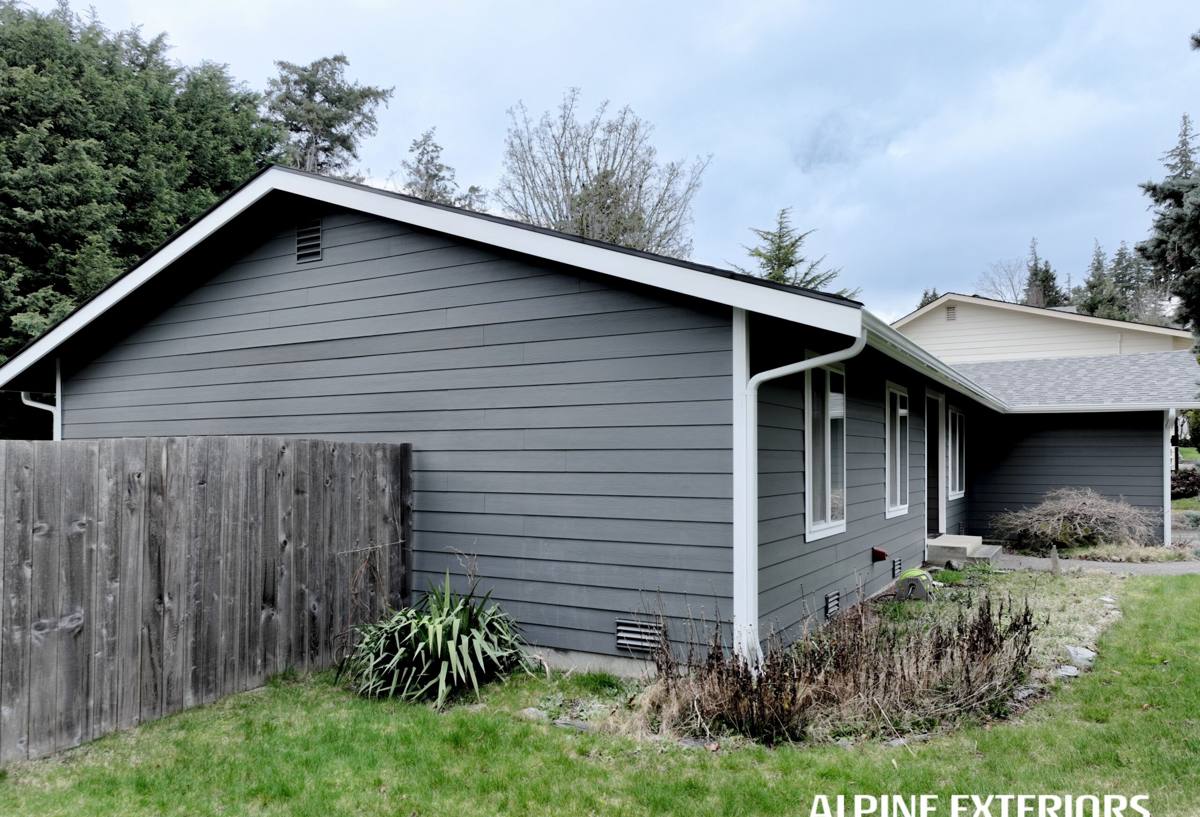
What Sudden Valley's Setting Does to a Board & Batten Wall
Heavy Shade That Never Fully Lets a Wall Dry
Most lots in Sudden Valley sit under substantial tree cover, and it's common for at least one or two elevations of a home to get very little direct sun through most of the year. That matters more on board and batten than on a flatter profile, because the recessed seam behind every batten is already a place moisture likes to linger — and a wall that doesn't get real sun exposure between storms gives that dampness nowhere to go. Materials and installation methods that assume a wall dries out regularly simply don't get that assumption met on a shaded Sudden Valley lot.
Driving Rain and Variable Exposure Across a Hilly Community
Sudden Valley's terrain is hilly and irregular, with homes sitting at different elevations and orientations relative to the lake and the surrounding ridgelines. That means wind-driven rain doesn't hit every wall of the same house the same way, let alone every house in the community the same way. A vertical siding profile with battens running the full height of a wall gives that wind-driven rain a lot of joint length to work against, so the drainage and flashing detail behind the boards has to account for real exposure differences from one elevation to the next, not a single generic assumption.
A Long Moss Season on Every Seam
Shade, humidity off the lake, and Whatcom County's mild, wet climate combine into a moss and mildew season that runs most of the year on the parts of a Sudden Valley property that stay shaded. Roofs usually show it first, but a batten seam that's been sealed tight instead of properly detailed to shed water traps exactly the kind of standing dampness moss needs to take hold. It's worth noting that Sudden Valley sits well inland on a freshwater lake rather than out on the open water — so the bigger threat to siding here isn't salt corrosion the way it might be on a bluff overlooking the Strait, it's the sustained shade and moisture that keep every surface damp longer than it would stay on an open, sun-exposed lot.
Why the Batten Joint Is the Detail That Decides Everything
Board and batten uses roughly twice the seam length of a standard horizontal lap profile, and each of those seams needs its own fastening and clearance detail. On a shaded, damp lot like a typical Sudden Valley property, that adds up to a meaningful difference in how the wall performs long-term. A batten that's caulked tight against the board underneath it, instead of set with the manufacturer's specified clearance, traps whatever moisture gets past the surface right where it can't dry — which is a slow, quiet path toward staining, soft substrate, and paint failure right at the seam, usually a few wet seasons after the crew that installed it is long gone. A batten set with proper clearance and backed by a drainage gap behind the panel lets that same moisture find its way back out.
Fastener count is the other piece. Because both the boards and the battens need to be secured, board and batten uses more fasteners per square foot than most other siding profiles. On a lot that stays damp as long as a shaded Sudden Valley property does, fastener corrosion resistance and spacing aren't details to shortcut — they're a big part of what keeps the wall assembly sound over the long run.
Why We Only Install James Hardie for This Profile
Board and batten amplifies whatever weaknesses a siding material already has, simply because there's more seam and more exposed edge per square foot of wall. That's a big part of why we don't offer LP SmartSide, vinyl, Cemplank, Allura, primed spruce, or cedar in this profile. Those are legitimate products, and other contractors install them competently — but on a profile with this many joints, on lots this consistently shaded and damp, we made the professional call to standardize on one system we trust completely rather than offer a lower-cost option that quietly shifts long-term maintenance risk onto the homeowner.
| Material | Behavior at Batten Seams | Maintenance Under Heavy Shade | Realistic Lifespan Here |
|---|---|---|---|
| James Hardie fiber cement | Dimensionally stable; doesn't swell or cup at the joint | Low; factory finish resists moss and moisture-driven fading | 30+ years with proper install |
| LP SmartSide / engineered wood | Moisture-sensitive at cut edges and fastener holes | Moderate to high; edge sealing matters more without sun to dry it | Depends heavily on upkeep |
| Vinyl | Seams can gap or warp with temperature swings; less rigid at battens | Low upfront, but hidden moisture is hard to catch under panels | Variable, shorter on shaded walls |
| Cedar / primed wood | Absorbs moisture readily at every seam | High; needs recurring refinishing, especially in shade | Shorter without consistent maintenance |
James Hardie's fiber cement core doesn't expand and contract with moisture the way wood-based products do, which is exactly the stability that matters most on a profile built entirely from vertical seams. The factory-applied ColorPlus finish also means the only field-painted surfaces on the job are cut edges we prime on site — unlike a field-finished material, where every board face depends on paint holding up outdoors in a climate that doesn't give it much sun to cure or dry against.
What a Correct Board & Batten Install Involves in Sudden Valley
The finished look of board and batten is simple, but there's a lot happening behind it on a properly built wall:
- Weather-resistive barrier installed and correctly lapped before any siding goes up, with extra attention on elevations that stay shaded longest
- A drainage gap or rainscreen behind the panel so moisture that gets past the surface can dry out instead of sitting against the wall
- Boards and battens fastened with corrosion-resistant fasteners at Hardie's specified spacing — not just enough to hold the material up
- Battens set with proper clearance rather than caulked tight, so the wall sheds water instead of trapping it at every seam
- Properly flashed and lapped transitions at windows, doors, corners, and the base of the wall, where a vertical profile meets a horizontal surface
- Cut boards primed on any field-cut edge to preserve the factory ColorPlus finish everywhere else
Skip any one of those steps and the wall can still look right on install day. The problems that follow — seam staining, soft spots near the base, paint failure along the battens — take a wet season or two to surface, which is exactly why they're easy for a rushed install to get away with until the homeowner is the one dealing with it.
Our Process for a Sudden Valley Board & Batten Project
Walkthrough and Assessment
We start by walking the specific elevations involved, noting which walls face the weather directly and which sit under heavier canopy and stay damp longer. On an existing home, we also check for hidden moisture or rot in the wall assembly before any new siding goes up — covering an existing problem with new material just buries it.
Planning the Detail Before Cutting Material
Batten spacing, corner treatment, and how the siding meets windows, trim, and rooflines all get worked out before crews start cutting. On a profile with this many seams, planning those details on paper first avoids the kind of field improvisation that's where corners tend to get cut.
Installation to Manufacturer Spec
Every fastener, clearance gap, and flashing lap follows James Hardie's published installation requirements for this climate zone. That's what keeps the manufacturer's warranty intact, and it's the same standard that keeps the wall performing the way it's supposed to for decades rather than years.
Final Walkthrough
We walk the finished job with you, cover what little maintenance board and batten actually needs, and make sure you know what a properly detailed seam looks like if you ever want to check it yourself.
Cost Factors for Board & Batten in Sudden Valley
| Factor | Why It Matters |
|---|---|
| Number of shaded vs. sun-exposed elevations | Shaded walls often warrant extra drainage detailing, which adds labor |
| Existing wall condition | Rot or moisture damage found during tear-off needs repair before new siding goes up |
| Batten spacing and reveal | Tighter spacing uses more material and more fastening labor |
| Trim and window detailing | More openings mean more flashing and finish work around each one |
| Access and site conditions | Steep or wooded lots, common throughout Sudden Valley, can add labor time |
Board and batten generally costs more per square foot than standard lap siding, mostly due to the added batten material and the extra labor of fastening and detailing two layers instead of one. Beyond that baseline, the factors above are what actually separate one Sudden Valley home's quote from another's — we'll walk your property and give you real numbers rather than a rough estimate based on square footage alone.
Why Hire a Crew That Already Works in Sudden Valley
Sudden Valley is a private community with its own internal road network and homeowners association, and a contractor who regularly works here already understands the practical side of that — how to schedule around community access, and how quickly exposure changes from one lot to the next even within the same neighborhood because of terrain and tree cover. That familiarity shows up in the choices that actually matter on a board and batten project: which elevations need extra drainage detailing because they never see direct sun, how much batten clearance a damp, shaded wall really needs versus what a generic install guide assumes, and where a rainscreen gap earns its keep instead of being an optional upsell.
A Simple Checklist Before Hiring for Board & Batten in Sudden Valley
- Ask what siding material they install and why, and whether it's backed by a written manufacturer warranty
- Confirm current Washington contractor licensing and active liability insurance
- Ask specifically how they handle batten clearance and drainage on shaded, tree-covered walls
- Ask about experience working within HOA or private-road communities, including access and scheduling
- Get a clear, written scope of work before signing anything
That kind of judgment doesn't show up on a spec sheet, but it's the difference between a board and batten wall that still looks and performs the same in fifteen years and one that's showing seam staining by year five.
If you're weighing board and batten for a home in Sudden Valley, we're happy to walk the property with you, talk through what your specific elevations need given their shade and exposure, and give you a straightforward, no-pressure estimate. There's a form below — reach out and we'll set up a time to take a look.