 Ferndale Roofing
 Point Roberts' Exposure Is Different From the Rest of Whatcom County
Point Roberts sits on its own peninsula, cut off from the rest of Washington State by land and surrounded on three sides by Boundary Bay and the Strait of Georgia. That geography is part of what makes it a special place to live — and it's also exactly why siding here takes more abuse than siding on a home twenty minutes inland in Ferndale. Homes in Point Roberts sit closer to open salt water, catch wind off the water with almost nothing to break it, and spend a large part of the year damp. Siding that would hold up fine in a more sheltered part of Whatcom County can start showing problems years earlier out here.
Salt Air and Driving Rain
Salt-laden marine air is corrosive to fasteners, hard on paint films, and unkind to any siding material that relies on a surface coating to keep water out. Add wind-driven rain that hits walls at an angle instead of running straight down, and you get moisture finding its way into seams, laps, and fastener holes that would stay dry on a calmer site. Over time, that combination is what separates a siding job that lasts decades from one that needs attention in year eight or nine.
A Long Moss Season
Like the rest of the Pacific Northwest, Point Roberts gets an extended wet season where shaded and north-facing walls barely dry out between rain events. That's ideal growing conditions for moss and algae, which hold moisture against the wall longer than the siding was ever meant to tolerate. On the wrong substrate, that constant dampness leads to swelling, soft spots, or paint failure. On the right substrate, installed correctly, it's a cosmetic issue you can rinse off — not a structural one.
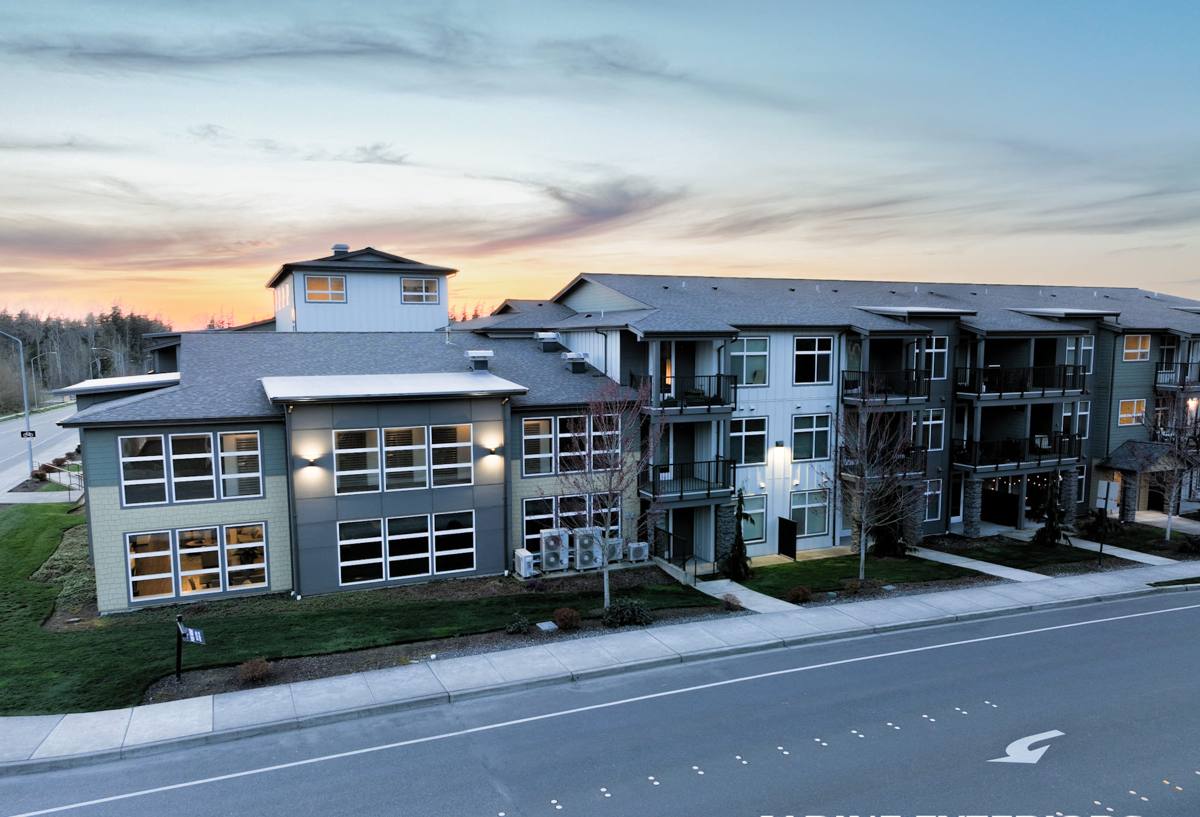
What Happens When Siding Isn't Built for This Climate
Most siding failures we see in coastal Whatcom County aren't dramatic — they're slow. A wood-based product absorbs moisture at a cut edge or a nail hole, and a few years later that spot is soft. A vinyl panel handles rain fine but never really stops wind and salt from working at its seams and fastener slots over the long run. An engineered wood product with the wrong exposure to sun and moisture cycles can bubble or delaminate at the surface. None of these are freak accidents — they're the predictable result of putting a product into a coastal environment it wasn't built to handle indefinitely, or installing it in a way that doesn't respect how it moves and absorbs moisture.
That's the lens we use when we talk about siding in Point Roberts: not "what's cheapest to hang" but "what still looks and performs the way it should after fifteen winters of salt air and rain."
Why We Only Install James Hardie Fiber Cement
We install James Hardie fiber cement siding exclusively. We don't install vinyl, LP SmartSide, Cemplank, Allura, primed spruce, or cedar — not because those products have no merit, but because after years of doing exterior work in this region, fiber cement is the one material we're comfortable standing behind on a home that's going to face salt air and driving rain for the next several decades.
Non-Combustible and Engineered for Moisture
James Hardie siding is made from cement, sand, and cellulose fibers, which makes it non-combustible and dimensionally stable in a way that wood-based and vinyl products can't match. It doesn't rot, it doesn't provide fuel in a wildfire exposure, and it holds its shape through wet-dry cycles instead of swelling and shrinking the way wood fiber products can.
ColorPlus Finish and the HZ Product Lines
Hardie's ColorPlus finish is baked on in a factory-controlled process, which gives it more consistent coverage and better fade and moisture resistance than a coating applied on site after installation. Hardie also builds specific HZ ("HardieZone") formulations engineered for different climate exposures — an important detail in a marine environment like Point Roberts, where the product needs to perform through sustained damp conditions, not just occasional rain.
How Siding Options Compare in a Coastal Climate
It helps to see the trade-offs side by side. This is a general comparison based on how these materials typically perform in a wet, salt-exposed coastal environment like Point Roberts — not a claim about any specific product failing.
| Material | Moisture/Salt Behavior | Maintenance Burden | Typical Lifespan Here |
|---|---|---|---|
| Vinyl siding | Sheds rain but seams and fastener slots stay vulnerable to wind-driven moisture and salt over time | Low, but prone to cracking, fading, and warping near heat sources | Moderate |
| LP SmartSide / engineered wood | Wood-fiber core is sensitive to cut edges, sustained dampness, and moss-holding surfaces | Regular caulk and paint upkeep required | Moderate, shorter if maintenance lapses |
| Cedar / primed spruce | Natural wood movement and moisture absorption; performs only as well as its finish is maintained | High — repainting/staining on a recurring cycle | Shorter without diligent upkeep |
| James Hardie fiber cement | Non-combustible, dimensionally stable, engineered HZ formulations for climate exposure | Low — occasional wash, no recoating cycle needed | Long, backed by a strong transferable warranty |
None of this means the other materials are without merit elsewhere. It means that for a home sitting a few hundred feet from salt water and wind, we've made a professional call about which product gives homeowners the best odds of a siding job that still looks right in twenty years.
What a Correct Installation Actually Involves
The material is only half the equation. Fiber cement siding installed wrong will still fail early, and in a high-moisture environment like Point Roberts, installation mistakes show up faster than they would somewhere drier.
Water-Resistive Barrier and Flashing Details
Every opening, joint, and penetration needs proper flashing and a continuous water-resistive barrier behind the siding, lapped correctly so water is always directed outward and down. This is the layer that does the real work of keeping wind-driven rain out of the wall assembly — the siding is the second line of defense, not the only one.
Fastening, Gapping, and Field-Cut Sealing
Hardie's installation specifications call for specific fastener types, spacing, and clearance gaps at butt joints, corners, and trim — details that matter more in a coastal wind environment than they would somewhere calmer. Field cuts need to be sealed per manufacturer spec, since an unsealed cut edge is one of the few places fiber cement can take on moisture it isn't designed to handle.
- Correct clearance from grade, decks, and roof lines so water doesn't wick up into the bottom course
- Proper lap and overlap at all horizontal and vertical joints
- Manufacturer-spec fasteners driven flush, not overdriven, at the correct spacing
- Sealed field cuts and touched-up ColorPlus finish at cut edges
- Flashing integrated with windows, doors, and any wall penetrations before siding goes on
Skip any one of these and you've got a product with a strong warranty installed in a way that can void it — which is why installation quality matters as much as the material choice itself.
Our Process for a Point Roberts Project
Working an Exclave Community
Point Roberts' location means every project needs a bit more planning than a typical Whatcom County job. Material deliveries and crew scheduling have to account for the drive through Canada to reach the peninsula, so we plan logistics up front — staging materials, sequencing the tear-off and install, and lining up crew time — instead of figuring it out on the fly once we're on site. Homeowners shouldn't have to think about any of that; it's on us to have it handled before work starts.
Site Prep, Removal, and Sequencing
We start with an on-site assessment of the existing siding and the wall assembly underneath, since what we find there — soft sheathing, past moisture damage, outdated flashing — shapes the real scope of the job. Old siding comes off, the wall is inspected and repaired where needed, the water-resistive barrier and flashing go in correctly, and then the Hardie siding is installed to manufacturer spec from the ground up. We walk the job with the homeowner at the end so everything is visible and understood before we call it done.
Signs Your Point Roberts Home May Need New Siding
- Persistent moss or algae growth that comes back quickly after cleaning
- Soft spots, bubbling, or visible swelling, especially near the ground or under windows
- Paint or finish that's peeling, chalking heavily, or fading unevenly
- Visible gaps at seams, corners, or trim that let daylight or drafts through
- Warping, cupping, or panels that no longer sit flat against the wall
- Rising energy bills that suggest the wall assembly isn't sealing the way it should
Any one of these on its own isn't necessarily an emergency, but a home showing two or three of them is usually past the point where cleaning or spot repair solves the underlying problem.
Why Local Experience in Point Roberts Matters
A crew that's already worked in Point Roberts understands the logistics of getting there, has seen how homes in that specific exposure hold up over time, and isn't learning the site conditions on the homeowner's dime. That local track record shows up in small decisions — how flashing gets detailed on a wall that takes wind straight off the water, how a schedule gets planned around border crossings and ferry-free but limited access, how a crew reads a wall that's been fighting salt air for thirty years. It's the difference between a siding job that was installed and one that was installed for this specific site.
If you're weighing a siding project on your Point Roberts home, we're happy to take a look and talk through what your home actually needs — no pressure, no hard sell. Fill out the form below for a free estimate.