 Ferndale Roofing
 Siding Built for the Everson Side of Whatcom County
Everson sits inland from Ferndale along the Nooksack River corridor, but it shares the same weather pattern that defines exterior work across Whatcom County: long, wet winters, a moss season that can run eight months or more, and enough humidity year-round that anything organic on the outside of a house eventually pays for it. Homes closer to Bellingham Bay and the Ferndale coastline also deal with salt-laden air moving in off Georgia Strait, which adds corrosion and finish breakdown to the list of things siding has to survive out here. Whatever the exact conditions on a given lot, the baseline is the same: driving rain, low winter sun that never fully dries north-facing walls, and tree cover that keeps moisture sitting on exterior surfaces longer than it should.
We install fiber cement siding — specifically James Hardie products — on homes throughout this stretch of the county, and this page covers what that actually means for a house in and around Everson: what the climate demands, what a correct installation looks like, and why it matters that the crew doing the work already knows this area.
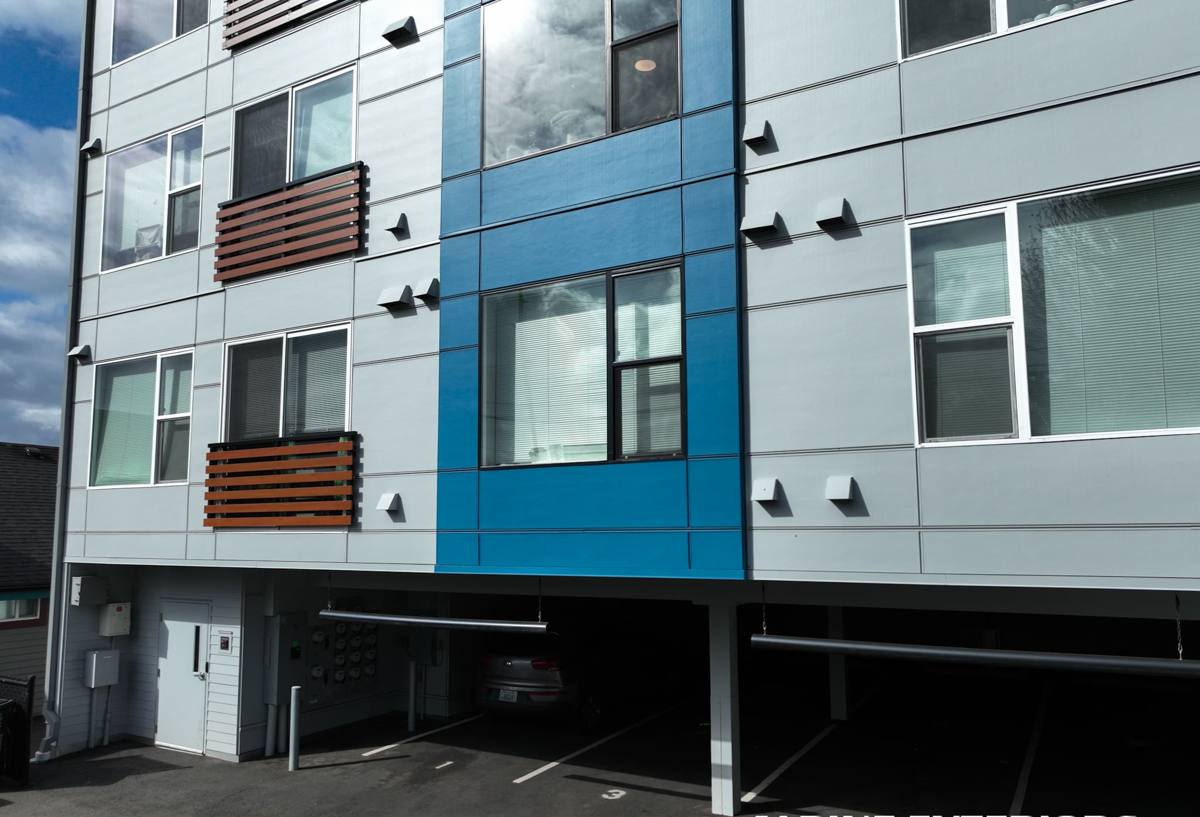
What Rain, Moss, and Salt Air Do to Siding Over Time
Moisture Is the Real Enemy, Not Just Rain
It's not the rain itself that damages siding — it's what happens when moisture gets trapped against a wall and can't dry out. Whatcom County's weather pattern is defined by long stretches of low-intensity rain and heavy overcast, which keeps humidity elevated for days at a time. Wood-based siding products absorb that moisture, swell, and eventually rot from the inside out, often well before the damage is visible from the ground.
Moss and Organic Growth
Shaded lots, tree cover, and north-facing walls around Everson create ideal conditions for moss, algae, and mildew to take hold on exterior surfaces. On siding that can't shed moisture quickly, that growth digs into the surface and accelerates breakdown of paint and substrate alike. A siding product's ability to resist and release moisture — not just repel it briefly — is what determines how it performs after five or ten moss seasons, not one.
Salt Air and Finish Breakdown
Closer to the coastline, airborne salt accelerates the failure of lower-quality paint finishes and can corrode fasteners and trim over time. Even homes further inland get some exposure during storm events when wind carries moisture-laden air well past the shoreline. A siding system needs a factory finish engineered to hold up to that, not a field-applied coat that starts breaking down in a few seasons.
Why Fiber Cement Is the Right Answer Here
Fiber cement is a cement-and-cellulose composite, not wood and not vinyl. It doesn't absorb water the way wood-based products do, it doesn't warp or expand and contract with humidity the way vinyl does, and it holds a factory-applied finish far longer than field-painted products. That combination is exactly what a house in this climate needs: a material that stays dimensionally stable through wet winters and dry summers, resists moss and mildew on shaded walls, and keeps its color and seal without repeated repainting.
We install James Hardie products exclusively. We don't install vinyl siding, LP SmartSide, Cemplank, Allura, or primed wood siding, and we're upfront about why: those products all ask a homeowner to accept a trade-off — more maintenance, more moisture sensitivity, a shorter effective lifespan, or a weaker warranty — that we don't think makes sense for homes in this climate. James Hardie is the one fiber cement system we've found consistently holds up to install-to-spec, backs it with a strong transferable warranty, and gives homeowners a factory finish that's actually engineered for Pacific Northwest conditions rather than a generic national spec.
James Hardie's Climate-Engineered HZ5 Line
James Hardie makes region-specific formulations, and the HZ5 product line is engineered for climates like ours — colder, wetter, with more freeze-thaw cycling than the Southeast or Southwest lines are built for. That matters more than most homeowners realize; a siding product engineered for Arizona humidity levels is not the same product performance-wise as one engineered for Whatcom County. ColorPlus Technology, Hardie's factory-applied finish process, bakes on color and sealant in a controlled environment, which is a meaningfully different (and more durable) process than site-painting siding after installation, especially in a climate where you rarely get more than a few consecutive dry days to work with.
What a Correct Fiber Cement Installation Involves
Fiber cement is only as good as the installation behind it. A siding job that skips the details below will show water damage and finish failure well before it should, regardless of how good the underlying product is.
- Removal of existing siding and inspection of sheathing for rot, especially around window and door openings and lower wall sections
- Repair or replacement of any compromised sheathing before new siding goes on — covering damaged wood does not fix it
- Installation of a weather-resistant barrier (house wrap) with correct lapping to shed water downward and outward
- Proper flashing at every penetration — windows, doors, hose bibs, light fixtures, and vents — since these are where the majority of water intrusion actually starts
- Correct fastener type, spacing, and depth per Hardie's published installation specs, since over- or under-driven fasteners are a common cause of premature failure
- Minimum clearance maintained between siding and grade, decks, and roof lines to prevent wicking and splash-back moisture
- Caulking and sealant only where Hardie's specs call for it — not as a substitute for proper flashing
- Final inspection of butt joints, corners, and trim transitions for tight, weather-tight fit
Every one of those steps is a place where a rushed or unfamiliar crew can cut a corner that won't show up as a problem for a year or two — but will show up eventually, usually as a moisture or moss issue at exactly the vulnerable points this climate targets first.
How We Approach a Job Near Everson
Assessment
We start with a walk-around of the exterior, checking existing siding condition, sheathing exposure at corners and trim, drainage patterns around the foundation, and any shaded or tree-covered walls that are likely dealing with more moisture and moss than the rest of the house.
Product Selection
We help homeowners choose the right Hardie board profile, plank size, and color for their home, factoring in sun exposure, shade, and how a given ColorPlus finish will hold up on that specific elevation.
Installation
Our crews follow James Hardie's published installation specifications exactly — fastener placement, clearances, flashing details — because that's what keeps the manufacturer's warranty valid and what actually determines how the siding performs over the next several decades.
Final Walkthrough
We walk the finished job with the homeowner, checking trim lines, caulking, and touch-up work before calling it done.
Comparing Siding Options for This Climate
| Factor | Fiber Cement (James Hardie) | Vinyl | Wood / Engineered Wood |
|---|---|---|---|
| Moisture resistance | High — doesn't absorb water, resists rot | Sheds water but can trap moisture behind panels | Absorbs moisture, prone to rot if not maintained |
| Moss/mildew resistance | Strong, especially with factory finish | Moderate — moss can grow in seams and laps | Weak — organic material is a moss host |
| Finish durability | Factory-baked ColorPlus finish, long-lasting | Color molded in, but can fade and become brittle in UV/cold cycling | Field-applied paint/stain, needs recoating every few years |
| Salt air / coastal exposure | Engineered to hold up well | Can become brittle and discolor over time | More vulnerable to accelerated deterioration |
| Fire resistance | Non-combustible | Combustible, can melt/deform | Combustible |
| Typical maintenance | Occasional wash, minimal repainting | Low, but repairs can be visually mismatched | Regular repainting/sealing, moisture monitoring |
Cost Factors Homeowners Should Understand
Fiber cement siding typically costs more upfront than vinyl and can be comparable to or less than high-end wood or engineered wood products once you account for long-term maintenance. Rather than quoting a number that won't reflect your specific house, it's more useful to know what actually drives the cost of a job:
- Total square footage of wall area and the complexity of the home's roofline and trim
- Condition of existing sheathing — hidden rot repair is the most common source of cost changes mid-project
- Board profile chosen (lap siding, shingle-style panels, board-and-batten) and trim detailing
- Number and complexity of penetrations (windows, doors, fixtures) requiring flashing
- Site access and staging, particularly for two-story homes or tight lots
- Removal and disposal of existing siding material
We walk through all of these during an in-person estimate so a homeowner understands exactly what's driving their number, rather than getting a flat quote that doesn't account for the condition of their specific home.
Why Local Experience Matters for This Job
A siding job done to a generic national spec doesn't necessarily account for what this specific climate does to a house. A crew that already works in Ferndale, Everson, and the surrounding Whatcom County area knows which walls tend to hold moisture longest, how much clearance to leave given how wet the ground stays through winter, and where moss tends to establish itself first on a given roof and wall configuration. That local pattern recognition is part of what separates an installation that looks right on day one from one that actually holds up through a decade of Pacific Northwest winters.
We also stand behind the work with a crew that's still local and reachable if something needs attention down the road — not a subcontractor who worked one job in the area and moved on.
Signs Your Current Siding May Already Be Struggling
If your home's exterior is showing any of the following, it's worth having it looked at before small problems become structural ones:
- Visible moss or algae buildup that returns quickly after cleaning
- Soft spots, bubbling, or warping, especially near the bottom of walls or around windows
- Peeling or chalking paint that's returned within a year or two of repainting
- Gaps opening up at seams, corners, or trim boards
- Visible staining on interior walls near exterior corners, which often indicates moisture getting through
If you're seeing any of this on a home in or around Everson, it's worth getting an honest assessment rather than waiting for it to get worse through another wet season.
If you'd like an honest look at your home's exterior and what fiber cement siding would involve for your specific house, we're happy to come out for a free, no-pressure estimate — the form below gets you on our schedule.