 Ferndale Roofing
 Why Decks Near Fairhaven Wear Out Faster Than People Expect
Homes in and around the Fairhaven area, close to the Whatcom County shoreline, take a different kind of beating than decks built further inland. Salt-laden air off the bay accelerates corrosion on fasteners, hinges, and any metal connector that isn't rated for the exposure. Combine that with the region's long stretch of driving rain from fall through spring, and a low sun angle that leaves shaded sections of decking wet for days at a time, and you get a structure that ages faster than the calendar suggests. A deck that looks fine on a dry August afternoon can be hiding soft framing, rusted-out hardware, or a ledger board that's been slowly separating from the house for years.
Then there's moss. Whatcom County's moss season isn't a minor cosmetic issue — it's a moisture trap. Moss holds water against decking boards and stair treads long after the rain has stopped, which is exactly the condition wood rot and mildew need to take hold. On a deck that gets partial shade from trees or the house itself, moss can establish itself within a single wet season if it isn't kept in check.
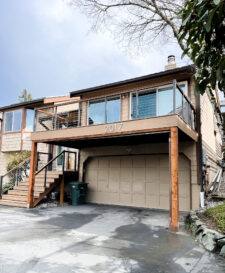
Signs Your Deck Needs Replacement, Not Just Repair
Not every tired-looking deck needs to come out. But there's a point where patching boards is just delaying an inevitable full rebuild, and spending money on repairs past that point is money wasted. Here's how we tell the difference on a site visit.
Repair Territory
- A handful of individual boards are cupped, splintering, or soft, but the framing underneath is solid
- Railings are loose at the post connections but the posts themselves aren't rotted
- Surface graying or moss buildup with no structural softness when probed
Replacement Territory
- The ledger board (where the deck attaches to the house) shows rot, rust streaking, or gaps — this is the single most common failure point we find and the most dangerous to ignore
- Joists or beams flex noticeably underfoot or show soft spots when tested with an awl
- Multiple support posts have rot at the base, especially where they meet grade or old concrete piers
- Fasteners are original, undersized, or clearly not rated for exterior/coastal exposure
- The deck was built without proper flashing at the house connection — a common shortcut on older builds that guarantees water intrusion over time
What a Correct Deck Replacement Actually Involves
A deck replacement done right is a structural project, not a cosmetic one. The visible decking boards are the smallest part of the job. What matters more:
Ledger and Flashing
The ledger connection to your house is where most deck failures start, and it's also where most water damage to the house itself originates if it's done wrong. A correct install uses proper flashing that directs water away from the house sheathing, not just caulk, which fails within a few seasons in this climate.
Framing and Fasteners
Joists, beams, and posts need to be sized for the actual load and span, not just matched to whatever was there before. Every fastener and structural connector should be rated for exterior or coastal use — stainless or heavy hot-dip galvanized, not standard zinc-coated hardware that starts rusting within a year or two of salt-air exposure.
Footings and Posts
Support posts need footings that are sized and set to current frost and load requirements, with proper post bases that keep wood off standing water. This is one of the most common shortcuts on older decks, and it's not something you can fix without pulling the structure apart — which is exactly why replacement is the right call once posts start failing.
Drainage Under the Deck
On low-clearance or ground-level decks, we look at how water moves underneath. If grading pushes water toward the house or lets it pool against posts, that gets corrected during the rebuild rather than left as a problem for the new deck to inherit.
Choosing Materials for Salt Air and a Long Wet Season
There's no single "best" decking material — there's a best material for your specific deck's sun exposure, budget, and how much maintenance you're realistically willing to do. Here's the honest breakdown.
| Material | How It Handles This Climate | Maintenance | Trade-offs |
|---|---|---|---|
| Pressure-treated lumber | Good rot resistance when properly sealed and maintained; needs re-sealing to shed salt-air moisture | Annual cleaning and re-sealing recommended | Lowest upfront cost; shortest lifespan if maintenance lapses |
| Cedar | Naturally rot-resistant, ages gracefully, but softer surface can show wear near the shoreline | Periodic sealing or staining to hold color and resist moisture | Higher cost than PT; classic look homeowners often want |
| Composite decking | Excellent moisture and moss resistance; doesn't absorb water like wood | Occasional washing; no sealing or staining | Higher upfront cost; hardware and framing underneath still need to be correctly rated |
| PVC/capped composite | Best resistance to salt air and standing moisture of the common options | Lowest maintenance of the group | Highest material cost; still relies on proper substructure |
Whatever decking you choose, we treat the framing and fasteners as the non-negotiable part. A composite deck built on undersized, poorly protected framing will still fail early — the surface material only solves half the problem.
Our Replacement Process
- On-site assessment — we check the ledger, framing, posts, and footings, not just the decking surface, and tell you honestly whether you're looking at repair or full replacement
- Written estimate — clear scope, materials, and timeline before any work starts
- Demolition and disposal — old decking, framing, and hardware removed and hauled off
- Structural rebuild — footings, posts, beams, joists, and ledger flashing installed to current standards
- Decking, railings, and stairs — installed per your material choice, with fasteners and connectors rated for coastal exposure
- Final walkthrough — we go over care and maintenance specific to the material you chose and your site's sun/shade pattern
Permits and Local Building Considerations
Deck rebuilds that involve structural changes — new footings, elevation changes, or attachment to the house — typically require a permit through the applicable jurisdiction, whether that's the City of Ferndale or Whatcom County depending on where your property sits. We handle the permit process as part of the job rather than leaving it for you to sort out, and we build to current code for footing depth, guardrail height, and stair geometry rather than just matching what was there before.
Cost Factors Homeowners Should Understand
| Factor | Why It Moves the Price |
|---|---|
| Deck size and height | Larger decks and multi-level or elevated decks need more framing, footings, and stair structure |
| Decking material | Composite and PVC cost more upfront than pressure-treated or cedar but need less long-term upkeep |
| Ledger and flashing condition | Correcting old, improperly flashed ledger connections adds labor but is not optional for a safe rebuild |
| Footing and post condition | Replacing undersized or frost-heaved footings adds cost but prevents the same failure from recurring |
| Railings and stairs | Custom railing styles, glass panels, or multiple stair runs add material and labor |
| Site access | Decks over slopes, near water features, or with limited equipment access take more time to build safely |
Most full deck replacements land in a broad middle range once you factor in structural correction, but the honest answer is that it depends heavily on size, material, and what we find once the old decking comes off. We'd rather give you a real number after a site visit than a guess that doesn't hold up.
Maintenance That Actually Extends the Life of Your New Deck
A correctly built deck still needs seasonal attention in this climate. Here's the short list that makes the biggest difference:
- Sweep debris and standing moisture off the surface regularly during fall and winter, especially in shaded areas
- Clear moss as soon as it appears rather than waiting for spring cleanup — it holds moisture against boards the whole time it's there
- Keep gutters and downspouts near the deck clear so runoff isn't dumping extra water onto the structure
- Check railing posts and stair connections once a year for looseness, which shows up before visible rot does
- Re-seal or re-stain wood decking on the schedule appropriate to the product — don't wait until it's visibly gray and dry
- Keep planters and furniture feet off direct wood contact where possible to avoid trapped moisture spots
Why Hiring a Crew That Already Works This Area Matters
A deck built to a generic spec sheet doesn't account for what actually happens to lumber and hardware near the Whatcom County shoreline over several winters. A crew that already works decks in and around Ferndale and the Fairhaven area knows which fastener grades hold up, where moss tends to establish first on a given roof and sun orientation, and how local permitting actually works in practice rather than in theory. That local pattern-recognition is the difference between a deck that needs attention again in five years and one that's still solid in twenty.
If your deck is showing its age, or you just want an honest read on whether it's a repair or a full rebuild, we're happy to take a look. The estimate is free, there's no pressure, and you'll get a straight answer either way — just fill out the form below to get started.