 Ferndale Roofing
 Why Sudden Valley Decks Take Extra Punishment
A deck in Sudden Valley works harder than a deck in a dry climate ever will. Whatcom County sees long stretches of driving rain, damp air that never fully clears, and a shade-heavy tree canopy on many lots that keeps moisture sitting on wood surfaces well after a storm has passed. Add the salt-laden air that moves through this part of Washington off the Sound, and you have three separate forces working against every fastener, board, and post holding your deck together.
None of these factors are dramatic on their own. A little moss here, a slightly loose railing there. The problem is that they compound. Moss holds moisture against the decking surface. Trapped moisture accelerates wood decay and corrodes metal fasteners. Corroded fasteners loosen connections. Loose connections let more water in. By the time a deck feels "off" underfoot, that cycle has usually been running for a year or more.
We repair decks throughout this area regularly, and the pattern is consistent: the decks that last are the ones where small problems get caught and fixed before they become structural ones.
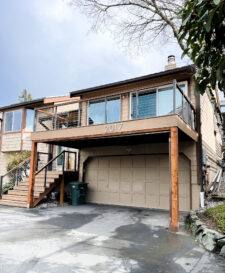
The Most Common Deck Problems We Find Locally
Rot at Ground-Contact and Shaded Areas
Wood rot shows up first where airflow is worst — under the deck, around post bases, and along any board that stays shaded most of the day. In wooded, tree-covered lots, that can mean a large share of the deck surface never fully dries between rain events, even in summer.
Corroded or Failing Fasteners
Older decks built with standard galvanized screws or nails, rather than fasteners rated for treated lumber and coastal-influenced moisture, tend to show rust streaking and fastener pull-out well before the boards themselves fail. Once a fastener loses its grip, the board around it works loose and the hole enlarges, which lets in more water.
Moss and Algae Buildup
A long moss season here means moss isn't just a cosmetic issue — it's a moisture trap and a slip hazard. Moss growing in the grain of decking boards holds water against the wood surface almost permanently during the wetter months, which is one of the fastest ways to shorten a deck's life.
Ledger Board and Flashing Failures
The ledger board — where the deck attaches to the house — is the single most important structural connection on most decks, and it's also the most common point of hidden water damage. Missing or improperly installed flashing lets water track behind the ledger and into the house framing, where it can sit unnoticed for years.
Railing and Guardrail Looseness
Railings take constant stress from leaning, wind, and seasonal wood movement. Loose posts and wobbly guardrails are one of the most common repair calls we get, and they're also a safety issue that shouldn't wait.
Signs Your Deck Needs Repair
Most deck problems give warning signs well before anything becomes dangerous. Worth checking for:
- Soft or spongy spots when you walk across the decking
- Boards that have visibly cupped, split, or separated from neighboring boards
- Rust streaks running down from screw or nail heads
- Green or black growth that doesn't scrub off easily, especially in shaded sections
- Railings or guardrail posts that move when you push on them
- Gaps or dark staining where the deck meets the house siding or ledger board
- Stairs that feel less solid than they used to, or squeak under weight
- Visible daylight or gaps around post bases and footings
Any one of these on its own might be minor. Several at once usually means the deck is due for a full assessment, not just a patch.
What a Proper Deck Repair Actually Involves
Structural Framing First
Before anything cosmetic happens, we check the framing that carries the load: joists, beams, posts, and footings. Surface boards can look fine while the structure underneath has already lost integrity. Probing suspect wood with an awl tells us far more than a visual check alone.
Ledger Board and Flashing
If the ledger connection shows any sign of water intrusion, that gets addressed properly — not just resealed. That can mean pulling siding back far enough to inspect the house framing behind it, correcting flashing so water sheds away from the house instead of behind it, and confirming the ledger is fastened with hardware rated for the load and exposure.
Decking Surface
Individual boards that are soft, split, or badly cupped get replaced rather than patched. We match fastener spacing and gapping to the existing deck where boards are being blended in, since gaps that are too tight trap debris and moisture, and gaps that are too wide create a tripping hazard.
Railings and Guardrails
Railing repairs get checked against current code requirements for height and baluster spacing, not just re-tightened as-is. A repair is also a chance to correct a railing that was undersized or non-compliant to begin with.
Fasteners and Hardware
Every fastener we install is rated for treated lumber and outdoor exposure. Mixing incompatible metals — for example, standard steel hardware against certain treated lumber chemicals — accelerates corrosion, so matching hardware correctly matters more than it might seem.
Repair or Replace? How We Help You Decide
Not every deck problem calls for a full rebuild, and not every deck is worth patching indefinitely. The honest answer usually comes down to where the damage is and how much of the structure it has reached.
| Factor | Leans Toward Repair | Leans Toward Replacement |
|---|---|---|
| Framing condition | Joists and posts are sound; damage is isolated | Rot has reached multiple structural members |
| Age of the deck | Under 15 years, built to code | Original construction is old or was never permitted correctly |
| Extent of surface damage | A handful of boards or one section | Widespread cupping, splitting, or rot across most boards |
| Ledger connection | Flashing intact, no water tracking into the house | Active water intrusion behind the siding |
| Railing compliance | Meets current height and spacing code | Undersized or non-compliant, and replacing anyway |
We walk every deck with this kind of checklist before recommending anything, and we'll tell you plainly if a repair is the more sensible route — we're not interested in selling a rebuild a homeowner doesn't need.
Decking Material Considerations When Boards Are Replaced
When a repair involves swapping out a meaningful number of boards, it's worth talking through material options rather than automatically matching what's there. Each has real trade-offs given this region's rain and moss exposure.
| Material | Moisture Behavior | Maintenance | Typical Lifespan |
|---|---|---|---|
| Pressure-treated wood | Resists rot when sealed regularly; absorbs water if coating lapses | Annual cleaning and re-sealing recommended | 10–20 years with upkeep |
| Cedar | Naturally rot-resistant but still needs sealing in wet, shaded areas | Periodic cleaning and sealing | 15–20 years with upkeep |
| Composite | Doesn't absorb water like wood, but surface can still hold moss if not cleaned | Occasional washing, no sealing needed | 25–30 years |
There's no universally "right" answer — it depends on how much upkeep you want to do and how the existing deck is built. We'll walk through what fits your situation rather than pushing one product line.
Our Deck Repair Process
- Assessment — We inspect the full structure, not just the visible surface: framing, ledger, fasteners, and railings.
- Written scope — You get a clear explanation of what's failing, what needs to be repaired versus replaced, and why.
- Repair work — Structural issues are addressed first, followed by decking, railings, and hardware.
- Cleanup and moss treatment — Debris is cleared and any remaining moss or algae growth is treated so it isn't reintroduced immediately.
- Final walk-through — We go over the completed repair with you before considering the job done.
Why Hiring a Crew That Already Works in Sudden Valley Matters
Deck repair isn't just carpentry — it's carpentry that has to hold up against this specific region's weather pattern. A crew that regularly works decks in and around Ferndale and greater Whatcom County already knows which connection points fail first in wet, shaded lots, which fastener choices actually hold up against salt-air corrosion over time, and how to schedule work around a wet season without cutting corners to beat the rain. That local pattern recognition is what separates a repair that lasts from one that reappears in two years.
It also matters for permitting and code compliance. Deck and railing work often falls under local building code depending on scope and height, and a crew familiar with the area's permitting process can flag when a repair needs to go through that process rather than finding out after the fact.
Maintenance Tips to Extend Your Repair's Life
A well-done repair still needs basic upkeep, especially given how much moisture this region deals with:
- Sweep debris and standing leaves off the deck surface regularly, especially in fall
- Rinse or gently scrub moss and algae before it establishes rather than after
- Reseal wood decking on the schedule appropriate to the product, not just when it looks dry
- Check railings and stair connections once or twice a year for looseness
- Keep gutters and downspouts near the deck clear so runoff isn't pouring directly onto it
If you're noticing soft spots, loose railings, moss that won't quit, or you just want an honest read on where your deck stands, we're happy to take a look. Fill out the form below for a free, no-pressure estimate.